 Add to Chrome
 Add to Firefox
 Add to Edge
Echo4DIR: 4D Implicit Heart Reconstruction from 2D Echocardiography Videos
May 21, 2026
Reconstructing 4D (3D+t) cardiac geometry from sparse 2D echocardiography is highly desirable yet fundamentally challenged by geometric ambiguity and temporal discontinuity. To tackle these issues, we propose Echo4DIR, a novel test-time 4D implicit reconstruction framework. Specifically, we learn robust 3D shape priors from statistical shape models (SSMs) via a cardiac conditional SDF, constructing an Epipolar Mask Encoder module with epipolar cross attention to effectively fuse multi-view features. To bridge the synthetic-to-real domain gap, we introduce a self-supervised SDF-tailored differentiable rendering strategy for patient-specific 3D shape adaptation using uncalibrated clinical masks without requiring 3D ground truth. Crucially, the inherent continuity of implicit representation overcomes sparse observations, enabling anatomically reliable geometry at arbitrary resolutions. Furthermore, to empower our framework with physically continuous 4D extension, we introduce a Radial SDF Alignment strategy that strictly locks shape evolution to the predicted velocity field, fundamentally eliminating mesh drift. Extensive experiments on synthetic benchmarks and real clinical datasets demonstrate that Echo4DIR achieves state-of-the-art 4D cardiac mesh reconstruction, notably yielding an impressive clinical overlap of up to 98.35% Dice and 96.75% IoU.

Vision-aware Multimodal Prompt Tuning for Uploadable Multi-source Few-shot Domain Adaptation
Mar 08, 2025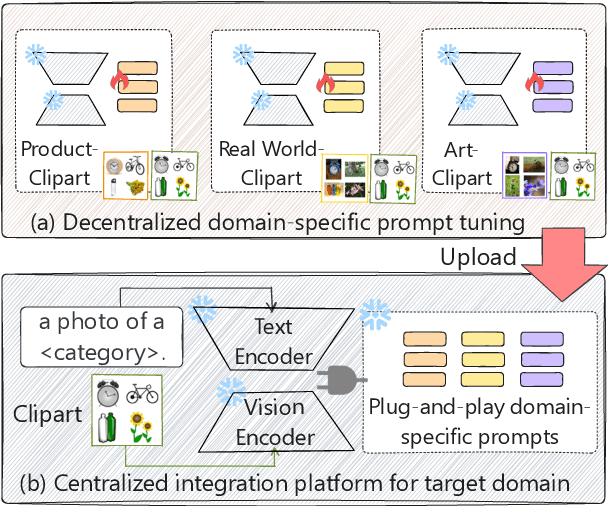
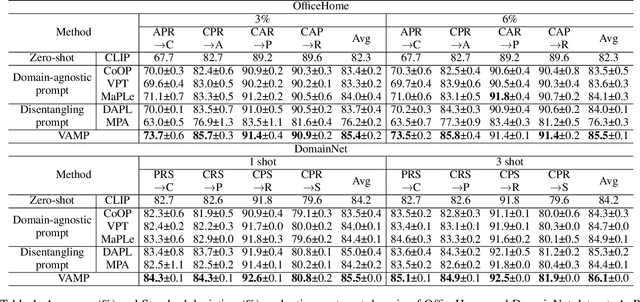
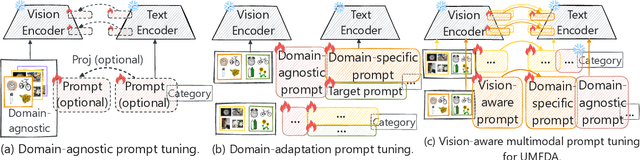
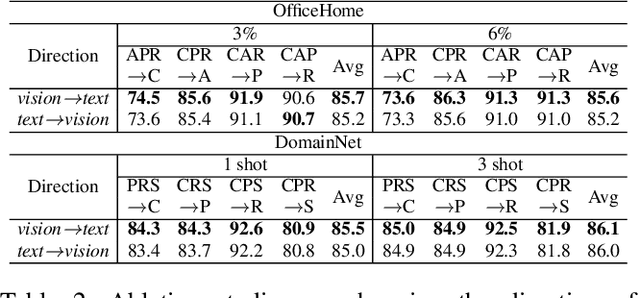
Conventional multi-source domain few-shot adaptation (MFDA) faces the challenge of further reducing the load on edge-side devices in low-resource scenarios. Considering the native language-supervised advantage of CLIP and the plug-and-play nature of prompt to transfer CLIP efficiently, this paper introduces an uploadable multi-source few-shot domain adaptation (UMFDA) schema. It belongs to a decentralized edge collaborative learning in the edge-side models that must maintain a low computational load. And only a limited amount of annotations in source domain data is provided, with most of the data being unannotated. Further, this paper proposes a vision-aware multimodal prompt tuning framework (VAMP) under the decentralized schema, where the vision-aware prompt guides the text domain-specific prompt to maintain semantic discriminability and perceive the domain information. The cross-modal semantic and domain distribution alignment losses optimize each edge-side model, while text classifier consistency and semantic diversity losses promote collaborative learning among edge-side models. Extensive experiments were conducted on OfficeHome and DomainNet datasets to demonstrate the effectiveness of the proposed VAMP in the UMFDA, which outperformed the previous prompt tuning methods.