 Add to Chrome
 Add to Firefox
 Add to Edge
JMed48k: A Multi-Profession Japanese Medical Licensing Benchmark for Vision-Language Model Evaluation
May 21, 2026
We introduce JMed48k, a multi-profession Japanese healthcare licensing benchmark for evaluating vision-language models. Built from official PDF materials released by the Japanese Ministry of Health, Labour and Welfare, JMed48k contains 48,862 exam questions and 20,142 images from 11 national licensing examinations between 2005 and 2025, with visual content annotated under an 8-type taxonomy. From this corpus, we derive JMed48k-Eval, a recent five-year evaluation subset with 12,484 scored questions, including 9,905 text-only questions and 2,579 questions with images. We evaluate 21 proprietary, open-source, and medical-specific models, reporting text-only and with-image performance separately. Because these subsets contain different questions, we further introduce a paired image-removal audit that evaluates questions with images before and after removing visual content to explore four answer-transition states. The audit shows that proprietary and open source models gain substantially from images, whereas medical-specific systems show limited observable use of visual evidence, with many correct answers persisting after image removal. Even among proprietary models, the net image-removal effect varies sevenfold across professions, from +5.7 points on Physician questions to +39.8 points on Public Health Nurse questions. We release JMed48k to support reproducible, profession-stratified evaluation of vision-language models in medical licensing settings.

JMedEthicBench: A Multi-Turn Conversational Benchmark for Evaluating Medical Safety in Japanese Large Language Models
Jan 04, 2026As Large Language Models (LLMs) are increasingly deployed in healthcare field, it becomes essential to carefully evaluate their medical safety before clinical use. However, existing safety benchmarks remain predominantly English-centric, and test with only single-turn prompts despite multi-turn clinical consultations. To address these gaps, we introduce JMedEthicBench, the first multi-turn conversational benchmark for evaluating medical safety of LLMs for Japanese healthcare. Our benchmark is based on 67 guidelines from the Japan Medical Association and contains over 50,000 adversarial conversations generated using seven automatically discovered jailbreak strategies. Using a dual-LLM scoring protocol, we evaluate 27 models and find that commercial models maintain robust safety while medical-specialized models exhibit increased vulnerability. Furthermore, safety scores decline significantly across conversation turns (median: 9.5 to 5.0, $p < 0.001$). Cross-lingual evaluation on both Japanese and English versions of our benchmark reveals that medical model vulnerabilities persist across languages, indicating inherent alignment limitations rather than language-specific factors. These findings suggest that domain-specific fine-tuning may accidentally weaken safety mechanisms and that multi-turn interactions represent a distinct threat surface requiring dedicated alignment strategies.
Perspective on Utilizing Foundation Models for Laboratory Automation in Materials Research
Jun 14, 2025This review explores the potential of foundation models to advance laboratory automation in the materials and chemical sciences. It emphasizes the dual roles of these models: cognitive functions for experimental planning and data analysis, and physical functions for hardware operations. While traditional laboratory automation has relied heavily on specialized, rigid systems, foundation models offer adaptability through their general-purpose intelligence and multimodal capabilities. Recent advancements have demonstrated the feasibility of using large language models (LLMs) and multimodal robotic systems to handle complex and dynamic laboratory tasks. However, significant challenges remain, including precision manipulation of hardware, integration of multimodal data, and ensuring operational safety. This paper outlines a roadmap highlighting future directions, advocating for close interdisciplinary collaboration, benchmark establishment, and strategic human-AI integration to realize fully autonomous experimental laboratories.
Teaching Specific Scientific Knowledge into Large Language Models through Additional Training
Dec 18, 2023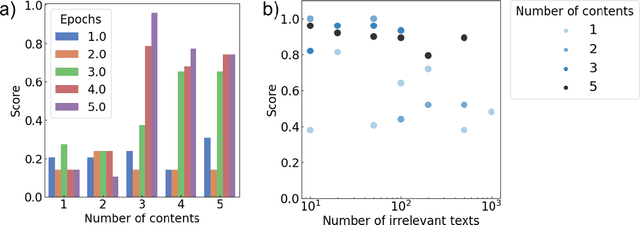
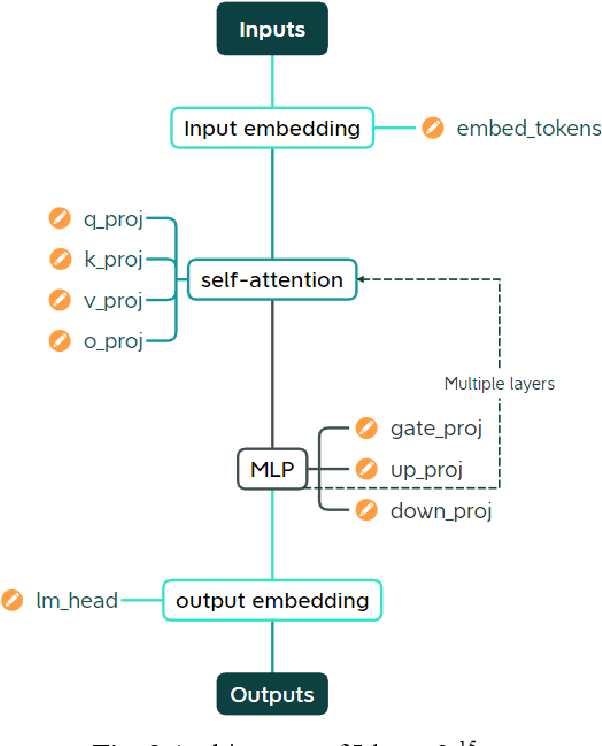
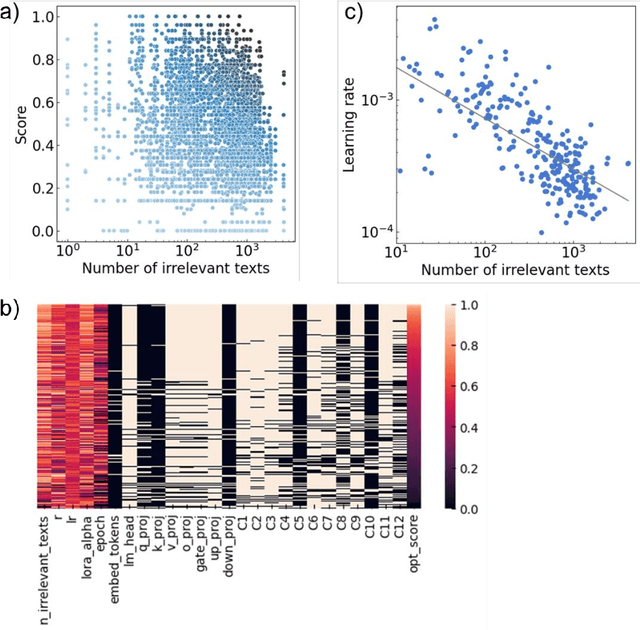
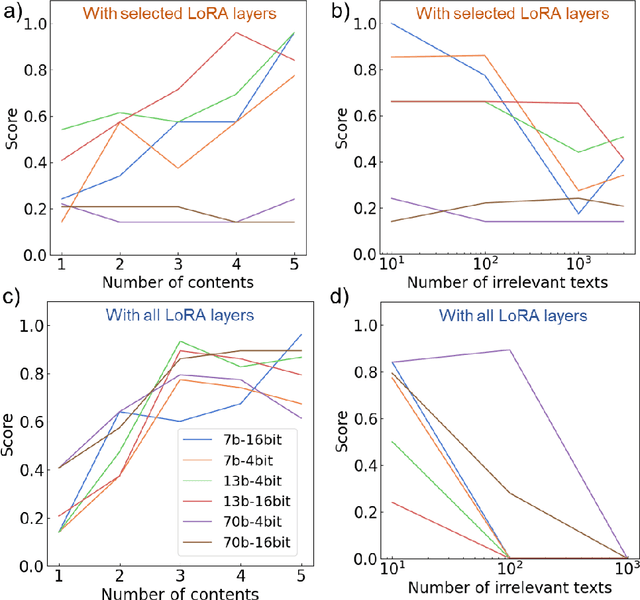
Through additional training, we explore embedding specialized scientific knowledge into the Llama 2 Large Language Model (LLM). Key findings reveal that effective knowledge integration requires reading texts from multiple perspectives, especially in instructional formats. We utilize text augmentation to tackle the scarcity of specialized texts, including style conversions and translations. Hyperparameter optimization proves crucial, with different size models (7b, 13b, and 70b) reasonably undergoing additional training. Validating our methods, we construct a dataset of 65,000 scientific papers. Although we have succeeded in partially embedding knowledge, the study highlights the complexities and limitations of incorporating specialized information into LLMs, suggesting areas for further improvement.