 Add to Chrome
 Add to Firefox
 Add to Edge
Omics-scale polymer computational database transferable to real-world artificial intelligence applications
Nov 07, 2025
Developing large-scale foundational datasets is a critical milestone in advancing artificial intelligence (AI)-driven scientific innovation. However, unlike AI-mature fields such as natural language processing, materials science, particularly polymer research, has significantly lagged in developing extensive open datasets. This lag is primarily due to the high costs of polymer synthesis and property measurements, along with the vastness and complexity of the chemical space. This study presents PolyOmics, an omics-scale computational database generated through fully automated molecular dynamics simulation pipelines that provide diverse physical properties for over $10^5$ polymeric materials. The PolyOmics database is collaboratively developed by approximately 260 researchers from 48 institutions to bridge the gap between academia and industry. Machine learning models pretrained on PolyOmics can be efficiently fine-tuned for a wide range of real-world downstream tasks, even when only limited experimental data are available. Notably, the generalisation capability of these simulation-to-real transfer models improve significantly as the size of the PolyOmics database increases, exhibiting power-law scaling. The emergence of scaling laws supports the "more is better" principle, highlighting the significance of ultralarge-scale computational materials data for improving real-world prediction performance. This unprecedented omics-scale database reveals vast unexplored regions of polymer materials, providing a foundation for AI-driven polymer science.

Perspective on Utilizing Foundation Models for Laboratory Automation in Materials Research
Jun 14, 2025This review explores the potential of foundation models to advance laboratory automation in the materials and chemical sciences. It emphasizes the dual roles of these models: cognitive functions for experimental planning and data analysis, and physical functions for hardware operations. While traditional laboratory automation has relied heavily on specialized, rigid systems, foundation models offer adaptability through their general-purpose intelligence and multimodal capabilities. Recent advancements have demonstrated the feasibility of using large language models (LLMs) and multimodal robotic systems to handle complex and dynamic laboratory tasks. However, significant challenges remain, including precision manipulation of hardware, integration of multimodal data, and ensuring operational safety. This paper outlines a roadmap highlighting future directions, advocating for close interdisciplinary collaboration, benchmark establishment, and strategic human-AI integration to realize fully autonomous experimental laboratories.
Teaching Specific Scientific Knowledge into Large Language Models through Additional Training
Dec 18, 2023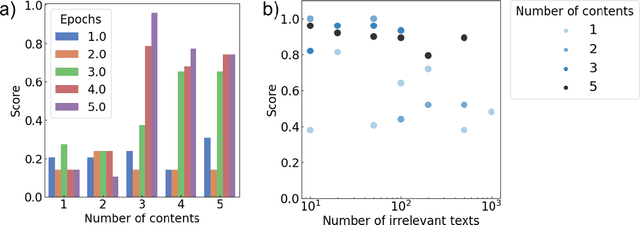
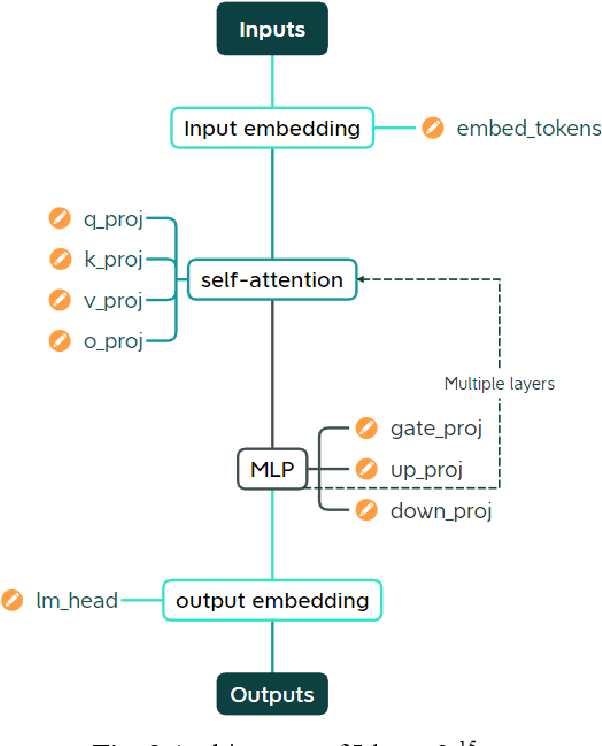
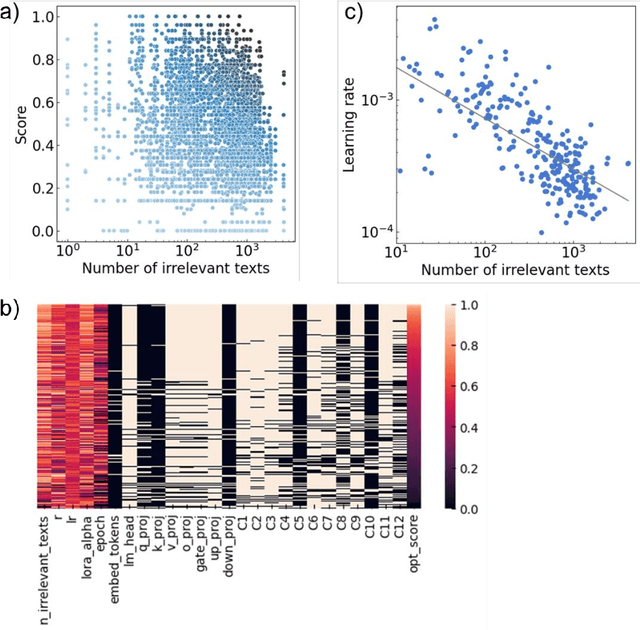
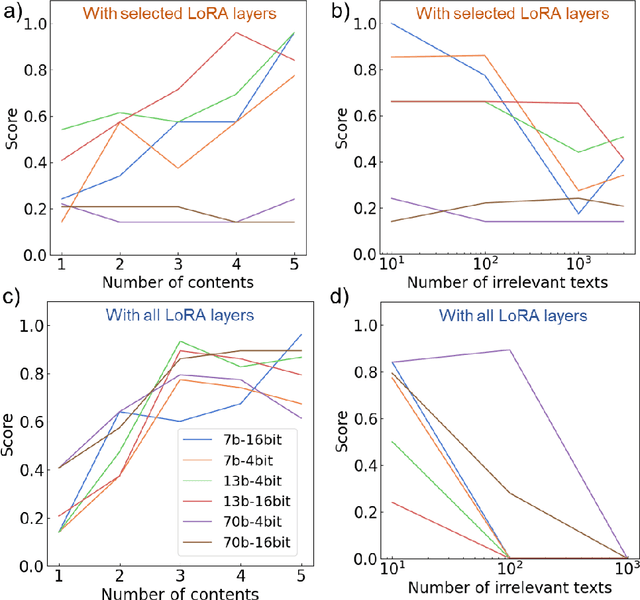
Through additional training, we explore embedding specialized scientific knowledge into the Llama 2 Large Language Model (LLM). Key findings reveal that effective knowledge integration requires reading texts from multiple perspectives, especially in instructional formats. We utilize text augmentation to tackle the scarcity of specialized texts, including style conversions and translations. Hyperparameter optimization proves crucial, with different size models (7b, 13b, and 70b) reasonably undergoing additional training. Validating our methods, we construct a dataset of 65,000 scientific papers. Although we have succeeded in partially embedding knowledge, the study highlights the complexities and limitations of incorporating specialized information into LLMs, suggesting areas for further improvement.