 Add to Chrome
 Add to Firefox
 Add to Edge
Uni-OPD: Unifying On-Policy Distillation with a Dual-Perspective Recipe
May 05, 2026
On-policy distillation (OPD) has recently emerged as an effective post-training paradigm for consolidating the capabilities of specialized expert models into a single student model. Despite its empirical success, the conditions under which OPD yields reliable improvement remain poorly understood. In this work, we identify two fundamental bottlenecks that limit effective OPD: insufficient exploration of informative states and unreliable teacher supervision for student rollouts. Building on this insight, we propose Uni-OPD, a unified OPD framework that generalizes across Large Language Models (LLMs) and Multimodal Large Language Models (MLLMs), centered on a dual-perspective optimization strategy. Specifically, from the student's perspective, we adopt two data balancing strategies to promote exploration of informative student-generated states during training. From the teacher's perspective, we show that reliable supervision hinges on whether aggregated token-level guidance remains order-consistent with the outcome reward. To this end, we develop an outcome-guided margin calibration mechanism to restore order consistency between correct and incorrect trajectories. We conduct extensive experiments on 5 domains and 16 benchmarks covering diverse settings, including single-teacher and multi-teacher distillation across LLMs and MLLMs, strong-to-weak distillation, and cross-modal distillation. Our results verify the effectiveness and versatility of Uni-OPD and provide practical insights into reliable OPD.

Cascading Convolutional Color Constancy
Dec 24, 2019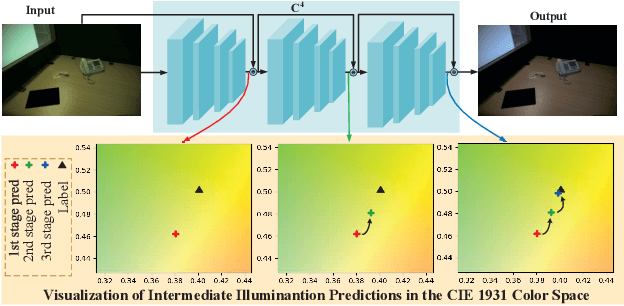

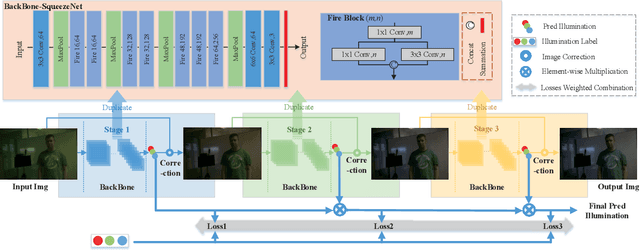
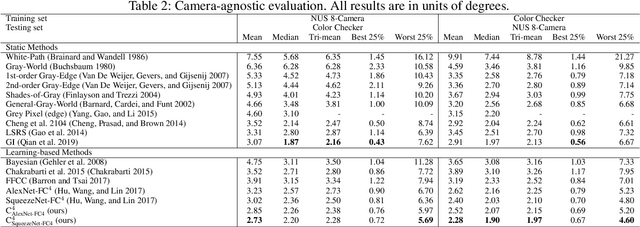
Regressing the illumination of a scene from the representations of object appearances is popularly adopted in computational color constancy. However, it's still challenging due to intrinsic appearance and label ambiguities caused by unknown illuminants, diverse reflection property of materials and extrinsic imaging factors (such as different camera sensors). In this paper, we introduce a novel algorithm by Cascading Convolutional Color Constancy (in short, C4) to improve robustness of regression learning and achieve stable generalization capability across datasets (different cameras and scenes) in a unique framework. The proposed C4 method ensembles a series of dependent illumination hypotheses from each cascade stage via introducing a weighted multiply-accumulate loss function, which can inherently capture different modes of illuminations and explicitly enforce coarse-to-fine network optimization. Experimental results on the public Color Checker and NUS 8-Camera benchmarks demonstrate superior performance of the proposed algorithm in comparison with the state-of-the-art methods, especially for more difficult scenes.