 Add to Chrome
 Add to Firefox
 Add to Edge
G0.5: One Autoregressive Stream for Robot Reasoning and Action
Aug 12, 2026
The prevailing recipe for Vision-Language-Action (VLA) models couples a pretrained VLM with a separately trained flow-matching action expert. This makes the VLM a context encoder rather than a decision-maker. We introduce G0.5, a pretrained autoregressive VLA in which a single transformer decoder emits reasoning and action tokens under a single objective. Three components make this tractable at foundation-model scale: a learnable cross-embodiment action tokenizer that maps heterogeneous robot actions into a shared vocabulary; a native chain-of-thought stream interleaving task decomposition, object grounding, and action hints with action tokens; and a visual memory module that injects multi-second history through the vision encoder. Because reasoning and action share a single set of weights, the pretrained VLM's capabilities carry over to physical behavior: the model follows instructions closely, and prompts directly steer action granularity, task horizon, and out-of-distribution scene handling without further training. Pretrained on a large collection of robot datasets together with VQA samples, G0.5 surpasses state-of-the-art models across 7 independent regimes: real-world fine-tuning on R1lite and R1pro robots (76.7\% vs.\ 53.3\% for $π_{0.5}$ and 24.4\% for GR00T-N1.7), the 2025 BEHAVIOR Challenge on 50 long-horizon household mobile manipulation tasks using a generalist policy (31.4\% vs.\ 26.3\% for $π_{0.5}$ and 26.1\% for the challenge winner), DROID post-training followed by zero-shot transfer to an unseen environment and objects (82.5\%), a language-following Pick-and-Place benchmark, LIBERO (98.9\%), RoboTwin 2.0 (93.3\%), and SimplerEnv-Bridge (87.3\%).

MobileWAM: Bridging World Action Models to Mobile Manipulation with Chain-of-Foresight
Aug 06, 2026World action models (WAMs) built on video generation backbones are a rising recipe for robot learning, yet remain confined to tabletop manipulation. Mobile manipulation demands simultaneous locomotion and whole-body manipulation amid scene-scale dynamics, yet is still dominated by dynamics-blind visual encoders with hand-crafted coordination. We bridge this gap with MobileWAM, a mixture-of-transformers architecture that fuses a pretrained video diffusion transformer with a lightweight action expert through layerwise joint attention, translating internet-scale motion priors into whole-body control. To reconcile the heterogeneous dynamics of moving and manipulating, each feed-forward layer of the action expert becomes a three-expert mixture of shared, locomotion, and manipulation experts, softly routed by the motion intent in the action tokens. To densify supervision, we further propose Chain-of-Foresight (CoF): intermediate representations sequentially predict a chain of future latent chunks, each step conditioned on its predecessor. CoF pairs naturally with our decoupled video--action denoising scheme. At deployment, the WAM serves as a pure current-frame encoder; foresight acts only through gradients, so at inference the foresight chain and video generation are discarded, leaving only policy-level cost. MobileWAM surpasses state-of-the-art mobile manipulation policies on ManiSkill-HAB and fine-tunes to a real ARX Lift2 mobile manipulator across diverse tasks with strong generalization. Code will be released soon.
Optimal transport for vector Gaussian mixture models
Dec 16, 2020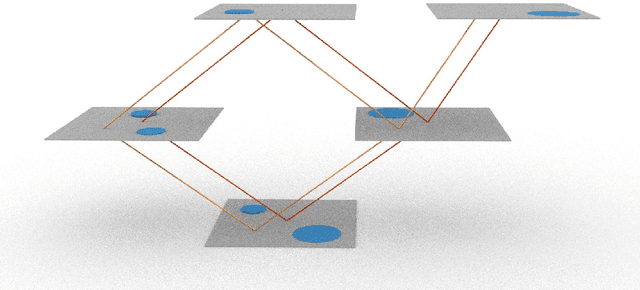
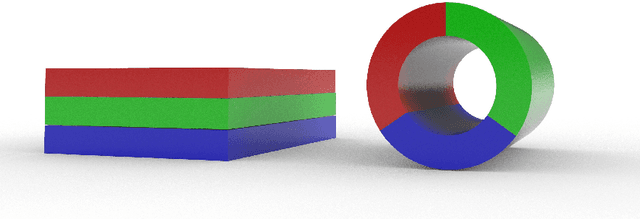
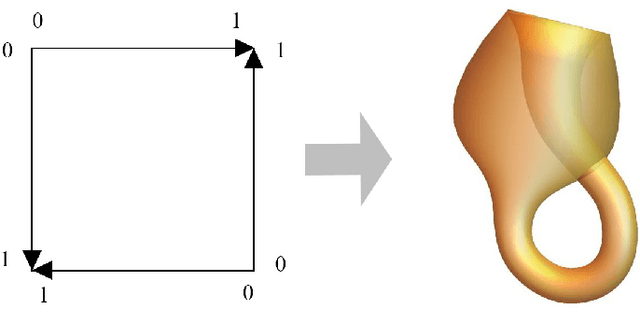
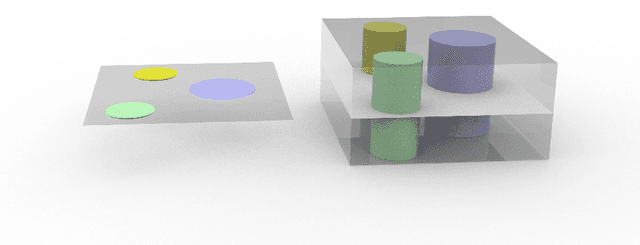
Vector Gaussian mixture models form an important special subset of vector-valued distributions. Any physical entity that can mutate or transit among alternative manifestations distributed in a given space falls into this category. A key example is color imagery. In this note, we vectorize the Gaussian mixture model and study different optimal mass transport related problems for such models. The benefits of using vector Gaussian mixture for optimal mass transport include computational efficiency and the ability to preserve structure.