 Add to Chrome
 Add to Firefox
 Add to Edge
When Synthetic Speech Is All You Have: Better Call GRPO
Jul 09, 2026
LLM-based ASR adapted to regulated domains such as banking is bottlenecked by privacy: real speech is costly and legally constrained to collect, making synthetic text-to-speech (TTS) an attractive substitute. Yet synthetic speech stays acoustically mismatched with real recordings, and work on this gap has stayed within supervised fine-tuning (SFT). We instead turn to reinforcement learning, and show that Group Relative Policy Optimization (GRPO) extracts far more from the same synthetic speech than SFT. Synthetic-only adaptation of the model with GRPO, a critic-free method rewarding low-WER hypotheses, reduces WER by 40\% relative to SFT (36.71\%$\to$22.09\%), and an SFT-then-GRPO combination pushes this further to 45\%. We trace the gain to behavior rather than representation: GRPO reduces insertion errors by improving stopping calibration and speech-to-text alignment by better anchoring attention to audio, leaving early-layer representations intact. When synthetic speech is the main resource, reinforcement learning should be preferred over supervised fine-tuning.

How to Leverage Synthetic Speech for LLM-Based ASR Systems?
Jun 27, 2026In regulated domains such as banking and healthcare, where privacy constraints make real speech costly to collect and retain, synthetic speech from modern text-to-speech (TTS) is an appealing alternative for training automatic speech recognition (ASR) without exposing sensitive customer recordings. Yet a persistent distributional gap between synthetic and real data limits how far it can replace genuine recordings. Prior work largely treats this gap as a black box to be engineered around, but in our work, we instead examine its origin directly by probing a SLAM-ASR architecture. Then, we localise where its LLM backbone separates real from synthetic speech and find the discriminative signal concentrated in the early-to-middle layers, where temporal and prosodic perturbations disrupt it most. We further show that representation-level separability, help, but does not directly predict downstream ASR gains. On the other hand, convolving synthetic audio with room impulse responses (RIRs) narrows the gap not by making synthetic speech sound cleaner or more natural, but by reproducing the acoustic irregularities of real recordings. Translating these findings into the training procedure, by adding a layer-selection module combined with RIR augmentation matches a fully real-data baseline using only 25% of the real speech (13.6h) and surpasses it at all higher proportions.
TokenVerse++: Towards Flexible Multitask Learning with Dynamic Task Activation
Aug 27, 2025Token-based multitasking frameworks like TokenVerse require all training utterances to have labels for all tasks, hindering their ability to leverage partially annotated datasets and scale effectively. We propose TokenVerse++, which introduces learnable vectors in the acoustic embedding space of the XLSR-Transducer ASR model for dynamic task activation. This core mechanism enables training with utterances labeled for only a subset of tasks, a key advantage over TokenVerse. We demonstrate this by successfully integrating a dataset with partial labels, specifically for ASR and an additional task, language identification, improving overall performance. TokenVerse++ achieves results on par with or exceeding TokenVerse across multiple tasks, establishing it as a more practical multitask alternative without sacrificing ASR performance.
Performance evaluation of SLAM-ASR: The Good, the Bad, the Ugly, and the Way Forward
Nov 06, 2024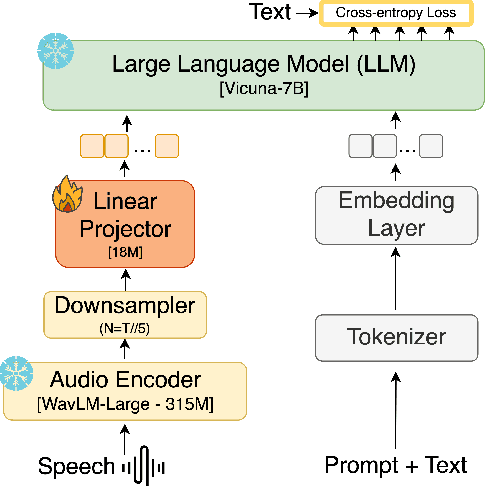
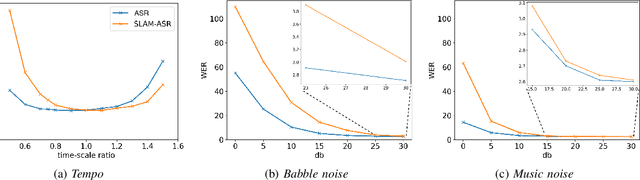
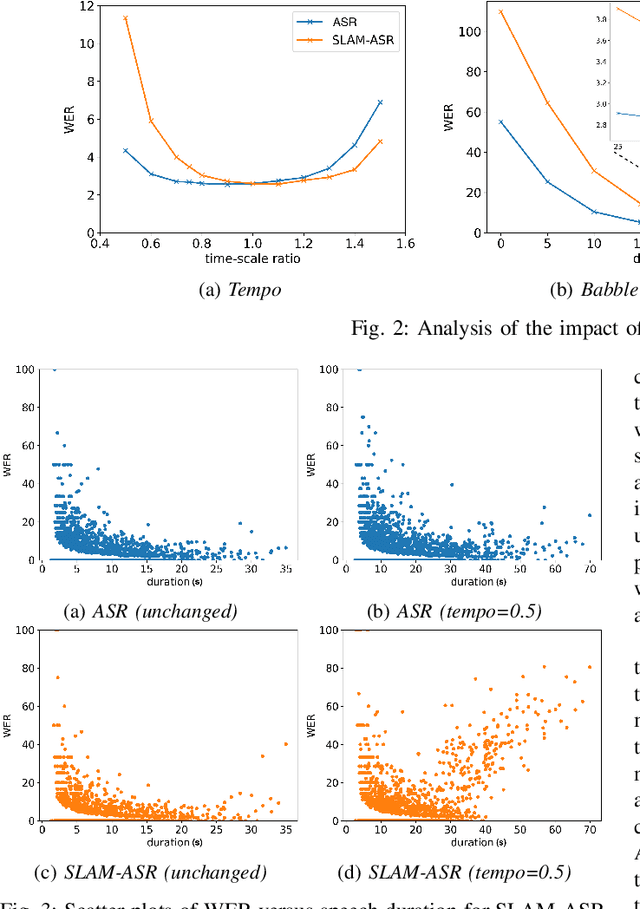
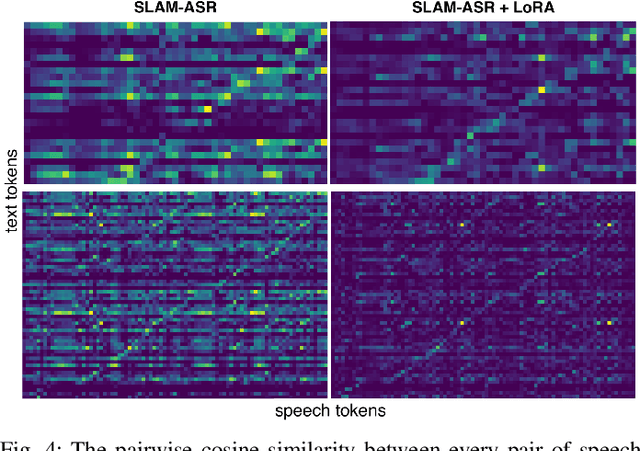
Recent research has demonstrated that training a linear connector between speech foundation encoders and large language models (LLMs) enables this architecture to achieve strong ASR capabilities. Despite the impressive results, it remains unclear whether these simple approaches are robust enough across different scenarios and speech conditions, such as domain shifts and different speech perturbations. In this paper, we address these questions by conducting various ablation experiments using a recent and widely adopted approach called SLAM-ASR. We present novel empirical findings that offer insights on how to effectively utilize the SLAM-ASR architecture across a wide range of settings. Our main findings indicate that the SLAM-ASR exhibits poor performance in cross-domain evaluation settings. Additionally, speech perturbations within in-domain data, such as changes in speed or the presence of additive noise, can significantly impact performance. Our findings offer critical insights for fine-tuning and configuring robust LLM-based ASR models, tailored to different data characteristics and computational resources.