 Add to Chrome
 Add to Firefox
 Add to Edge
PartialBiGrasp: Inferring Hidden Local Geometry for Bimanual Grasping from Partial Views
Aug 19, 2026
Dual-arm robotic grasping is essential for manipulating large, heavy, and geometrically complex objects that cannot be reliably handled using a single manipulator. These large objects often contain only sparse graspable regions determined by local geometric properties such as thickness, edge structure, and gripper clearance. Prior bimanual grasping methods assume access to a full point cloud of the object which inherently contains this geometric information, but may not be accessible in real scenarios. This work proposes PartialBiGrasp, a dual-arm grasp generation framework that operates directly on partial point cloud observations. Our model learns geometric features implicitly through convolutional occupancy networks, enabling local reasoning about graspability, collision-free contact regions, and object thickness. We leverage this understanding to generate force-closure compliant grasp pairs, which are further refined using a sampling-based optimization to correct for ambiguity caused by incomplete geometry. We evaluate our approach using analytical force-closure metrics, large-scale simulation experiments, and real-world robot evaluations on noisy partial point clouds of novel objects, demonstrating robust and physically stable dual-arm grasp generation.

Actuator-Aware Spatiotemporal Tube Synthesis for Temporal Reach-Avoid-Stay Tasks
Jul 25, 2026This work proposes an actuator-aware spatiotemporal tube (STT) synthesis framework to accomplish temporal reach-avoid-stay (T-RAS) tasks for an unknown nonlinear multi-input and multi-output (MIMO) system under actuator constraints. Existing STT synthesis methods address actuator saturation after the tube generation either through repeated online re-optimization or controller redesign. Instead, the proposed framework incorporates actuator constraints directly into the tube synthesis process. The STT centerline and width are parameterized using Bernstein polynomial basis functions, whose convex-hull property enables sample-free enforcement of geometric and derivative constraints. By analyzing the worst-case closed-loop error dynamics of an approximation-free prescribed performance controller (PPC) used for STT tracking, we derive a linear actuator feasibility constraint. The constraints are embedded directly in terms of the tubes' Bernstein control points into the STT synthesis optimization for actuator-feasible tube generation, eliminating the need for online re-optimization or controller redesign. A simulation study on an omnidirectional mobile robot performing a T-RAS task shows that the proposed framework adheres to the prescribed actuator limits throughout the task and reduces required control effort by approximately $50\%$ compared with an existing STT synthesis method.
Object Pose and Shape Estimation for Grasping: Does it Work?
May 26, 2026The problem of object pose and shape estimation has seen key advancements lately. Encoder-decoder (e.g., SAM3D, LRM, CRISP) and diffusion-based models (e.g., InstantMesh, Zero123, SceneComplete) have shown category-agnostic shape encoding capacity and open-set generalizability. In this work, we ask the question: Are the object pose and shape estimation methods mature enough, such that when used with antipodal grasp sampling, can outperform the end-to-end grasp synthesis methods? We explore this question in detail by scoping our study to parallel jaw grippers, 7-DoF grasps, and single-view RGB(-D) image as input. We implement and compare a state-of-the-art, end-to-end grasp synthesis method and three modular methods, which first estimate the object pose and shape for all objects in the scene, and generate grasps using antipodal sampling. We observe that the modular methods outperform the end-to-end method in all our experiments. The modular methods are able to synthesize plenty of grasps, even for small objects, where the end-to-end methods fail. The effectiveness of the modular methods is contingent on the accuracy of the pose and shape estimation, and suffers partial degradation in cluttered scenes - a limitation of the existing pose and shape estimation methods. We also analyze the failure modes and run-times for the three modular methods, which use two different ways of object pose and shape estimation: one based on an encoder-decoder model, while another a diffusion model. Finally, we demonstrate that the single-view object pose and shape estimation methods can be augmented with vision-language models to yield language-conditioned grasps from just single-view RGB-D image as input. We notice comparable performance to the state-of-the-art LERF-TOGO baseline.
Leveraging Cycle-Consistent Anchor Points for Self-Supervised RGB-D Registration
Oct 16, 2025With the rise in consumer depth cameras, a wealth of unlabeled RGB-D data has become available. This prompts the question of how to utilize this data for geometric reasoning of scenes. While many RGB-D registration meth- ods rely on geometric and feature-based similarity, we take a different approach. We use cycle-consistent keypoints as salient points to enforce spatial coherence constraints during matching, improving correspondence accuracy. Additionally, we introduce a novel pose block that combines a GRU recurrent unit with transformation synchronization, blending historical and multi-view data. Our approach surpasses previous self- supervised registration methods on ScanNet and 3DMatch, even outperforming some older supervised methods. We also integrate our components into existing methods, showing their effectiveness.
* 8 pages, accepted at ICRA 2024 (International Conference on Robotics and Automation)
DG16M: A Large-Scale Dataset for Dual-Arm Grasping with Force-Optimized Grasps
Mar 11, 2025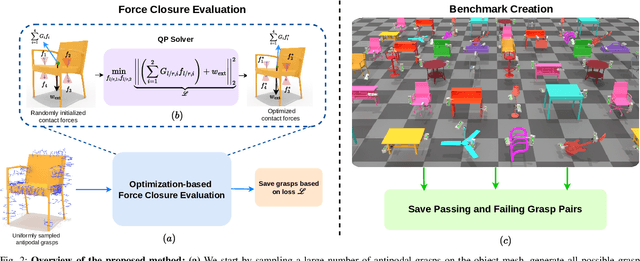
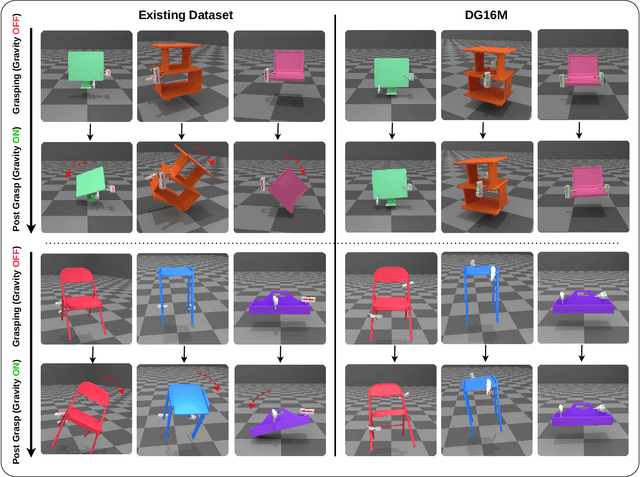
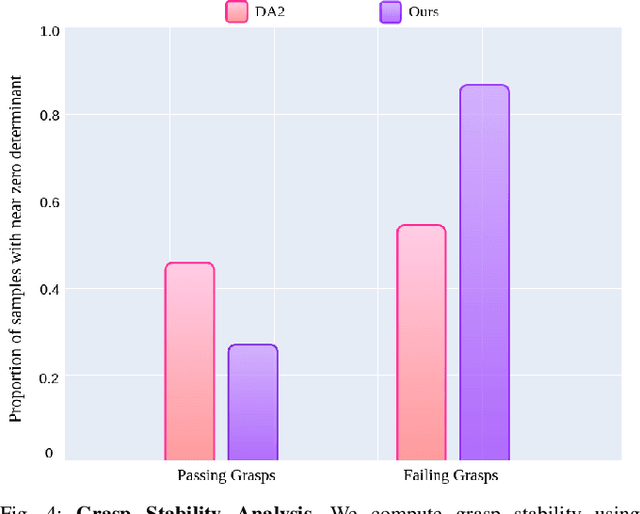

Dual-arm robotic grasping is crucial for handling large objects that require stable and coordinated manipulation. While single-arm grasping has been extensively studied, datasets tailored for dual-arm settings remain scarce. We introduce a large-scale dataset of 16 million dual-arm grasps, evaluated under improved force-closure constraints. Additionally, we develop a benchmark dataset containing 300 objects with approximately 30,000 grasps, evaluated in a physics simulation environment, providing a better grasp quality assessment for dual-arm grasp synthesis methods. Finally, we demonstrate the effectiveness of our dataset by training a Dual-Arm Grasp Classifier network that outperforms the state-of-the-art methods by 15\%, achieving higher grasp success rates and improved generalization across objects.
MetricGold: Leveraging Text-To-Image Latent Diffusion Models for Metric Depth Estimation
Nov 16, 2024
Recovering metric depth from a single image remains a fundamental challenge in computer vision, requiring both scene understanding and accurate scaling. While deep learning has advanced monocular depth estimation, current models often struggle with unfamiliar scenes and layouts, particularly in zero-shot scenarios and when predicting scale-ergodic metric depth. We present MetricGold, a novel approach that harnesses generative diffusion model's rich priors to improve metric depth estimation. Building upon recent advances in MariGold, DDVM and Depth Anything V2 respectively, our method combines latent diffusion, log-scaled metric depth representation, and synthetic data training. MetricGold achieves efficient training on a single RTX 3090 within two days using photo-realistic synthetic data from HyperSIM, VirtualKitti, and TartanAir. Our experiments demonstrate robust generalization across diverse datasets, producing sharper and higher quality metric depth estimates compared to existing approaches.
Imagine-2-Drive: High-Fidelity World Modeling in CARLA for Autonomous Vehicles
Nov 15, 2024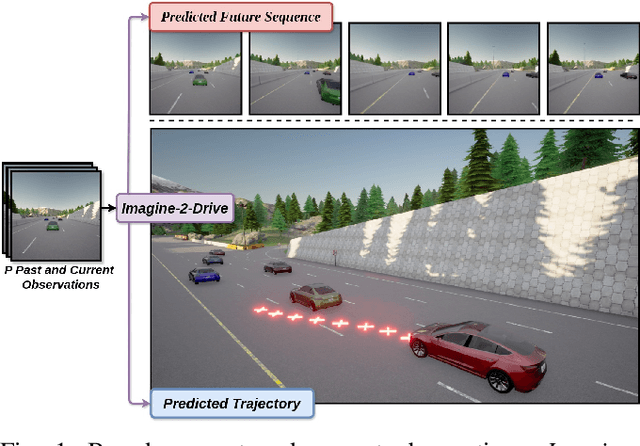
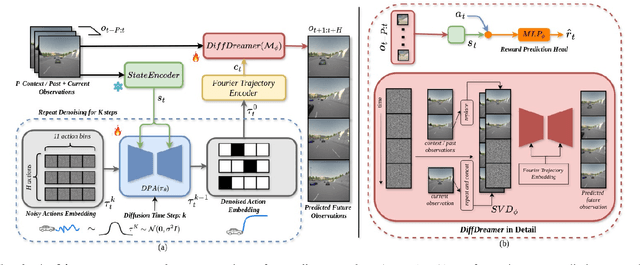
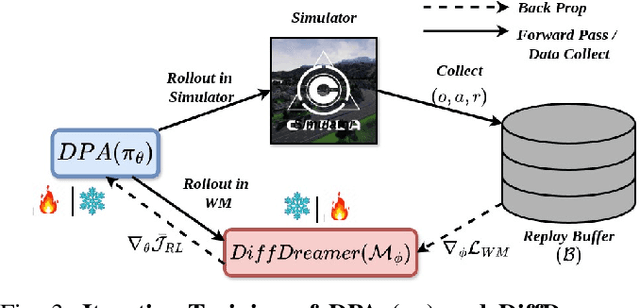
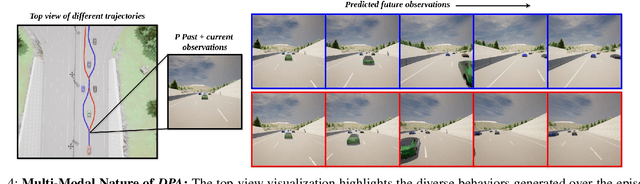
In autonomous driving with image based state space, accurate prediction of future events and modeling diverse behavioral modes are essential for safety and effective decision-making. World model-based Reinforcement Learning (WMRL) approaches offers a promising solution by simulating future states from current state and actions. However, utility of world models is often limited by typical RL policies being limited to deterministic or single gaussian distribution. By failing to capture the full spectrum of possible actions, reduces their adaptability in complex, dynamic environments. In this work, we introduce Imagine-2-Drive, a framework that consists of two components, VISTAPlan, a high-fidelity world model for accurate future prediction and Diffusion Policy Actor (DPA), a diffusion based policy to model multi-modal behaviors for trajectory prediction. We use VISTAPlan to simulate and evaluate trajectories from DPA and use Denoising Diffusion Policy Optimization (DDPO) to train DPA to maximize the cumulative sum of rewards over the trajectories. We analyze the benefits of each component and the framework as a whole in CARLA with standard driving metrics. As a consequence of our twin novelties- VISTAPlan and DPA, we significantly outperform the state of the art (SOTA) world models on standard driving metrics by 15% and 20% on Route Completion and Success Rate respectively.
DA-VIL: Adaptive Dual-Arm Manipulation with Reinforcement Learning and Variable Impedance Control
Oct 25, 2024


Dual-arm manipulation is an area of growing interest in the robotics community. Enabling robots to perform tasks that require the coordinated use of two arms, is essential for complex manipulation tasks such as handling large objects, assembling components, and performing human-like interactions. However, achieving effective dual-arm manipulation is challenging due to the need for precise coordination, dynamic adaptability, and the ability to manage interaction forces between the arms and the objects being manipulated. We propose a novel pipeline that combines the advantages of policy learning based on environment feedback and gradient-based optimization to learn controller gains required for the control outputs. This allows the robotic system to dynamically modulate its impedance in response to task demands, ensuring stability and dexterity in dual-arm operations. We evaluate our pipeline on a trajectory-tracking task involving a variety of large, complex objects with different masses and geometries. The performance is then compared to three other established methods for controlling dual-arm robots, demonstrating superior results.
Towards Global Localization using Multi-Modal Object-Instance Re-Identification
Sep 18, 2024Re-identification (ReID) is a critical challenge in computer vision, predominantly studied in the context of pedestrians and vehicles. However, robust object-instance ReID, which has significant implications for tasks such as autonomous exploration, long-term perception, and scene understanding, remains underexplored. In this work, we address this gap by proposing a novel dual-path object-instance re-identification transformer architecture that integrates multimodal RGB and depth information. By leveraging depth data, we demonstrate improvements in ReID across scenes that are cluttered or have varying illumination conditions. Additionally, we develop a ReID-based localization framework that enables accurate camera localization and pose identification across different viewpoints. We validate our methods using two custom-built RGB-D datasets, as well as multiple sequences from the open-source TUM RGB-D datasets. Our approach demonstrates significant improvements in both object instance ReID (mAP of 75.18) and localization accuracy (success rate of 83% on TUM-RGBD), highlighting the essential role of object ReID in advancing robotic perception. Our models, frameworks, and datasets have been made publicly available.
Constrained 6-DoF Grasp Generation on Complex Shapes for Improved Dual-Arm Manipulation
Apr 06, 2024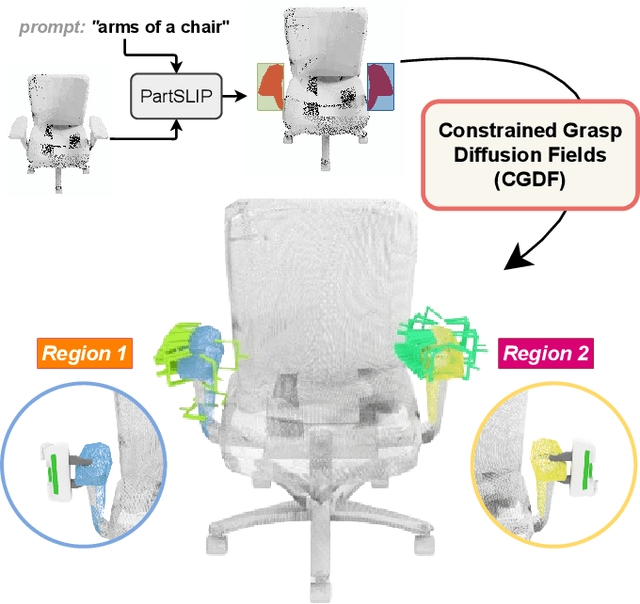
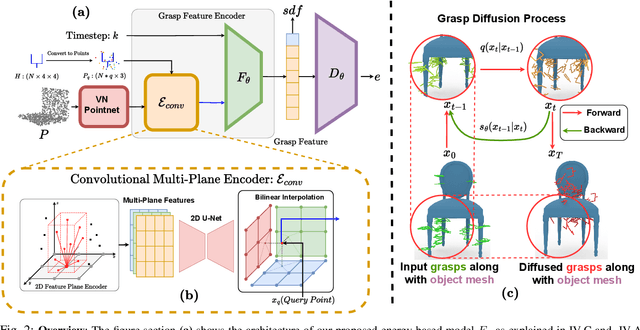
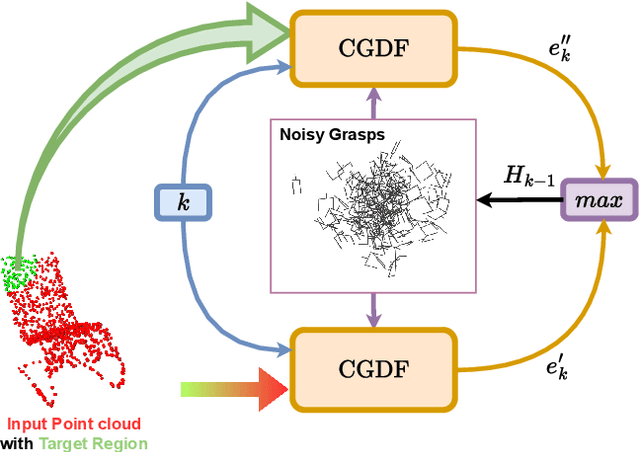
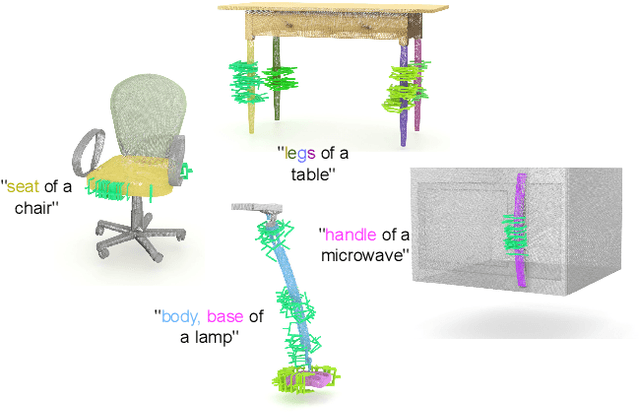
Efficiently generating grasp poses tailored to specific regions of an object is vital for various robotic manipulation tasks, especially in a dual-arm setup. This scenario presents a significant challenge due to the complex geometries involved, requiring a deep understanding of the local geometry to generate grasps efficiently on the specified constrained regions. Existing methods only explore settings involving table-top/small objects and require augmented datasets to train, limiting their performance on complex objects. We propose CGDF: Constrained Grasp Diffusion Fields, a diffusion-based grasp generative model that generalizes to objects with arbitrary geometries, as well as generates dense grasps on the target regions. CGDF uses a part-guided diffusion approach that enables it to get high sample efficiency in constrained grasping without explicitly training on massive constraint-augmented datasets. We provide qualitative and quantitative comparisons using analytical metrics and in simulation, in both unconstrained and constrained settings to show that our method can generalize to generate stable grasps on complex objects, especially useful for dual-arm manipulation settings, while existing methods struggle to do so.