 Add to Chrome
 Add to Firefox
 Add to Edge
ToolCaching: Towards Efficient Caching for LLM Tool-calling
Jan 20, 2026
Recent advances in Large Language Models (LLMs) have revolutionized web applications, enabling intelligent search, recommendation, and assistant services with natural language interfaces. Tool-calling extends LLMs with the ability to interact with external APIs, greatly enhancing their practical utility. While prior research has improved tool-calling performance by adopting traditional computer systems techniques, such as parallel and asynchronous execution, the challenge of redundant or repeated tool-calling requests remains largely unaddressed. Caching is a classic solution to this problem, but applying it to LLM tool-calling introduces new difficulties due to heterogeneous request semantics, dynamic workloads, and varying freshness requirements, which render conventional cache policies ineffective. To address these issues, we propose ToolCaching, an efficient feature-driven and adaptive caching framework for LLM tool-calling systems. ToolCaching systematically integrates semantic and system-level features to evaluate request cacheability and estimate caching value. At its core, the VAAC algorithm integrates bandit-based admission with value-driven, multi-factor eviction, jointly accounting for request frequency, recency, and caching value. Extensive experiments on synthetic and public tool-calling workloads demonstrate that ToolCaching with VAAC achieves up to 11% higher cache hit ratios and 34% lower latency compared to standard policies, effectively accelerating LLM tool-calling in practical applications.

Label Information Enhanced Fraud Detection against Low Homophily in Graphs
Feb 21, 2023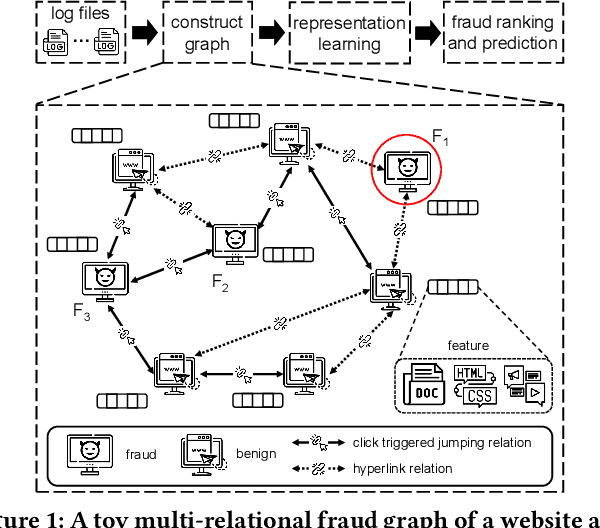


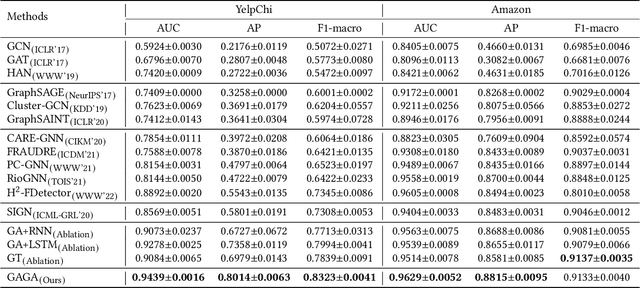
Node classification is a substantial problem in graph-based fraud detection. Many existing works adopt Graph Neural Networks (GNNs) to enhance fraud detectors. While promising, currently most GNN-based fraud detectors fail to generalize to the low homophily setting. Besides, label utilization has been proved to be significant factor for node classification problem. But we find they are less effective in fraud detection tasks due to the low homophily in graphs. In this work, we propose GAGA, a novel Group AGgregation enhanced TrAnsformer, to tackle the above challenges. Specifically, the group aggregation provides a portable method to cope with the low homophily issue. Such an aggregation explicitly integrates the label information to generate distinguishable neighborhood information. Along with group aggregation, an attempt towards end-to-end trainable group encoding is proposed which augments the original feature space with the class labels. Meanwhile, we devise two additional learnable encodings to recognize the structural and relational context. Then, we combine the group aggregation and the learnable encodings into a Transformer encoder to capture the semantic information. Experimental results clearly show that GAGA outperforms other competitive graph-based fraud detectors by up to 24.39% on two trending public datasets and a real-world industrial dataset from Anonymous. Even more, the group aggregation is demonstrated to outperform other label utilization methods (e.g., C&S, BoT/UniMP) in the low homophily setting.