 Add to Chrome
 Add to Firefox
 Add to Edge
UniPolymer: A Unified Framework for Property Prediction, Structure Recommendation, and Evaluation in Polyimide Design
Jul 31, 2026
Designing polyimide structures with specific glass transition temperatures (Tg) is highly challenging. Existing methods primarily focus on target-conditioned generation, lacking an assessment of the consistency between the generated structure and the target properties. This leads to low-quality candidates deviating from the design objective entering subsequent processes, increasing invalid experiments and prolonging the development cycle. To address this issue, we propose UniPolymer, a unified framework for property prediction, target-conditioned generation, candidate evaluation, and structure recommendation in polyimide design and a dataset containing 10066 deduplicated polyimide repeating units with Tg tags (PITg-Curated) was constructed. To improve the consistency between generated candidate structures and the target Tg, UniPolymer first establishes a reliable structure-property relationship mapping through self-supervised chemical semantic learning, structural consistency enhancement, and multi-scale information fusion. Subsequently, the model employs a continuous-discrete joint Tg representation to guide the autoregressive generation of SELFIES. The generated candidate structures are further evaluated using a frozen property predictor and polyimide-specific structural constraints, and ranked according to their deviation from the target Tg, thereby preventing structures deviating from the target from entering the subsequent validation stage. Experimental results show that UniPolymer achieved a property prediction accuracy of R^2=0.93 and a candidate structure evaluation pass rate of 73.79%, which are 2% and 1.21% higher than the best baseline, respectively. Meanwhile, the predicted Tg values of the recommended candidates are in high agreement with the results of molecular dynamics simulations, thereby reducing the number of candidates that enter the high-cost experimental stage.

LabOSBench: Benchmarking Computer Use Agents for Scientific Instrument Control
Jun 15, 2026Current computer-use benchmarks primarily focus on software operation tasks in virtualized systems, whereas scientific instrumentation scenarios require coordinated control over complex interfaces, and feedback-driven parameter adjustment. However, directly evaluating agents on physical high-precision instruments is impractical due to high cost, safety risks, limited accessibility, and difficulty in ensuring reproducible evaluation. This motivates the need for a simulated yet realistic testbed that preserves the operational challenges of scientific instruments while enabling scalable and safe benchmarking. To this end, we introduce LabOSBench, a challenging benchmark for multimodal GUI agents built on a suite of web-based scientific-instrument simulators. Operating directly via a browser, LabOSBench avoids resource-heavy OS virtualization while supporting flexible task configuration and execution-based evaluation. Specifically, LabOSBench constructs 96 subtasks across eight instrument simulators, covering workflows from sample loading, alignment, parameter tuning, and data acquisition to result inspection. We evaluate general-purpose vision-language models, specialized GUI agent models, and advanced agentic frameworks at both subtask and end-to-end levels. Our experiments reveal that while existing agents can complete many structured GUI subtasks, they still struggle with feedback-driven operations and long-horizon workflow execution. Overall, LabOSBench provides a reproducible, low-cost testbed for advancing computer-using agents toward scientific-instrument control.
Fast Adaptive Anti-Jamming Channel Access via Deep Q Learning and Coarse-Grained Spectrum Prediction
Feb 07, 2025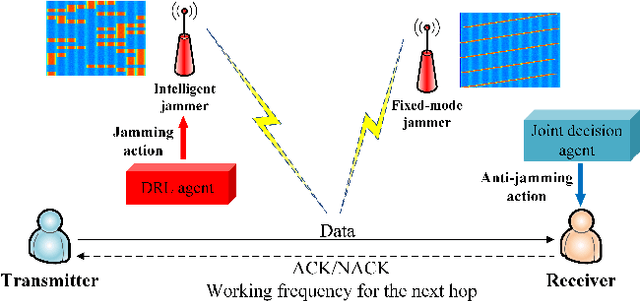
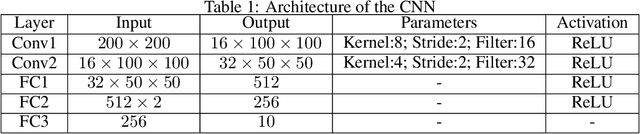
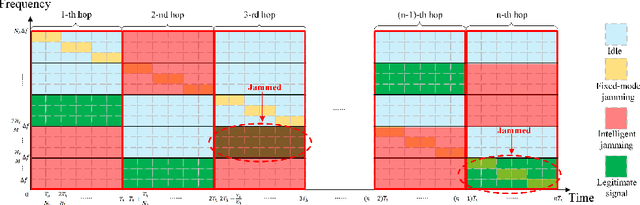
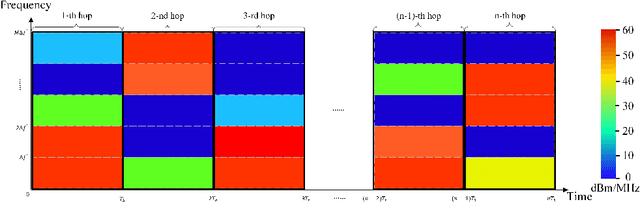
This paper investigates the anti-jamming channel access problem in complex and unknown jamming environments, where the jammer could dynamically adjust its strategies to target different channels. Traditional channel hopping anti-jamming approaches using fixed patterns are ineffective against such dynamic jamming attacks. Although the emerging deep reinforcement learning (DRL) based dynamic channel access approach could achieve the Nash equilibrium under fast-changing jamming attacks, it requires extensive training episodes. To address this issue, we propose a fast adaptive anti-jamming channel access approach guided by the intuition of ``learning faster than the jammer", where a synchronously updated coarse-grained spectrum prediction serves as an auxiliary task for the deep Q learning (DQN) based anti-jamming model. This helps the model identify a superior Q-function compared to standard DRL while significantly reducing the number of training episodes. Numerical results indicate that the proposed approach significantly accelerates the rate of convergence in model training, reducing the required training episodes by up to 70% compared to standard DRL. Additionally, it also achieves a 10% improvement in throughput over NE strategies, owing to the effective use of coarse-grained spectrum prediction.