 Add to Chrome
 Add to Firefox
 Add to Edge
Bridging Artificial Intelligence and Power Systems Education Using a Hands-On Executable Framework
Aug 03, 2026
Artificial intelligence (AI) is increasingly central to power and energy systems, supporting modeling, forecasting, optimization, and control. Yet most existing works emphasize specialized applications and offer little reusable material for newcomers or interdisciplinary learners, who increasingly rely on large language models rather than building their own. This gap points to a need for engineering-grounded AI (EGAI), in which AI workflows follow established engineering and power-system domain rules rather than acting as task-agnostic black boxes. Motivated by a community survey of researchers and practitioners, which shows 92% report at least one barrier before running an AI model and 94% want a power-specific hands-on course. This paper presents a framework consisting of open, executable module library that lowers the entry barrier for AI in power systems. The modules follow a progressive difficulty ladder that maps core AI concepts onto representative power-system tasks: (i) foundational deep neural network (DNN) templates for function approximation and load-curve fitting; (ii) a domain-coupled convolutional neural network (CNN) power-flow surrogate for a 5-bus system; and (iii) frontier modules on DNN-assisted optimization, deep reinforcement learning (DRL) for battery storage control, and physics-informed neural networks (PINNs) for the swing equation. All modules are released as Jupyter notebooks that run locally or on Google Colab and are delivered through an IEEE online course and IEEE Power & Energy Society (PES) webinar series. The webinar drew more than 590 live attendees, which is among the ten most-attended IEEE PES webinars, and over 344 repository visits within two weeks, reinforcing the survey-based motivation.

Do AI Agents Know When a Task Is Simple? Toward Complexity-Aware Reasoning and Execution
Jul 14, 2026Large language model (LLM) agents increasingly automate multi-step engineering and informatics workflows, yet they rarely ask how much effort a task actually requires. They often follow a maximum-context-first strategy--re-reading files and dependencies they have already seen--turning a one-line edit into a small code-base audit. We argue the missing capability is task-aware execution-scope estimation: judging a task's difficulty, the information it truly needs, and the shortest reliable path before committing budget. We formalize minimum-sufficient execution and the Agent Cognitive Redundancy Ratio (ACRR), and propose E3 (Estimate, Execute, Expand): the agent estimates an initial operating point, executes a minimum viable path, and expands scope only when verification fails. On MSE-Bench--a deterministic benchmark of 121 edits in a capability-controlled simulator--E3 matches the strongest baseline's 100% success while cutting cost by 85%, tokens by 91%, and inspected files by 92%, and further beats a strong adaptive retrieval baseline by 16%; the gains survive held-out instruction wording and essentially every cost weighting. A companion real-model harness (LLM-Case) corroborates the effect on a live gpt-4o agent editing a real open-source library, with every candidate patch graded by actually running the project's real pytest suite against a measured oracle: the over-reading is milder but real, and E3 is the leanest and fastest policy at comparable task success--its one shortfall a provider rate-limit, not a wrong edit. We frame this as a controlled probe of execution redundancy, not a measurement of any deployed agent, and position task-aware execution as a step toward engineering-grounded AI (EGAI)--agents whose effort is anchored in the engineering reality of the task. We release the framework and benchmark.
QUSR: Quality-Aware and Uncertainty-Guided Image Super-Resolution Diffusion Model
Mar 10, 2026Diffusion-based image super-resolution (ISR) has shown strong potential, but it still struggles in real-world scenarios where degradations are unknown and spatially non-uniform, often resulting in lost details or visual artifacts. To address this challenge, we propose a novel super-resolution diffusion model, QUSR, which integrates a Quality-Aware Prior (QAP) with an Uncertainty-Guided Noise Generation (UNG) module. The UNG module adaptively adjusts the noise injection intensity, applying stronger perturbations to high-uncertainty regions (e.g., edges and textures) to reconstruct complex details, while minimizing noise in low-uncertainty regions (e.g., flat areas) to preserve original information. Concurrently, the QAP leverages an advanced Multimodal Large Language Model (MLLM) to generate reliable quality descriptions, providing an effective and interpretable quality prior for the restoration process. Experimental results confirm that QUSR can produce high-fidelity and high-realism images in real-world scenarios. The source code is available at https://github.com/oTvTog/QUSR.
ModuLoRA: Finetuning 3-Bit LLMs on Consumer GPUs by Integrating with Modular Quantizers
Sep 28, 2023

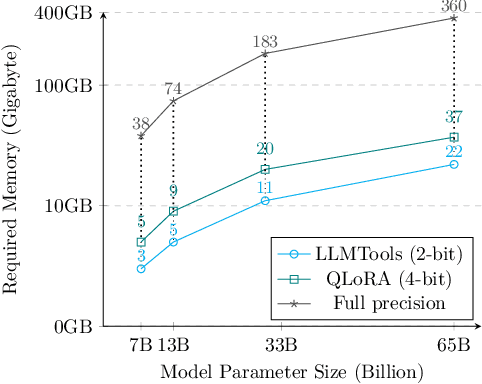
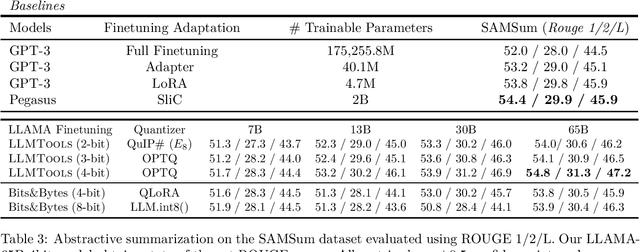
We propose a memory-efficient finetuning algorithm for large language models (LLMs) that supports finetuning LLMs with 65B parameters in 3-bit or 4-bit precision on as little as one 48GB GPU. Our method, modular low-rank adaptation (ModuLoRA), integrates any user-specified weight quantizer with finetuning via low-rank adapters (LoRAs). Our approach relies on a simple quantization-agnostic backward pass that adaptively materializes low-precision LLM weights from a custom black-box quantization module. This approach enables finetuning 3-bit LLMs for the first time--leveraging state-of-the-art 3-bit OPTQ quantization often outperforms finetuning that relies on less sophisticated 4-bit and 8-bit methods. In our experiments, ModuLoRA attains competitive performance on text classification, natural language infernece, and instruction following tasks using significantly less memory than existing approaches, and we also surpass the state-of-the-art ROUGE score on a popular summarization task. We release ModuLoRA together with a series of low-precision models--including the first family of 3-bit instruction following Alpaca LLMs--as part of LLMTOOLS, a user-friendly library for quantizing, running, and finetuning LLMs on consumer GPUs.
RSFDM-Net: Real-time Spatial and Frequency Domains Modulation Network for Underwater Image Enhancement
Feb 23, 2023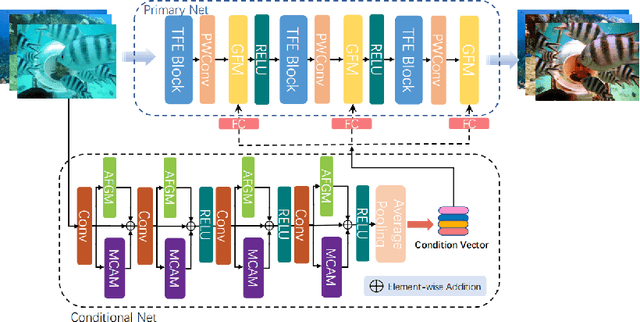
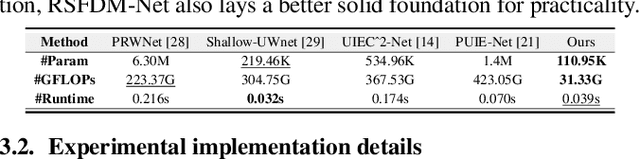
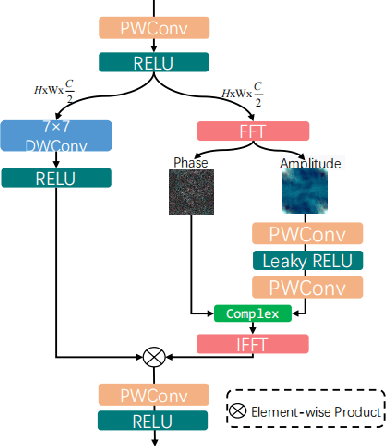
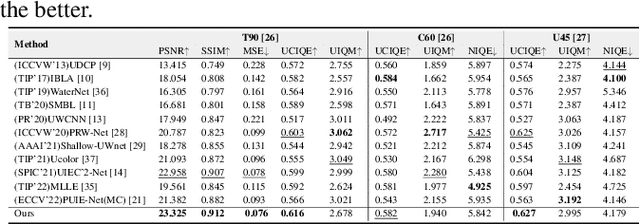
Underwater images typically experience mixed degradations of brightness and structure caused by the absorption and scattering of light by suspended particles. To address this issue, we propose a Real-time Spatial and Frequency Domains Modulation Network (RSFDM-Net) for the efficient enhancement of colors and details in underwater images. Specifically, our proposed conditional network is designed with Adaptive Fourier Gating Mechanism (AFGM) and Multiscale Convolutional Attention Module (MCAM) to generate vectors carrying low-frequency background information and high-frequency detail features, which effectively promote the network to model global background information and local texture details. To more precisely correct the color cast and low saturation of the image, we introduce a Three-branch Feature Extraction (TFE) block in the primary net that processes images pixel by pixel to integrate the color information extended by the same channel (R, G, or B). This block consists of three small branches, each of which has its own weights. Extensive experiments demonstrate that our network significantly outperforms over state-of-the-art methods in both visual quality and quantitative metrics.
A Deep Learning Based Chatbot for Campus Psychological Therapy
Oct 09, 2019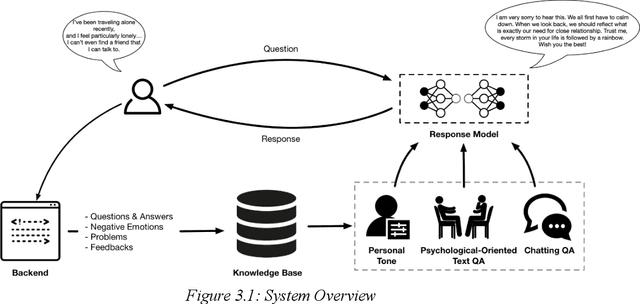
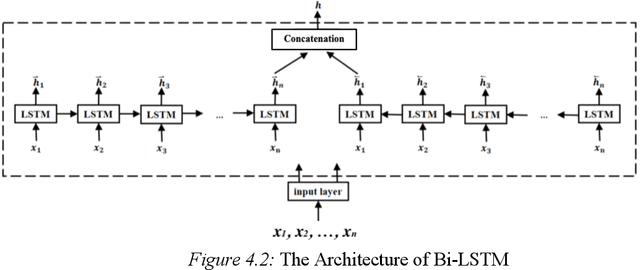
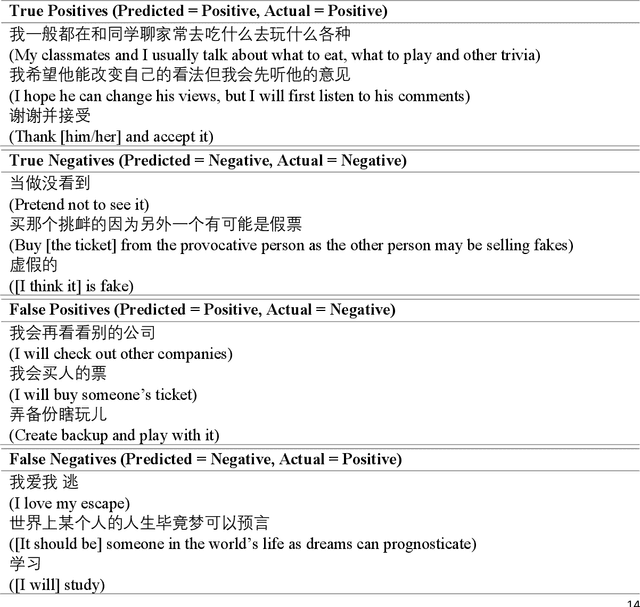
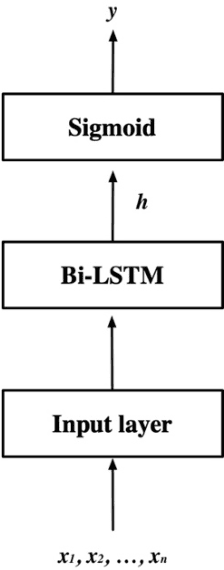
In this paper, we propose Evebot, an innovative, sequence to sequence (Seq2seq) based, fully generative conversational system for the diagnosis of negative emotions and prevention of depression through positively suggestive responses. The system consists of an assembly of deep-learning based models, including Bi-LSTM based model for detecting negative emotions of users and obtaining psychological counselling related corpus for training the chatbot, anti-language sequence to sequence neural network, and maximum mutual information (MMI) model. As adolescents are reluctant to show their negative emotions in physical interaction, traditional methods of emotion analysis and comforting methods may not work. Therefore, this system puts emphasis on using virtual platform to detect signs of depression or anxiety, channel adolescents' stress and mood, and thus prevent the emergence of mental illness. We launched the integrated chatbot system onto an online platform for real-world campus applications. Through a one-month user study, we observe better results in the increase in positivity than other public chatbots in the control group.