 Add to Chrome
 Add to Firefox
 Add to Edge
QUSR: Quality-Aware and Uncertainty-Guided Image Super-Resolution Diffusion Model
Mar 10, 2026
Diffusion-based image super-resolution (ISR) has shown strong potential, but it still struggles in real-world scenarios where degradations are unknown and spatially non-uniform, often resulting in lost details or visual artifacts. To address this challenge, we propose a novel super-resolution diffusion model, QUSR, which integrates a Quality-Aware Prior (QAP) with an Uncertainty-Guided Noise Generation (UNG) module. The UNG module adaptively adjusts the noise injection intensity, applying stronger perturbations to high-uncertainty regions (e.g., edges and textures) to reconstruct complex details, while minimizing noise in low-uncertainty regions (e.g., flat areas) to preserve original information. Concurrently, the QAP leverages an advanced Multimodal Large Language Model (MLLM) to generate reliable quality descriptions, providing an effective and interpretable quality prior for the restoration process. Experimental results confirm that QUSR can produce high-fidelity and high-realism images in real-world scenarios. The source code is available at https://github.com/oTvTog/QUSR.

SCP-Diff: Photo-Realistic Semantic Image Synthesis with Spatial-Categorical Joint Prior
Mar 14, 2024
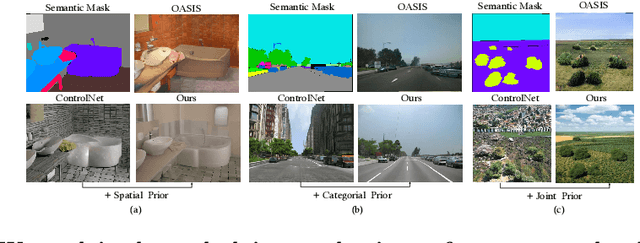
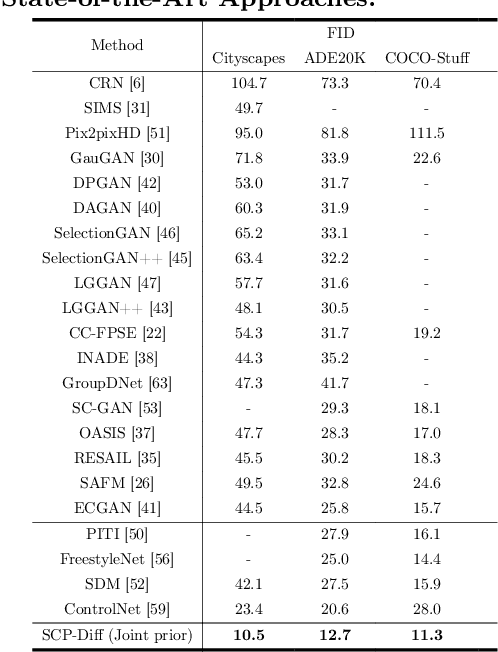
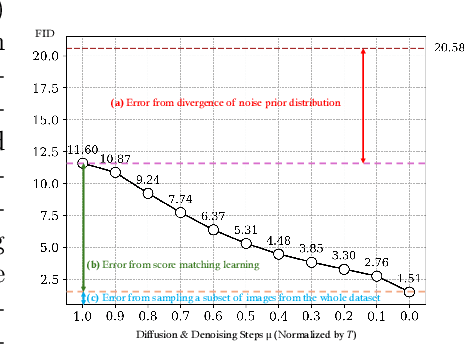
Semantic image synthesis (SIS) shows good promises for sensor simulation. However, current best practices in this field, based on GANs, have not yet reached the desired level of quality. As latent diffusion models make significant strides in image generation, we are prompted to evaluate ControlNet, a notable method for its dense control capabilities. Our investigation uncovered two primary issues with its results: the presence of weird sub-structures within large semantic areas and the misalignment of content with the semantic mask. Through empirical study, we pinpointed the cause of these problems as a mismatch between the noised training data distribution and the standard normal prior applied at the inference stage. To address this challenge, we developed specific noise priors for SIS, encompassing spatial, categorical, and a novel spatial-categorical joint prior for inference. This approach, which we have named SCP-Diff, has yielded exceptional results, achieving an FID of 10.53 on Cityscapes and 12.66 on ADE20K.The code and models can be accessed via the project page.