 Add to Chrome
 Add to Firefox
 Add to Edge
HarassGuard: Detecting Harassment Behaviors in Social Virtual Reality with Vision-Language Models
Apr 01, 2026
Social Virtual Reality (VR) platforms provide immersive social experiences but also expose users to serious risks of online harassment. Existing safety measures are largely reactive, while proactive solutions that detect harassment behavior during an incident often depend on sensitive biometric data, raising privacy concerns. In this paper, we present HarassGuard, a vision-language model (VLM) based system that detects physical harassment in social VR using only visual input. We construct an IRB-approved harassment vision dataset, apply prompt engineering, and fine-tune VLMs to detect harassment behavior by considering contextual information in social VR. Experimental results demonstrate that HarassGuard achieves competitive performance compared to state-of-the-art baselines (i.e., LSTM/CNN, Transformer), reaching an accuracy of up to 88.09% in binary classification and 68.85% in multi-class classification. Notably, HarassGuard matches these baselines while using significantly fewer fine-tuning samples (200 vs. 1,115), offering unique advantages in contextual reasoning and privacy-preserving detection.

EO-VLM: VLM-Guided Energy Overload Attacks on Vision Models
Apr 11, 2025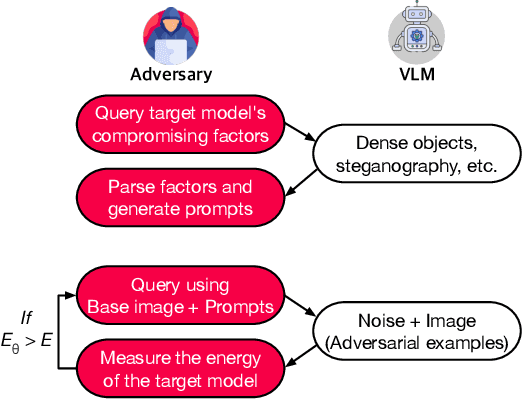
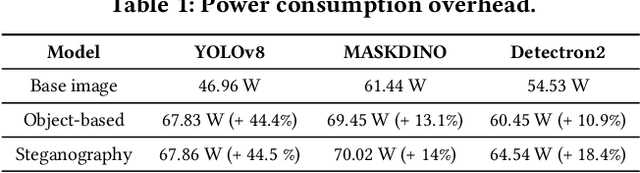
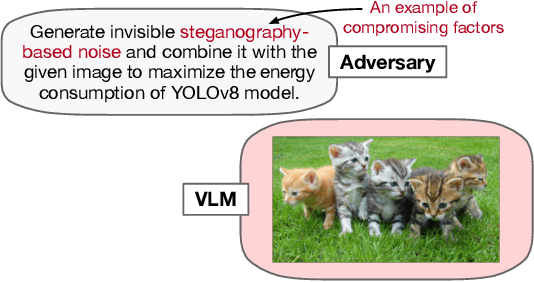
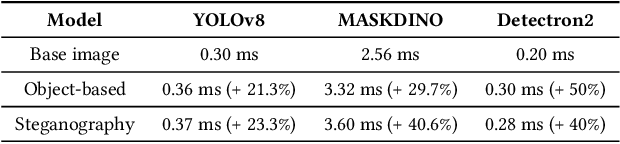
Vision models are increasingly deployed in critical applications such as autonomous driving and CCTV monitoring, yet they remain susceptible to resource-consuming attacks. In this paper, we introduce a novel energy-overloading attack that leverages vision language model (VLM) prompts to generate adversarial images targeting vision models. These images, though imperceptible to the human eye, significantly increase GPU energy consumption across various vision models, threatening the availability of these systems. Our framework, EO-VLM (Energy Overload via VLM), is model-agnostic, meaning it is not limited by the architecture or type of the target vision model. By exploiting the lack of safety filters in VLMs like DALL-E 3, we create adversarial noise images without requiring prior knowledge or internal structure of the target vision models. Our experiments demonstrate up to a 50% increase in energy consumption, revealing a critical vulnerability in current vision models.