 Add to Chrome
 Add to Firefox
 Add to Edge
Towards Error-Free EHRs: Reasoning-Intensive Consistency Verification Between Clinical Notes and Structured Tables in Electronic Health Records
May 26, 2026
Data consistency between unstructured clinical notes and structured tables in Electronic Health Records (EHRs) is essential for patient safety and clinical decision-making. However, existing work on note-table consistency verification mainly relies on surface-level matching of numeric values or simple events. Such approaches fail to capture the reasoning underlying real-world EHR documentation, including clinical interpretation, event relations, and temporal changes. To address this gap, we introduce EHR-ReasonCon, a reasoning-intensive benchmark for note-table consistency verification. Built on MIMIC-III with expert-guided annotations, it comprises 8,048 entities derived from clinical notes and provides high-quality ground-truth labels. The annotation protocol is supported by specialized table-exploration tools to ensure systematic evidence retrieval and reliable consistency assessment. We also propose EHR-Inspector, an LLM-based framework that segments notes, extracts anchor entities and temporal references, and uses table-exploration tools to verify consistency against structured tables. Evaluated using expert-validated LLM-as-a-judge metrics under harsh and lenient criteria, EHR-Inspector achieves state-of-the-art performance across multiple model backbones. Analyses further demonstrate the effectiveness of its components and highlight differences from human verification.

PICon: A Multi-Turn Interrogation Framework for Evaluating Persona Agent Consistency
Mar 26, 2026Large language model (LLM)-based persona agents are rapidly being adopted as scalable proxies for human participants across diverse domains. Yet there is no systematic method for verifying whether a persona agent's responses remain free of contradictions and factual inaccuracies throughout an interaction. A principle from interrogation methodology offers a lens: no matter how elaborate a fabricated identity, systematic interrogation will expose its contradictions. We apply this principle to propose PICon, an evaluation framework that probes persona agents through logically chained multi-turn questioning. PICon evaluates consistency along three core dimensions: internal consistency (freedom from self-contradiction), external consistency (alignment with real-world facts), and retest consistency (stability under repetition). Evaluating seven groups of persona agents alongside 63 real human participants, we find that even systems previously reported as highly consistent fail to meet the human baseline across all three dimensions, revealing contradictions and evasive responses under chained questioning. This work provides both a conceptual foundation and a practical methodology for evaluating persona agents before trusting them as substitutes for human participants. We provide the source code and an interactive demo at: https://kaist-edlab.github.io/picon/
R2-KG: General-Purpose Dual-Agent Framework for Reliable Reasoning on Knowledge Graphs
Feb 18, 2025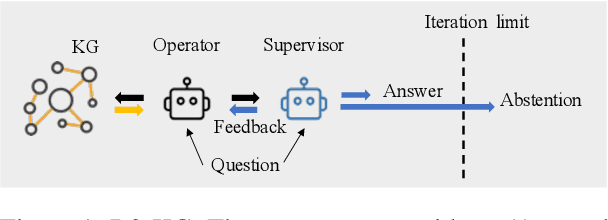
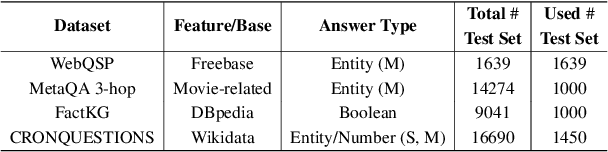
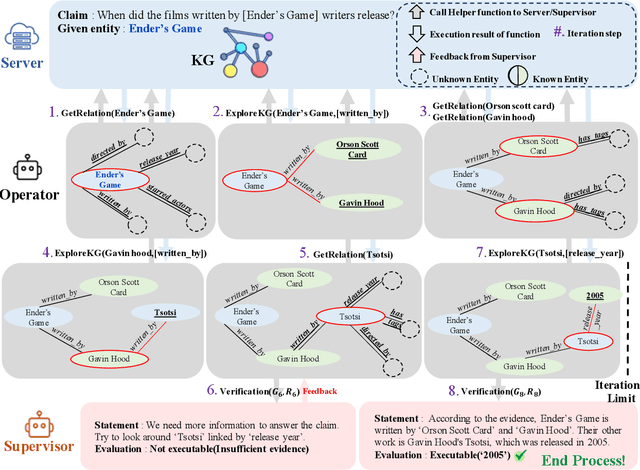
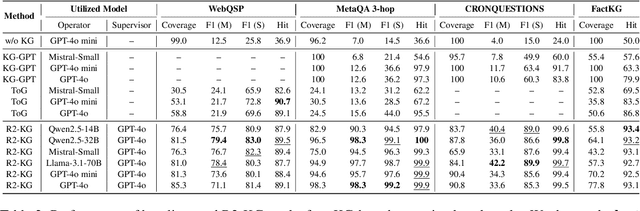
Recent studies have combined Large Language Models (LLMs) with Knowledge Graphs (KGs) to enhance reasoning, improving inference accuracy without additional training while mitigating hallucination. However, existing frameworks are often rigid, struggling to adapt to KG or task changes. They also rely heavily on powerful LLMs for reliable (i.e., trustworthy) reasoning. To address this, We introduce R2-KG, a plug-and-play, dual-agent framework that separates reasoning into two roles: an Operator (a low-capacity LLM) that gathers evidence and a Supervisor (a high-capacity LLM) that makes final judgments. This design is cost-efficient for LLM inference while still maintaining strong reasoning accuracy. Additionally, R2-KG employs an Abstention mechanism, generating answers only when sufficient evidence is collected from KG, which significantly enhances reliability. Experiments across multiple KG-based reasoning tasks show that R2-KG consistently outperforms baselines in both accuracy and reliability, regardless of the inherent capability of LLMs used as the Operator. Further experiments reveal that the single-agent version of R2-KG, equipped with a strict self-consistency strategy, achieves significantly higher-than-baseline reliability while reducing inference cost. However, it also leads to a higher abstention rate in complex KGs. Our findings establish R2-KG as a flexible and cost-effective solution for KG-based reasoning. It reduces reliance on high-capacity LLMs while ensuring trustworthy inference.