 Add to Chrome
 Add to Firefox
 Add to Edge
Unified Spatiotemporal Token Compression for Video-LLMs at Ultra-Low Retention
Mar 23, 2026
Video large language models (Video-LLMs) face high computational costs due to large volumes of visual tokens. Existing token compression methods typically adopt a two-stage spatiotemporal compression strategy, relying on stage-specific metrics and an implicit assumption of spatiotemporal separability. Under extremely low retention ratios, however, such approaches often result in unbalanced allocation and loss of visual evidence essential for question answering. We reformulate token compression as a spatiotemporal allocation task within a global token retention pool. We propose a unified selection mechanism that integrates attention weights and semantic similarity to globally select tokens with high contribution and low redundancy. Unselected tokens are merged via clustering and refilled, preserving information integrity. Inside the LLM, we further introduce text-aware merging to perform secondary compression based on query relevance. Without requiring retraining, our method serves as a plug-and-play module compatible with existing Video-LLMs. Experiments show that retaining only about 2% of visual tokens preserves 90.1% of baseline performance across multiple benchmarks, while reducing FLOPs to roughly 2.6%. These benefits generalize across diverse backbones, decreasing end-to-end inference latency and memory consumption. Our unified spatiotemporal token compression strategy establishes the state-of-the-art in video understanding under ultra-low token retention.

High-Precision Transformer-Based Visual Servoing for Humanoid Robots in Aligning Tiny Objects
Mar 06, 2025
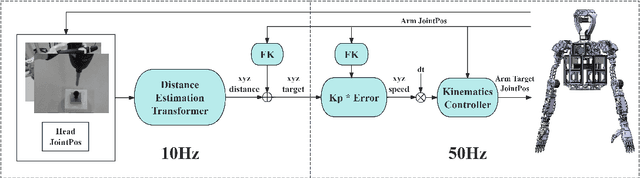


High-precision tiny object alignment remains a common and critical challenge for humanoid robots in real-world. To address this problem, this paper proposes a vision-based framework for precisely estimating and controlling the relative position between a handheld tool and a target object for humanoid robots, e.g., a screwdriver tip and a screw head slot. By fusing images from the head and torso cameras on a robot with its head joint angles, the proposed Transformer-based visual servoing method can correct the handheld tool's positional errors effectively, especially at a close distance. Experiments on M4-M8 screws demonstrate an average convergence error of 0.8-1.3 mm and a success rate of 93\%-100\%. Through comparative analysis, the results validate that this capability of high-precision tiny object alignment is enabled by the Distance Estimation Transformer architecture and the Multi-Perception-Head mechanism proposed in this paper.