 Add to Chrome
 Add to Firefox
 Add to Edge
Internalizing Agency from Reflective Experience
Mar 17, 2026
Large language models are increasingly deployed as autonomous agents that must plan, act, and recover from mistakes through long-horizon interaction with environments that provide rich feedback. However, prevailing outcome-driven post-training methods (e.g., RL with verifiable rewards) primarily optimize final success signals, leaving rich environment feedback underutilized. Consequently, they often lead to distribution sharpening: the policy becomes better at reproducing a narrow set of already-successful behaviors, while failing to improve the feedback-grounded agency needed to expand problem-solving capacity (e.g., Pass@k) in long-horizon settings. To address this, we propose LEAFE (Learning Feedback-Grounded Agency from Reflective Experience), a framework that internalizes recovery agency from reflective experience. Specifically, during exploration, the agent summarizes environment feedback into actionable experience, backtracks to earlier decision points, and explores alternative branches with revised actions. We then distill these experience-guided corrections into the model through supervised fine-tuning, enabling the policy to recover more effectively in future interactions. Across a diverse set of interactive coding and agentic tasks under fixed interaction budgets, LEAFE consistently improves Pass@1 over the base model and achieves higher Pass@k than outcome-driven baselines (GRPO) and experience-based methods such as Early Experience, with gains of up to 14% on Pass@128.

d3LLM: Ultra-Fast Diffusion LLM using Pseudo-Trajectory Distillation
Jan 12, 2026Diffusion large language models (dLLMs) offer capabilities beyond those of autoregressive (AR) LLMs, such as parallel decoding and random-order generation. However, realizing these benefits in practice is non-trivial, as dLLMs inherently face an accuracy-parallelism trade-off. Despite increasing interest, existing methods typically focus on only one-side of the coin, targeting either efficiency or performance. To address this limitation, we propose d3LLM (Pseudo-Distilled Diffusion Large Language Model), striking a balance between accuracy and parallelism: (i) during training, we introduce pseudo-trajectory distillation to teach the model which tokens can be decoded confidently at early steps, thereby improving parallelism; (ii) during inference, we employ entropy-based multi-block decoding with a KV-cache refresh mechanism to achieve high parallelism while maintaining accuracy. To better evaluate dLLMs, we also introduce AUP (Accuracy Under Parallelism), a new metric that jointly measures accuracy and parallelism. Experiments demonstrate that our d3LLM achieves up to 10$\times$ speedup over vanilla LLaDA/Dream and 5$\times$ speedup over AR models without much accuracy drop. Our code is available at https://github.com/hao-ai-lab/d3LLM.
SpaLLM: Unified Compressive Adaptation of Large Language Models with Sketching
Oct 08, 2024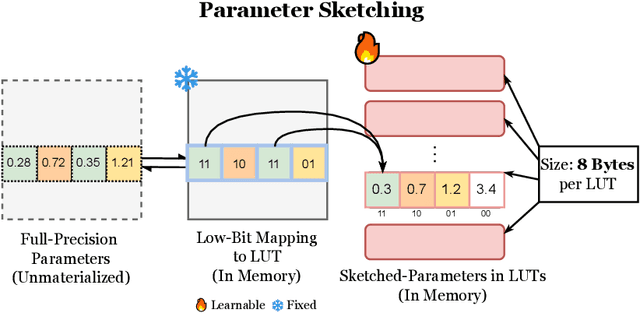
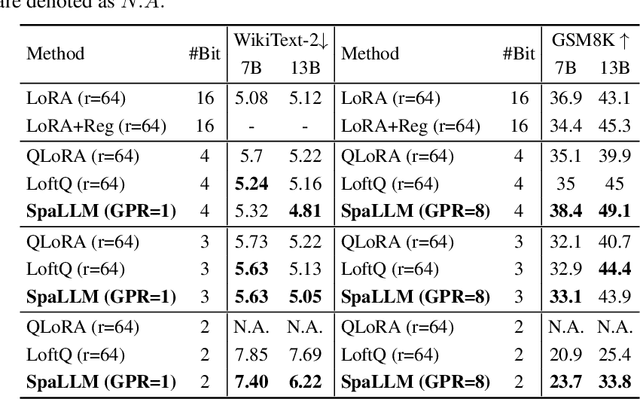


Compressive adaptation approaches, such as QLoRA, are widely popular alternatives for reducing memory requirements during fine-tuning of large language models (LLMs) while producing models capable of handling various downstream tasks. The key idea is to employ a "two-tower" architecture: compressing pre-trained LLM parameters into compact representations and fine-tuning the additive full-precision adapter, which typically has few tunable parameters in low-rank format. However, the strict algebraic assumptions, such as low-rank assumption, and the complexity of composing two-tower architectures are some of the known shortcomings, resulting in a poor accuracy-efficiency trade-off. In response to these known limitations, we propose SpaLLM (Sketched Parameter Adaptation of LLMs), a novel compressive adaptation approach for LLMs. This method is also the first to illustrate parameter-sharing compression methods for LLM fine-tuning, which, unlike QLoRA, are free from strict low-rank algebraic assumptions on adapters. Furthermore, our proposal unifies model compression and adaptation into a single, streamlined process, eliminating the need for two-tower architectures. SpaLLM sketches pre-trained LLM weights into lookup tables and directly fine-tunes the values in these tables. This approach simplifies LLMs' compressive adaptation workflow, potentially improves multi-user serving efficiency, and delivers significantly better accuracy for both natural language understanding and generation tasks. Moreover, by avoiding the "two-tower" architecture, our framework only requires one compressed matrix multiplication per layer during inference, demonstrating superior inference efficiency compared to previous methods.