 Add to Chrome
 Add to Firefox
 Add to Edge
Lifting Unlabeled Internet-level Data for 3D Scene Understanding
Apr 02, 2026
Annotated 3D scene data is scarce and expensive to acquire, while abundant unlabeled videos are readily available on the internet. In this paper, we demonstrate that carefully designed data engines can leverage web-curated, unlabeled videos to automatically generate training data, to facilitate end-to-end models in 3D scene understanding alongside human-annotated datasets. We identify and analyze bottlenecks in automated data generation, revealing critical factors that determine the efficiency and effectiveness of learning from unlabeled data. To validate our approach across different perception granularities, we evaluate on three tasks spanning low-level perception, i.e., 3D object detection and instance segmentation, to high-evel reasoning, i.e., 3D spatial Visual Question Answering (VQA) and Vision-Lanugage Navigation (VLN). Models trained on our generated data demonstrate strong zero-shot performance and show further improvement after finetuning. This demonstrates the viability of leveraging readily available web data as a path toward more capable scene understanding systems.

LEO-VL: Towards 3D Vision-Language Generalists via Data Scaling with Efficient Representation
Jun 11, 2025
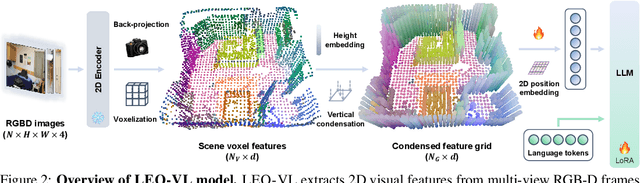
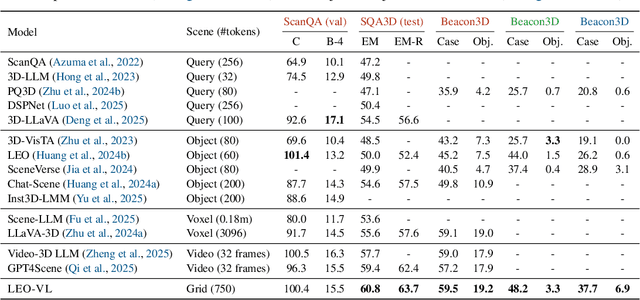
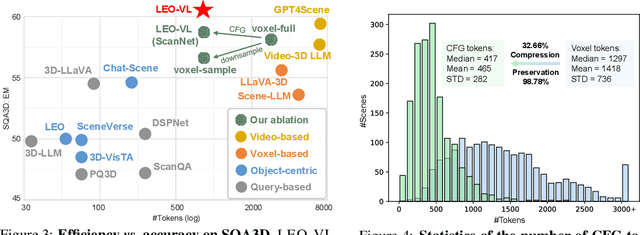
Developing 3D-VL generalists capable of understanding 3D scenes and following natural language instructions to perform a wide range of tasks has been a long-standing goal in the 3D-VL community. Despite recent progress, 3D-VL models still lag behind their 2D counterparts in capability and robustness, falling short of the generalist standard. A key obstacle to developing 3D-VL generalists lies in data scalability, hindered by the lack of an efficient scene representation. We propose LEO-VL, a 3D-VL model built upon condensed feature grid (CFG), an efficient scene representation that bridges 2D perception and 3D spatial structure while significantly reducing token overhead. This efficiency unlocks large-scale training towards 3D-VL generalist, for which we curate over 700k high-quality 3D-VL data spanning four domains of real-world indoor scenes and five tasks such as captioning and dialogue. LEO-VL achieves state-of-the-art performance on a variety of 3D QA benchmarks, including SQA3D, MSQA, and Beacon3D. Ablation studies confirm the efficiency of our representation, the importance of task and scene diversity, and the validity of our data curation principle. Furthermore, we introduce SceneDPO, a novel post-training objective that enhances the robustness of 3D-VL models. We hope our findings contribute to the advancement of scalable and robust 3D-VL generalists.