 Add to Chrome
 Add to Firefox
 Add to Edge
Autoverse: An Evolvable Game Langugage for Learning Robust Embodied Agents
Jul 05, 2024
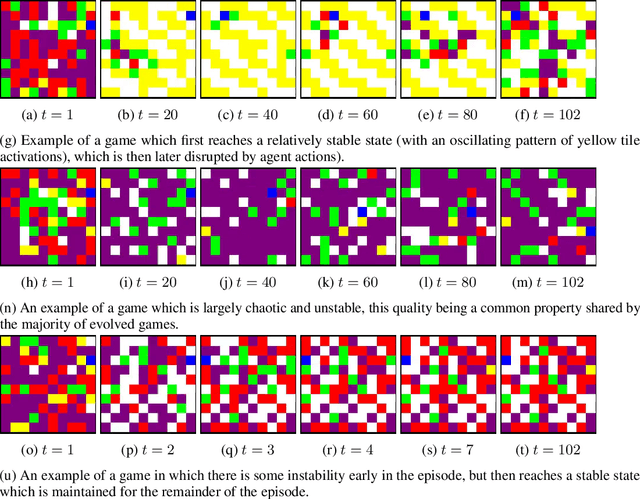
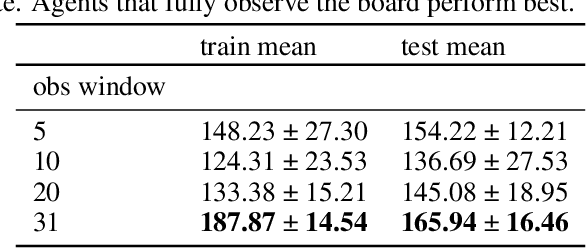
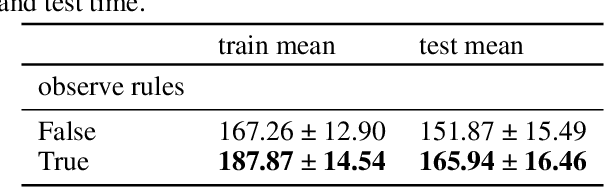
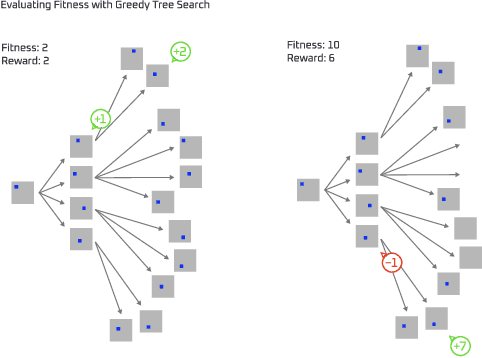
We introduce Autoverse, an evolvable, domain-specific language for single-player 2D grid-based games, and demonstrate its use as a scalable training ground for Open-Ended Learning (OEL) algorithms. Autoverse uses cellular-automaton-like rewrite rules to describe game mechanics, allowing it to express various game environments (e.g. mazes, dungeons, sokoban puzzles) that are popular testbeds for Reinforcement Learning (RL) agents. Each rewrite rule can be expressed as a series of simple convolutions, allowing for environments to be parallelized on the GPU, thereby drastically accelerating RL training. Using Autoverse, we propose jump-starting open-ended learning by imitation learning from search. In such an approach, we first evolve Autoverse environments (their rules and initial map topology) to maximize the number of iterations required by greedy tree search to discover a new best solution, producing a curriculum of increasingly complex environments and playtraces. We then distill these expert playtraces into a neural-network-based policy using imitation learning. Finally, we use the learned policy as a starting point for open-ended RL, where new training environments are continually evolved to maximize the RL player agent's value function error (a proxy for its regret, or the learnability of generated environments), finding that this approach improves the performance and generality of resultant player agents.

Goals as Reward-Producing Programs
May 21, 2024People are remarkably capable of generating their own goals, beginning with child's play and continuing into adulthood. Despite considerable empirical and computational work on goals and goal-oriented behavior, models are still far from capturing the richness of everyday human goals. Here, we bridge this gap by collecting a dataset of human-generated playful goals, modeling them as reward-producing programs, and generating novel human-like goals through program synthesis. Reward-producing programs capture the rich semantics of goals through symbolic operations that compose, add temporal constraints, and allow for program execution on behavioral traces to evaluate progress. To build a generative model of goals, we learn a fitness function over the infinite set of possible goal programs and sample novel goals with a quality-diversity algorithm. Human evaluators found that model-generated goals, when sampled from partitions of program space occupied by human examples, were indistinguishable from human-created games. We also discovered that our model's internal fitness scores predict games that are evaluated as more fun to play and more human-like.
Word2World: Generating Stories and Worlds through Large Language Models
May 06, 2024Large Language Models (LLMs) have proven their worth across a diverse spectrum of disciplines. LLMs have shown great potential in Procedural Content Generation (PCG) as well, but directly generating a level through a pre-trained LLM is still challenging. This work introduces Word2World, a system that enables LLMs to procedurally design playable games through stories, without any task-specific fine-tuning. Word2World leverages the abilities of LLMs to create diverse content and extract information. Combining these abilities, LLMs can create a story for the game, design narrative, and place tiles in appropriate places to create coherent worlds and playable games. We test Word2World with different LLMs and perform a thorough ablation study to validate each step. We open-source the code at https://github.com/umair-nasir14/Word2World.
DreamCraft: Text-Guided Generation of Functional 3D Environments in Minecraft
Apr 23, 2024Procedural Content Generation (PCG) algorithms enable the automatic generation of complex and diverse artifacts. However, they don't provide high-level control over the generated content and typically require domain expertise. In contrast, text-to-3D methods allow users to specify desired characteristics in natural language, offering a high amount of flexibility and expressivity. But unlike PCG, such approaches cannot guarantee functionality, which is crucial for certain applications like game design. In this paper, we present a method for generating functional 3D artifacts from free-form text prompts in the open-world game Minecraft. Our method, DreamCraft, trains quantized Neural Radiance Fields (NeRFs) to represent artifacts that, when viewed in-game, match given text descriptions. We find that DreamCraft produces more aligned in-game artifacts than a baseline that post-processes the output of an unconstrained NeRF. Thanks to the quantized representation of the environment, functional constraints can be integrated using specialized loss terms. We show how this can be leveraged to generate 3D structures that match a target distribution or obey certain adjacency rules over the block types. DreamCraft inherits a high degree of expressivity and controllability from the NeRF, while still being able to incorporate functional constraints through domain-specific objectives.
Missed Connections: Lateral Thinking Puzzles for Large Language Models
Apr 17, 2024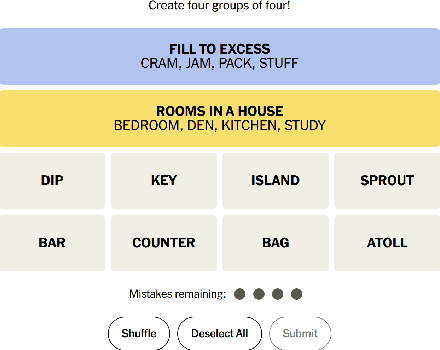
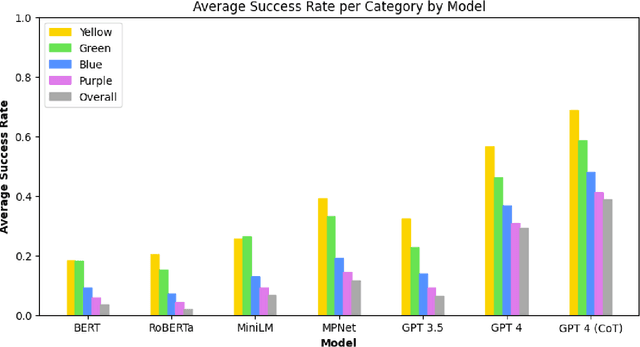
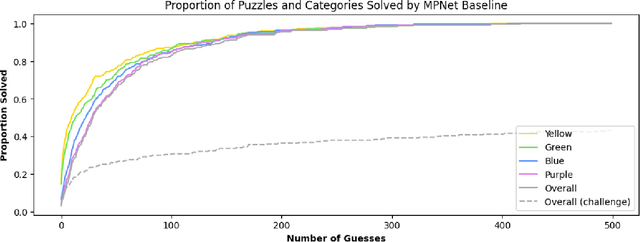
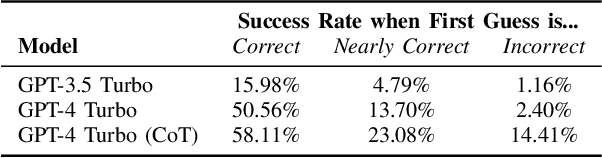
The Connections puzzle published each day by the New York Times tasks players with dividing a bank of sixteen words into four groups of four words that each relate to a common theme. Solving the puzzle requires both common linguistic knowledge (i.e. definitions and typical usage) as well as, in many cases, lateral or abstract thinking. This is because the four categories ascend in complexity, with the most challenging category often requiring thinking about words in uncommon ways or as parts of larger phrases. We investigate the capacity for automated AI systems to play Connections and explore the game's potential as an automated benchmark for abstract reasoning and a way to measure the semantic information encoded by data-driven linguistic systems. In particular, we study both a sentence-embedding baseline and modern large language models (LLMs). We report their accuracy on the task, measure the impacts of chain-of-thought prompting, and discuss their failure modes. Overall, we find that the Connections task is challenging yet feasible, and a strong test-bed for future work.
ChatGPT4PCG 2 Competition: Prompt Engineering for Science Birds Level Generation
Mar 05, 2024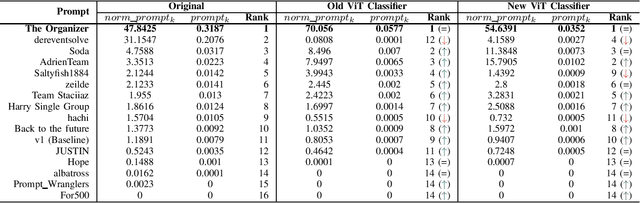
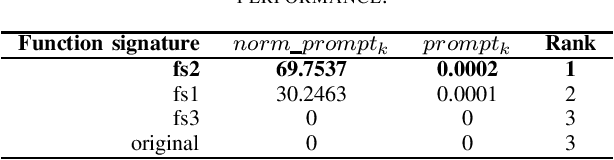
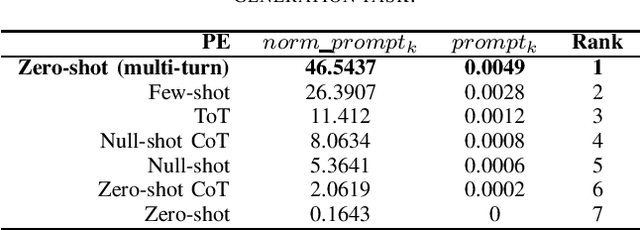
This paper presents the second ChatGPT4PCG competition at the 2024 IEEE Conference on Games. In this edition of the competition, we follow the first edition, but make several improvements and changes. We introduce a new evaluation metric along with allowing a more flexible format for participants' submissions and making several improvements to the evaluation pipeline. Continuing from the first edition, we aim to foster and explore the realm of prompt engineering (PE) for procedural content generation (PCG). While the first competition saw success, it was hindered by various limitations; we aim to mitigate these limitations in this edition. We introduce diversity as a new metric to discourage submissions aimed at producing repetitive structures. Furthermore, we allow submission of a Python program instead of a prompt text file for greater flexibility in implementing advanced PE approaches, which may require control flow, including conditions and iterations. We also make several improvements to the evaluation pipeline with a better classifier for similarity evaluation and better-performing function signatures. We thoroughly evaluate the effectiveness of the new metric and the improved classifier. Additionally, we perform an ablation study to select a function signature to instruct ChatGPT for level generation. Finally, we provide implementation examples of various PE techniques in Python and evaluate their preliminary performance. We hope this competition serves as a resource and platform for learning about PE and PCG in general.
The Ink Splotch Effect: A Case Study on ChatGPT as a Co-Creative Game Designer
Mar 04, 2024This paper studies how large language models (LLMs) can act as effective, high-level creative collaborators and ``muses'' for game design. We model the design of this study after the exercises artists use by looking at amorphous ink splotches for creative inspiration. Our goal is to determine whether AI-assistance can improve, hinder, or provide an alternative quality to games when compared to the creative intents implemented by human designers. The capabilities of LLMs as game designers are stress tested by placing it at the forefront of the decision making process. Three prototype games are designed across 3 different genres: (1) a minimalist base game, (2) a game with features and game feel elements added by a human game designer, and (3) a game with features and feel elements directly implemented from prompted outputs of the LLM, ChatGPT. A user study was conducted and participants were asked to blindly evaluate the quality and their preference of these games. We discuss both the development process of communicating creative intent to an AI chatbot and the synthesized open feedback of the participants. We use this data to determine both the benefits and shortcomings of AI in a more design-centric role.
Large Language Models and Games: A Survey and Roadmap
Feb 28, 2024Recent years have seen an explosive increase in research on large language models (LLMs), and accompanying public engagement on the topic. While starting as a niche area within natural language processing, LLMs have shown remarkable potential across a broad range of applications and domains, including games. This paper surveys the current state of the art across the various applications of LLMs in and for games, and identifies the different roles LLMs can take within a game. Importantly, we discuss underexplored areas and promising directions for future uses of LLMs in games and we reconcile the potential and limitations of LLMs within the games domain. As the first comprehensive survey and roadmap at the intersection of LLMs and games, we are hopeful that this paper will serve as the basis for groundbreaking research and innovation in this exciting new field.
Quality Diversity in the Amorphous Fortress (QD-AF): Evolving for Complexity in 0-Player Games
Dec 04, 2023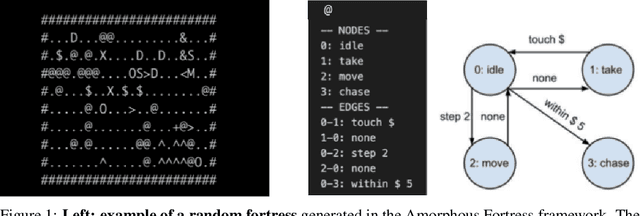
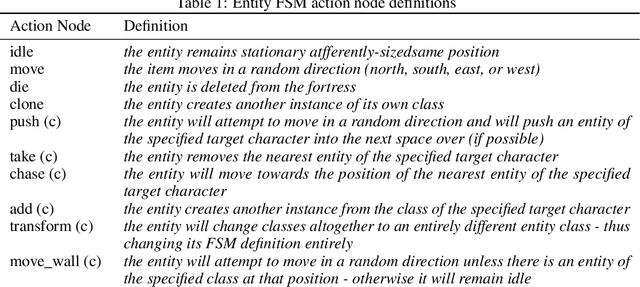
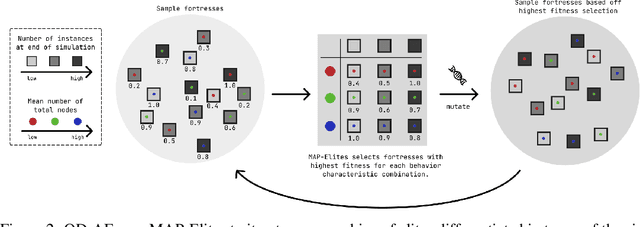
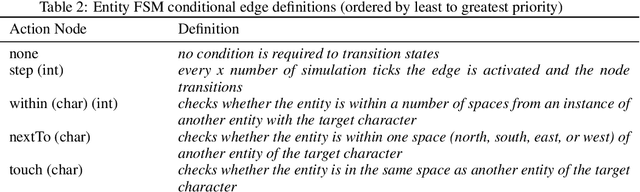
We explore the generation of diverse environments using the Amorphous Fortress (AF) simulation framework. AF defines a set of Finite State Machine (FSM) nodes and edges that can be recombined to control the behavior of agents in the `fortress' grid-world. The behaviors and conditions of the agents within the framework are designed to capture the common building blocks of multi-agent artificial life and reinforcement learning environments. Using quality diversity evolutionary search, we generate diverse sets of environments. These environments exhibit certain types of complexity according to measures of agents' FSM architectures and activations, and collective behaviors. Our approach, Quality Diversity in Amorphous Fortress (QD-AF) generates families of 0-player games akin to simplistic ecological models, and we identify the emergence of both competitive and co-operative multi-agent and multi-species survival dynamics. We argue that these generated worlds can collectively serve as training and testing grounds for learning algorithms.
Evolutionary Machine Learning and Games
Nov 20, 2023


Evolutionary machine learning (EML) has been applied to games in multiple ways, and for multiple different purposes. Importantly, AI research in games is not only about playing games; it is also about generating game content, modeling players, and many other applications. Many of these applications pose interesting problems for EML. We will structure this chapter on EML for games based on whether evolution is used to augment machine learning (ML) or ML is used to augment evolution. For completeness, we also briefly discuss the usage of ML and evolution separately in games.