 Add to Chrome
 Add to Firefox
 Add to Edge
Group-Invariant Unsupervised Skill Discovery: Symmetry-aware Skill Representations for Generalizable Behavior
Jan 20, 2026
Unsupervised skill discovery aims to acquire behavior primitives that improve exploration and accelerate downstream task learning. However, existing approaches often ignore the geometric symmetries of physical environments, leading to redundant behaviors and sample inefficiency. To address this, we introduce Group-Invariant Skill Discovery (GISD), a framework that explicitly embeds group structure into the skill discovery objective. Our approach is grounded in a theoretical guarantee: we prove that in group-symmetric environments, the standard Wasserstein dependency measure admits a globally optimal solution comprised of an equivariant policy and a group-invariant scoring function. Motivated by this, we formulate the Group-Invariant Wasserstein dependency measure, which restricts the optimization to this symmetry-aware subspace without loss of optimality. Practically, we parameterize the scoring function using a group Fourier representation and define the intrinsic reward via the alignment of equivariant latent features, ensuring that the discovered skills generalize systematically under group transformations. Experiments on state-based and pixel-based locomotion benchmarks demonstrate that GISD achieves broader state-space coverage and improved efficiency in downstream task learning compared to a strong baseline.

Empirical Mode Modeling: A data-driven approach to recover and forecast nonlinear dynamics from noisy data
Mar 10, 2021
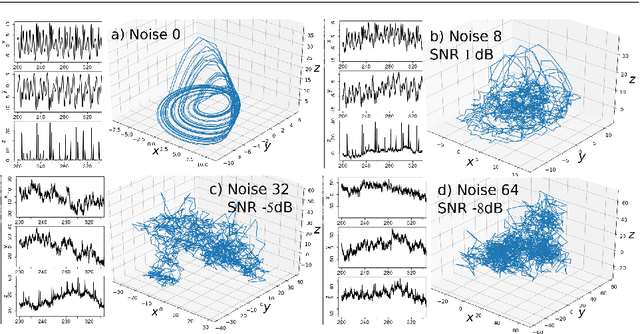
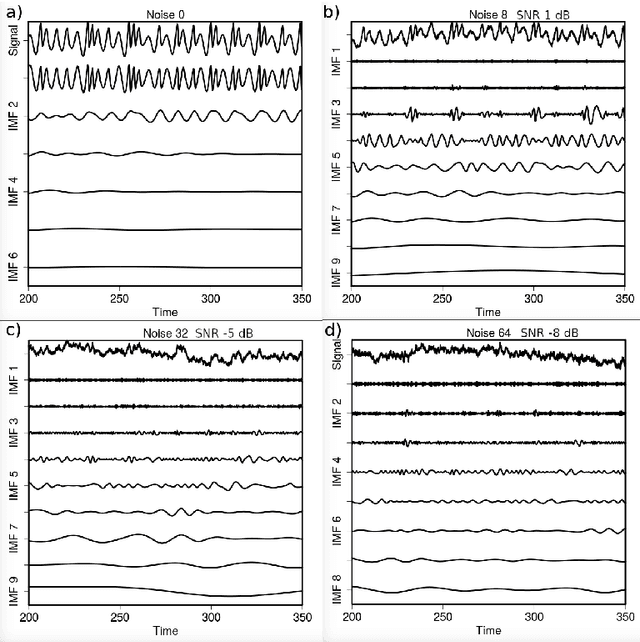
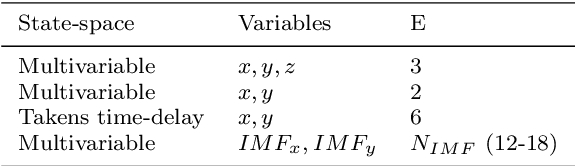
Data-driven, model-free analytics are natural choices for discovery and forecasting of complex, nonlinear systems. Methods that operate in the system state-space require either an explicit multidimensional state-space, or, one approximated from available observations. Since observational data are frequently sampled with noise, it is possible that noise can corrupt the state-space representation degrading analytical performance. Here, we evaluate the synthesis of empirical mode decomposition with empirical dynamic modeling, which we term empirical mode modeling, to increase the information content of state-space representations in the presence of noise. Evaluation of a mathematical, and, an ecologically important geophysical application across three different state-space representations suggests that empirical mode modeling may be a useful technique for data-driven, model-free, state-space analysis in the presence of noise.