 Add to Chrome
 Add to Firefox
 Add to Edge
Robust Multimodal Safety via Conditional Decoding
Mar 31, 2026
Multimodal large-language models (MLLMs) often experience degraded safety alignment when harmful queries exploit cross-modal interactions. Models aligned on text alone show a higher rate of successful attacks when extended to two or more modalities. In this work, we propose a simple conditional decoding strategy, CASA (Classification Augmented with Safety Attention) that utilizes internal representations of MLLMs to predict a binary safety token before response generation. We introduce a novel safety attention module designed to enhance the model's ability to detect malicious queries. Our design ensures robust safety alignment without relying on any external classifier or auxiliary head, and without the need for modality-specific safety fine-tuning. On diverse benchmarks such as MM-SafetyBench, JailbreakV-28k, and adversarial audio tests, CASA lowers the average attack success rate by more than 97% across modalities and across attack types. Our empirical evaluations also show that CASA maintains strong utility in benign inputs, a result validated through both automated and human evaluations (via 13 trained annotators). Together, these results highlight CASA as a simple and generalizable framework to improve multimodal LLM safety.

TN-Eval: Rubric and Evaluation Protocols for Measuring the Quality of Behavioral Therapy Notes
Mar 26, 2025

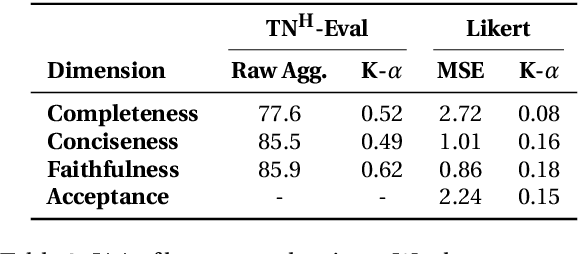

Behavioral therapy notes are important for both legal compliance and patient care. Unlike progress notes in physical health, quality standards for behavioral therapy notes remain underdeveloped. To address this gap, we collaborated with licensed therapists to design a comprehensive rubric for evaluating therapy notes across key dimensions: completeness, conciseness, and faithfulness. Further, we extend a public dataset of behavioral health conversations with therapist-written notes and LLM-generated notes, and apply our evaluation framework to measure their quality. We find that: (1) A rubric-based manual evaluation protocol offers more reliable and interpretable results than traditional Likert-scale annotations. (2) LLMs can mimic human evaluators in assessing completeness and conciseness but struggle with faithfulness. (3) Therapist-written notes often lack completeness and conciseness, while LLM-generated notes contain hallucination. Surprisingly, in a blind test, therapists prefer and judge LLM-generated notes to be superior to therapist-written notes.
TofuEval: Evaluating Hallucinations of LLMs on Topic-Focused Dialogue Summarization
Feb 20, 2024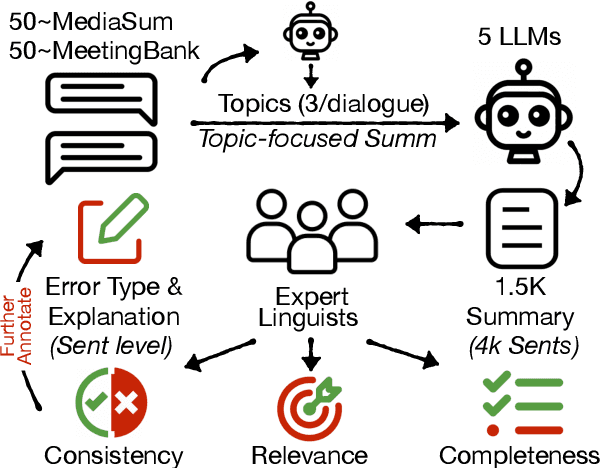

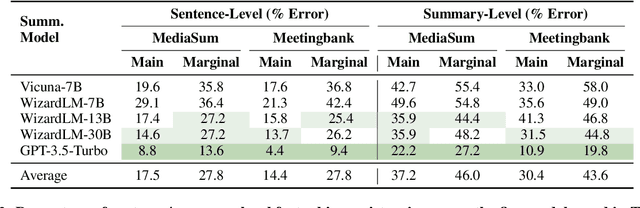

Single document news summarization has seen substantial progress on faithfulness in recent years, driven by research on the evaluation of factual consistency, or hallucinations. We ask whether these advances carry over to other text summarization domains. We propose a new evaluation benchmark on topic-focused dialogue summarization, generated by LLMs of varying sizes. We provide binary sentence-level human annotations of the factual consistency of these summaries along with detailed explanations of factually inconsistent sentences. Our analysis shows that existing LLMs hallucinate significant amounts of factual errors in the dialogue domain, regardless of the model's size. On the other hand, when LLMs, including GPT-4, serve as binary factual evaluators, they perform poorly and can be outperformed by prevailing state-of-the-art specialized factuality evaluation metrics. Finally, we conducted an analysis of hallucination types with a curated error taxonomy. We find that there are diverse errors and error distributions in model-generated summaries and that non-LLM based metrics can capture all error types better than LLM-based evaluators.