 Add to Chrome
 Add to Firefox
 Add to Edge
SubSplat: High-Resolution Pixel-aligned 3DGS via Sub-pixel Gaussian Reparameterization
Jul 23, 2026
Pixel-aligned Gaussian splatting enables efficient and generalizable novel-view synthesis. However, high-resolution rendering faces a critical trade-off where increasing input resolution improves detail at the expense of quadratically rising network computational cost. Conversely, maintaining low-resolution inputs stabilizes this cost but results in insufficient Gaussian density and artifacts. To address this, we propose SubSplat, which introduces Sub-pixel Gaussian Reparameterizer(SPGR) to subdivide primary Gaussians into fine-grained primitives, restoring structural density directly from low-resolution features. We further enhance the reparameterization quality through feature aggregation, which effectively captures high-frequency details across multiple views. Experiments on RealEstate10K and ACID demonstrate that SubSplat achieves high-fidelity rendering with superior efficiency. Our results validate that the proposed framework successfully resolves the trade-off between reparameterization fidelity and network computational cost inherent in pixel-aligned Gaussian Splatting.

The Tenth NTIRE 2025 Efficient Super-Resolution Challenge Report
Apr 14, 2025This paper presents a comprehensive review of the NTIRE 2025 Challenge on Single-Image Efficient Super-Resolution (ESR). The challenge aimed to advance the development of deep models that optimize key computational metrics, i.e., runtime, parameters, and FLOPs, while achieving a PSNR of at least 26.90 dB on the $\operatorname{DIV2K\_LSDIR\_valid}$ dataset and 26.99 dB on the $\operatorname{DIV2K\_LSDIR\_test}$ dataset. A robust participation saw \textbf{244} registered entrants, with \textbf{43} teams submitting valid entries. This report meticulously analyzes these methods and results, emphasizing groundbreaking advancements in state-of-the-art single-image ESR techniques. The analysis highlights innovative approaches and establishes benchmarks for future research in the field.
EPSR: Edge Profile Super resolution
Nov 09, 2020
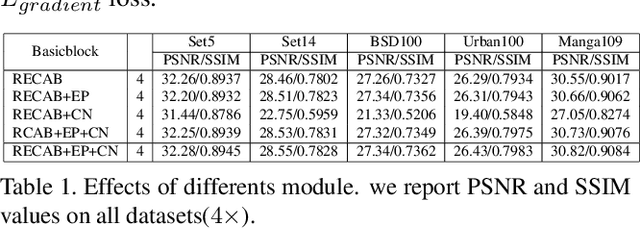
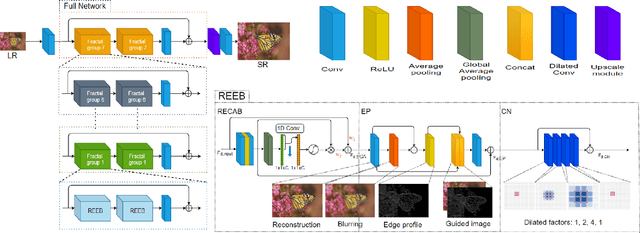
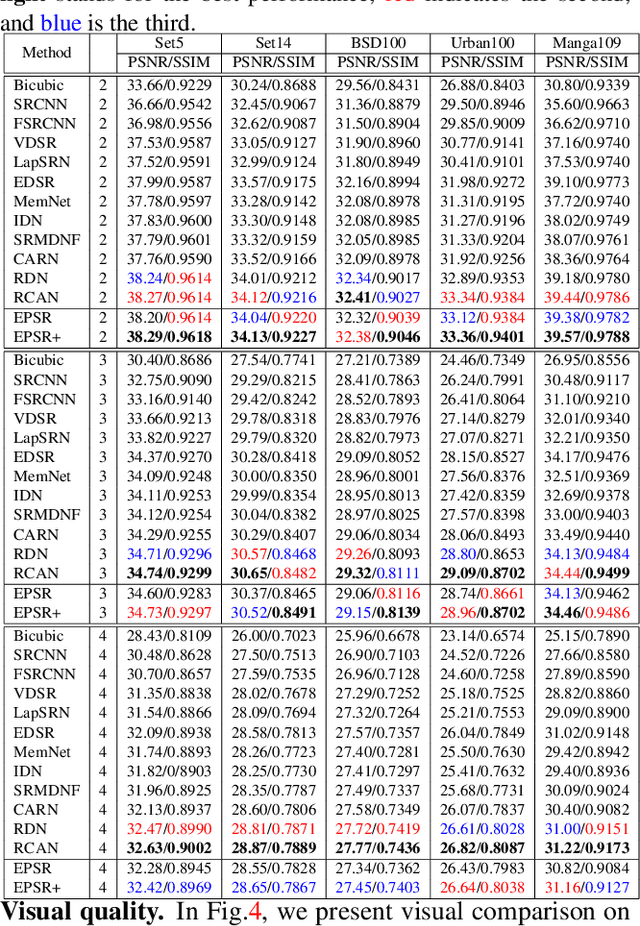
Recently numerous deep convolutional neural networks(CNNs) have been explored in single image super-resolution(SISR) and they achieved significant performance. However, most deep CNN-based SR mainly focuses on designing wider or deeper architecture and it is hard to find methods that utilize image properties in SISR. In this paper, by developing an edge-profile approach based on end-to-end CNN model to SISR problem, we propose an edge profile super resolution(EPSR). Specifically, we construct a residual edge enhance block(REEB), which consists of residual efficient channel attention block(RECAB), edge profile(EP) module, and context network(CN) module. RE-CAB extracts adaptively rescale channel-wise features by considering interdependencies among channels efficiently.From the features, EP module generates edge-guided features by extracting edge profile itself, and then CN module enhances details by exploiting contextual information of the features. To utilize various information from low to high frequency components, we design a fractal skip connection(FSC) structure. Since self-similarity of the architecture, FSC structure allows our EPSR to bypass abundant information into each REEB block. Experimental results present that our EPSR achieves competitive performance against state-of-the-art methods.