 Add to Chrome
 Add to Firefox
 Add to Edge
Null-LoRA: Low-Rank Adaptation on Null Space
Dec 18, 2025
Parameter-efficient fine-tuning methods have gained considerable popularity for adapting large-scale models to downstream tasks, particularly LoRA and its variants. Existing methods perform low-rank adaptation over the full parameter space. However, fine-tuning within a subspace can achieve comparable effectiveness. Inspired by the observation that pre-trained models possess non-trivial null spaces, we propose Null-space based Low-Rank Adaptation (Null-LoRA). Null-LoRA effectively reduces redundancy and enhances effective rank by freezing portions of the low-rank matrices. To further improve parameter efficiency, Null-LoRA constrains the entire incremental update within the null space, maximizing the utilization of incremental updates to adapt to new task paradigms. Null-LoRA surpasses the state of the art with fewer parameters in extensive experiments across image-text retrieval and visual question answering tasks.

TubeRMC: Tube-conditioned Reconstruction with Mutual Constraints for Weakly-supervised Spatio-Temporal Video Grounding
Nov 13, 2025Spatio-Temporal Video Grounding (STVG) aims to localize a spatio-temporal tube that corresponds to a given language query in an untrimmed video. This is a challenging task since it involves complex vision-language understanding and spatiotemporal reasoning. Recent works have explored weakly-supervised setting in STVG to eliminate reliance on fine-grained annotations like bounding boxes or temporal stamps. However, they typically follow a simple late-fusion manner, which generates tubes independent of the text description, often resulting in failed target identification and inconsistent target tracking. To address this limitation, we propose a Tube-conditioned Reconstruction with Mutual Constraints (\textbf{TubeRMC}) framework that generates text-conditioned candidate tubes with pre-trained visual grounding models and further refine them via tube-conditioned reconstruction with spatio-temporal constraints. Specifically, we design three reconstruction strategies from temporal, spatial, and spatio-temporal perspectives to comprehensively capture rich tube-text correspondences. Each strategy is equipped with a Tube-conditioned Reconstructor, utilizing spatio-temporal tubes as condition to reconstruct the key clues in the query. We further introduce mutual constraints between spatial and temporal proposals to enhance their quality for reconstruction. TubeRMC outperforms existing methods on two public benchmarks VidSTG and HCSTVG. Further visualization shows that TubeRMC effectively mitigates both target identification errors and inconsistent tracking.
SAUGE: Taming SAM for Uncertainty-Aligned Multi-Granularity Edge Detection
Dec 17, 2024Edge labels are typically at various granularity levels owing to the varying preferences of annotators, thus handling the subjectivity of per-pixel labels has been a focal point for edge detection. Previous methods often employ a simple voting strategy to diminish such label uncertainty or impose a strong assumption of labels with a pre-defined distribution, e.g., Gaussian. In this work, we unveil that the segment anything model (SAM) provides strong prior knowledge to model the uncertainty in edge labels. Our key insight is that the intermediate SAM features inherently correspond to object edges at various granularities, which reflects different edge options due to uncertainty. Therefore, we attempt to align uncertainty with granularity by regressing intermediate SAM features from different layers to object edges at multi-granularity levels. In doing so, the model can fully and explicitly explore diverse ``uncertainties'' in a data-driven fashion. Specifically, we inject a lightweight module (~ 1.5% additional parameters) into the frozen SAM to progressively fuse and adapt its intermediate features to estimate edges from coarse to fine. It is crucial to normalize the granularity level of human edge labels to match their innate uncertainty. For this, we simply perform linear blending to the real edge labels at hand to create pseudo labels with varying granularities. Consequently, our uncertainty-aligned edge detector can flexibly produce edges at any desired granularity (including an optimal one). Thanks to SAM, our model uniquely demonstrates strong generalizability for cross-dataset edge detection. Extensive experimental results on BSDS500, Muticue and NYUDv2 validate our model's superiority.
Accelerating Split Federated Learning over Wireless Communication Networks
Oct 24, 2023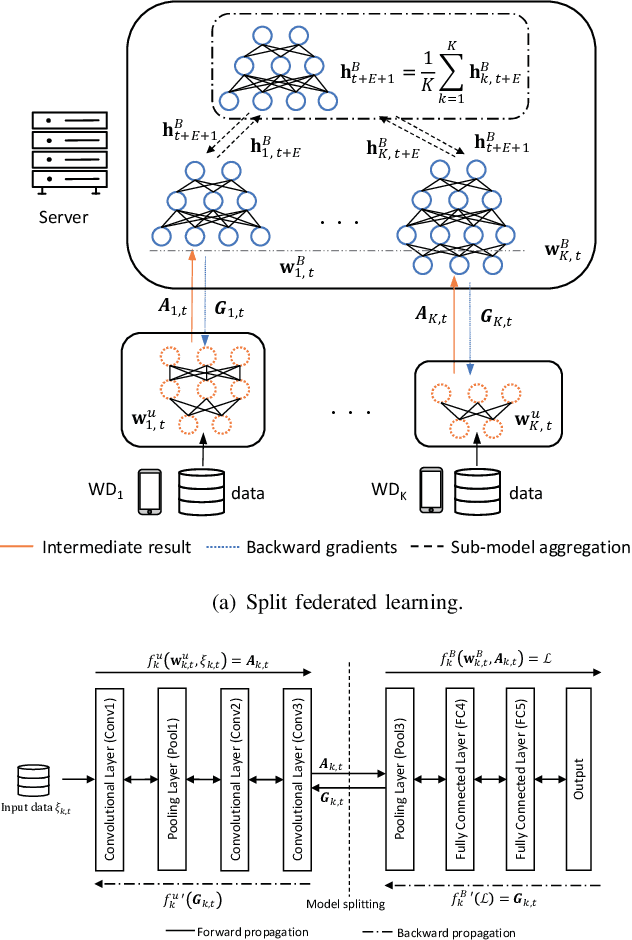

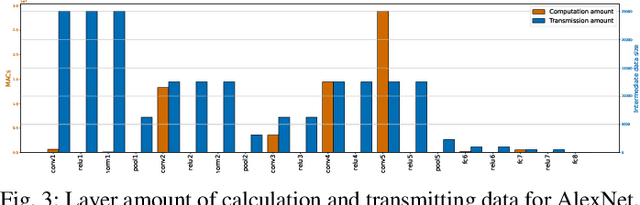
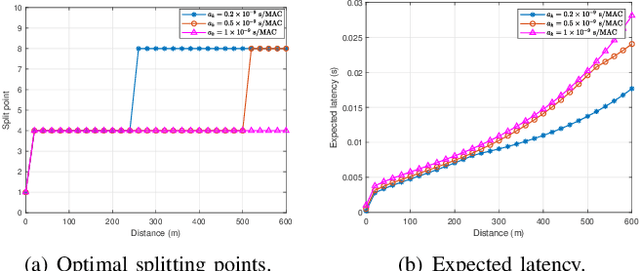
The development of artificial intelligence (AI) provides opportunities for the promotion of deep neural network (DNN)-based applications. However, the large amount of parameters and computational complexity of DNN makes it difficult to deploy it on edge devices which are resource-constrained. An efficient method to address this challenge is model partition/splitting, in which DNN is divided into two parts which are deployed on device and server respectively for co-training or co-inference. In this paper, we consider a split federated learning (SFL) framework that combines the parallel model training mechanism of federated learning (FL) and the model splitting structure of split learning (SL). We consider a practical scenario of heterogeneous devices with individual split points of DNN. We formulate a joint problem of split point selection and bandwidth allocation to minimize the system latency. By using alternating optimization, we decompose the problem into two sub-problems and solve them optimally. Experiment results demonstrate the superiority of our work in latency reduction and accuracy improvement.