 Add to Chrome
 Add to Firefox
 Add to Edge
GigaBrain-0.7: Scaling Embodied Foundation Models to Emergent Capabilities with a Three-System Architecture
Aug 16, 2026
Vision-language-action (VLA) models have become a dominant paradigm for generalist embodied agents, demonstrating strong complex and long-horizon task completion in structured settings. Yet it remains an open question whether current VLA systems can benefit from more effective architectural design, scale to substantially larger and more heterogeneous data regimes, and achieve broader generalization across tasks and embodiments. To this end, we present GigaBrain-0.7, an embodied foundation model with substantially improved generalization across diverse robot embodiments. Specifically, GigaBrain-0.7 unifies understanding, prediction, and action through a three-system architecture, scales pretraining to over 37,000 hours of heterogeneous embodied data, and introduces one-stage alignment training that jointly optimizes vision-language understanding and multi-embodiment action generation. Compared with the preceding GigaBrain-0 series and prior state-of-the-art models including $π_{0.5}$, GigaBrain-0.7 achieves substantial improvements in foundation zero-shot capabilities, language-conditioned instruction following, and post-training task success rates. In particular, on our in-house Maker H01 platform and mainstream robot embodiments, GigaBrain-0.7 demonstrates strong task adaptability and completion ability across both home and industrial scenarios. All training code and pretrained model weights will be released.

Route-Constrained Robust Fusion Estimation for MEMS/GNSS Integrated Navigation of Unmanned Ground Vehicles in GNSS Degraded Environments
Jun 18, 2026To address cumulative localization drift of unmanned ground vehicles in structured road environments under severe Global Navigation Satellite System signal occlusion, this paper proposes a robust route-constrained state estimation method. During periods without satellite signals, the proposed method establishes the correspondence between the historical dead reckoning trajectory and local segments of the mission route extracted from a high-definition map, and estimates a route-referenced position via a two-dimensional rigid transformation. The estimated position is then formulated as a pseudo-position observation and incorporated into an Extended Kalman Filter update. In this way, route constraints at the road level can be continuously injected into a unified state estimation framework, thereby suppressing position deviation relative to the mission route while indirectly improving azimuth estimation. To enhance practical applicability, engineering strategies, such as trigger control, matching quality validation, route offset compensation, and single update correction limiting, are further introduced. Experiments in three representative scenarios, including a long tunnel, a multi-segment tunnel, and a curved tunnel, show that the proposed method effectively suppresses error accumulation during satellite outages, reduces the risk of large maximum deviation, and improves localization continuity and road-level usability.
* Accepted workshop paper, 1st Workshop on Robot Meets GNSS and Ranging for Seamless Autonomy, IEEE ICRA 2026
Rotation and Permutation for Advanced Outlier Management and Efficient Quantization of LLMs
Jun 03, 2024

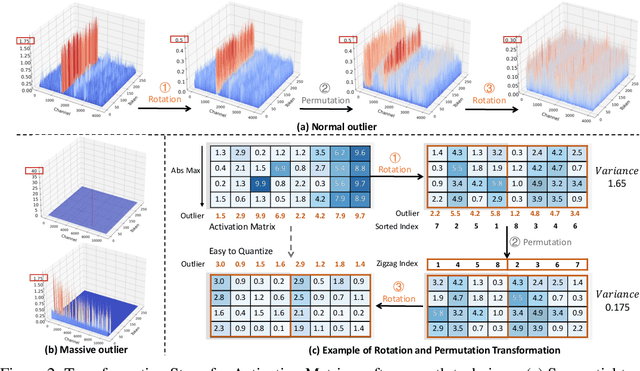

Quantizing large language models (LLMs) presents significant challenges, primarily due to outlier activations that compromise the efficiency of low-bit representation. Traditional approaches mainly focus on solving Normal Outliers-activations with consistently high magnitudes across all tokens. However, these techniques falter when dealing with Massive Outliers, which are significantly higher in value and often cause substantial performance losses during low-bit quantization. In this study, we propose DuQuant, an innovative quantization strategy employing rotation and permutation transformations to more effectively eliminate both types of outliers. Initially, DuQuant constructs rotation matrices informed by specific outlier dimensions, redistributing these outliers across adjacent channels within different rotation blocks. Subsequently, a zigzag permutation is applied to ensure a balanced distribution of outliers among blocks, minimizing block-wise variance. An additional rotation further enhances the smoothness of the activation landscape, thereby improving model performance. DuQuant streamlines the quantization process and demonstrates superior outlier management, achieving top-tier results in multiple tasks with various LLM architectures even under 4-bit weight-activation quantization. Our code is available at https://github.com/Hsu1023/DuQuant.