 Add to Chrome
 Add to Firefox
 Add to Edge
STRUCTUREDAGENT: Planning with AND/OR Trees for Long-Horizon Web Tasks
Mar 05, 2026
Recent advances in large language models (LLMs) have enabled agentic systems for sequential decision-making. Such agents must perceive their environment, reason across multiple time steps, and take actions that optimize long-term objectives. However, existing web agents struggle on complex, long-horizon tasks due to limited in-context memory for tracking history, weak planning abilities, and greedy behaviors that lead to premature termination. To address these challenges, we propose STRUCTUREDAGENT, a hierarchical planning framework with two core components: (1) an online hierarchical planner that uses dynamic AND/OR trees for efficient search and (2) a structured memory module that tracks and maintains candidate solutions to improve constraint satisfaction in information-seeking tasks. The framework also produces interpretable hierarchical plans, enabling easier debugging and facilitating human intervention when needed. Our results on WebVoyager, WebArena, and custom shopping benchmarks show that STRUCTUREDAGENT improves performance on long-horizon web-browsing tasks compared to standard LLM-based agents.

Pix2Key: Controllable Open-Vocabulary Retrieval with Semantic Decomposition and Self-Supervised Visual Dictionary Learning
Feb 26, 2026Composed Image Retrieval (CIR) uses a reference image plus a natural-language edit to retrieve images that apply the requested change while preserving other relevant visual content. Classic fusion pipelines typically rely on supervised triplets and can lose fine-grained cues, while recent zero-shot approaches often caption the reference image and merge the caption with the edit, which may miss implicit user intent and return repetitive results. We present Pix2Key, which represents both queries and candidates as open-vocabulary visual dictionaries, enabling intent-aware constraint matching and diversity-aware reranking in a unified embedding space. A self-supervised pretraining component, V-Dict-AE, further improves the dictionary representation using only images, strengthening fine-grained attribute understanding without CIR-specific supervision. On the DFMM-Compose benchmark, Pix2Key improves Recall@10 up to 3.2 points, and adding V-Dict-AE yields an additional 2.3-point gain while improving intent consistency and maintaining high list diversity.
High Fidelity 3D Hand Shape Reconstruction via Scalable Graph Frequency Decomposition
Jul 08, 2023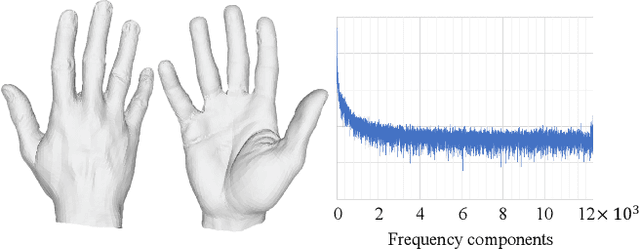
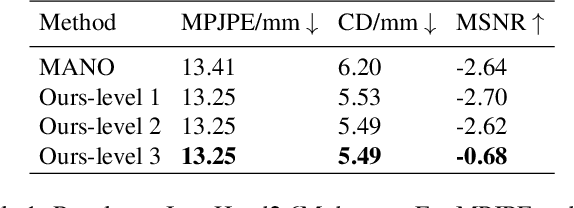
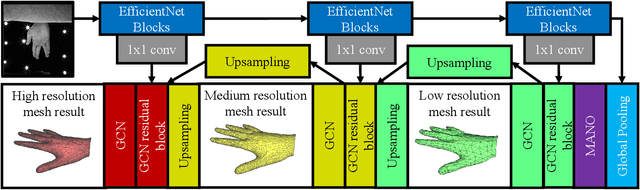
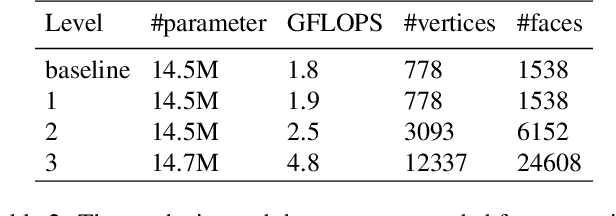
Despite the impressive performance obtained by recent single-image hand modeling techniques, they lack the capability to capture sufficient details of the 3D hand mesh. This deficiency greatly limits their applications when high-fidelity hand modeling is required, e.g., personalized hand modeling. To address this problem, we design a frequency split network to generate 3D hand mesh using different frequency bands in a coarse-to-fine manner. To capture high-frequency personalized details, we transform the 3D mesh into the frequency domain, and propose a novel frequency decomposition loss to supervise each frequency component. By leveraging such a coarse-to-fine scheme, hand details that correspond to the higher frequency domain can be preserved. In addition, the proposed network is scalable, and can stop the inference at any resolution level to accommodate different hardware with varying computational powers. To quantitatively evaluate the performance of our method in terms of recovering personalized shape details, we introduce a new evaluation metric named Mean Signal-to-Noise Ratio (MSNR) to measure the signal-to-noise ratio of each mesh frequency component. Extensive experiments demonstrate that our approach generates fine-grained details for high-fidelity 3D hand reconstruction, and our evaluation metric is more effective for measuring mesh details compared with traditional metrics.
* CVPR 2023