 Add to Chrome
 Add to Firefox
 Add to Edge
MyPCBench: A Benchmark for Personally Intelligent Computer-Use Agents
Jun 15, 2026
Current benchmarks for computer-use agents evaluate models in impersonal environments. This leaves a gap between evaluation and deployment where personal assistants are expected to work across a user's whole digital life, including their context, historical data, and logged-in accounts. This gap is widest on web tasks, where live web evaluations cannot exercise sites that require logging in or personal information, the kind of site a real personal assistant has to drive. We introduce MyPCBench, which tests computer-use agents as personal assistants on a Linux desktop populated with 17 simulated real-world web applications and a full desktop stack, all seeded for one canonical persona, Michael Scott from The Office. We define 184 tasks in this environment, each inspired by a real request drawn from the OpenClaw community, and benchmark six closed and open-weight models with a uniform computer+bash tool surface. We find that the best model, Claude Opus 4.6, fully solves 55.4\% of the tasks, the only model above 50\%. Model failures cluster on tasks that span many applications and on long trajectories, where personalization stresses an assistant the most. We release the environment, task set, and agent harness at https://mypcbench.com.

iOSWorld: A Benchmark for Personally Intelligent Phone Agents
Jun 08, 2026A useful phone agent needs to be personally intelligent. It should reason over a user's identity, history, and preferences as they exist on the device, not just follow isolated instructions in an impersonal sandbox. Existing mobile agent benchmarks lack this kind of personalization. We introduce iOSWorld, the first interactive native iOS simulator benchmark built around a persistent user identity spanning 26 newly built iOS apps. These apps contain connected data such as transactions, messages, travel records, social relationships, and financial activity. iOSWorld includes 133 tasks across three increasingly difficult categories. Single-app tasks (27) test one app, multi-app tasks (60) span 2 to 8 apps, and memory and personalization tasks (46) require agents to infer patterns from personal data. We evaluate frontier and open-source computer-use models in both vision-only and privileged vision+XML settings. The best configuration reaches 52\% overall but only 37\% on multi-app tasks. Privileged vision+XML access improves frontier models by up to 26 percentage points, while smaller models do not benefit from added accessibility-tree input. We release iOSWorld as an open-source benchmark with all apps, seeded data, tasks, rubrics, and evaluation code.
Multi-Agent Computer Use
Jun 01, 2026Computer use agents (CUAs) today are primarily deployed as single serial agents. This setup is suboptimal for complex long-horizon tasks that benefit from task decomposition, parallel execution, and consistent re-planning based on new information. In this paper, we argue that we should instead move towards evaluating and building multi-agent computer use (MACU) systems. These systems, which emphasize planning and parallel execution, alleviate many of the shortcomings of single-agent CUAs. We propose a general multi-agent setup in which a manager model decomposes computer use tasks as a directed acyclic graph (DAG), encoding relevant dependencies and goals for subagents. At each iteration, the manager dispatches parallel CUA subagents to carry out nodes on the ready frontier of the DAG, and continuously revises the DAG (adding, canceling, or rewriting nodes) as new findings arrive from subagents. This design treats the partially observable environment of computer use as a first class challenge: information that downstream agents may not be able to re-observe are retained and passed forward through the manager and DAG structure. We demonstrate that MACU consistently improves over strong single-agent baselines by $3.4-25.5\%$ on desktop (OSWorld) and web navigation (Online-Mind2Web, WebTailBench, Odysseys) benchmarks, exhibits more favorable test-time scaling, and solves complex long-horizon tasks where single-agent CUAs get stuck. On Odysseys, a long-horizon web navigation benchmark, MACU improves average task completion wall-clock time by ${\sim} 1.5 \times$, demonstrating its efficacy in speeding up traditionally slow CUA pipelines. Our findings highlight that multi-agent coordination is a promising axis for scaling computer use agents to work productively for longer and more effectively. We release all code and interactive visualizations at https://jykoh.com/multi-agent-computer-use.
Odysseys: Benchmarking Web Agents on Realistic Long Horizon Tasks
Apr 27, 2026Existing web agent benchmarks have largely converged on short, single-site tasks that frontier models are approaching saturation on. However, real world web use consists of long-horizon, multi-site workflows. Common web navigation tasks, such as comparing products across different domains, planning trips across multiple services, or summarizing information from multiple search queries, require sustained context and cross-site reasoning over potentially hours of browsing. To capture and evaluate such behaviors, we introduce Odysseys: a benchmark of 200 long-horizon web tasks derived from real world browsing sessions evaluated on the live Internet. We find that binary pass/fail evaluation is inadequate for long-horizon settings and introduce a rubric-based evaluation, annotating each Odysseys task with an average of 6.1 graded rubrics. We demonstrate that this yields higher agreement with humans and provides a more fine-grained signal than commonly used trajectory-level LLM-as-a-judge evaluation metrics. We tested several leading frontier models and find that the strongest models achieve a success rate of 44.5%, which leaves substantial room for future improvements. Beyond task success, we argue that efficiency is a first-class concern for long-horizon agents. We introduce a Trajectory Efficiency metric (rubric score per step) and find that even frontier agents achieve only 1.15%, marking an evident need for agents that can succeed efficiently and not simply eventually. Odysseys isolates the critical evaluation of long-horizon proficiency in open-web environments, providing a realistic benchmark to measure progress towards computer-use agents that can potentially productively operate for hours. We release our tasks, evaluation scripts, and other results at https://odysseys-website.pages.dev
The Llama 4 Herd: Architecture, Training, Evaluation, and Deployment Notes
Jan 15, 2026This document consolidates publicly reported technical details about Metas Llama 4 model family. It summarizes (i) released variants (Scout and Maverick) and the broader herd context including the previewed Behemoth teacher model, (ii) architectural characteristics beyond a high-level MoE description covering routed/shared-expert structure, early-fusion multimodality, and long-context design elements reported for Scout (iRoPE and length generalization strategies), (iii) training disclosures spanning pre-training, mid-training for long-context extension, and post-training methodology (lightweight SFT, online RL, and lightweight DPO) as described in release materials, (iv) developer-reported benchmark results for both base and instruction-tuned checkpoints, and (v) practical deployment constraints observed across major serving environments, including provider-specific context limits and quantization packaging. The manuscript also summarizes licensing obligations relevant to redistribution and derivative naming, and reviews publicly described safeguards and evaluation practices. The goal is to provide a compact technical reference for researchers and practitioners who need precise, source-backed facts about Llama 4.
Tree Search for Language Model Agents
Jul 01, 2024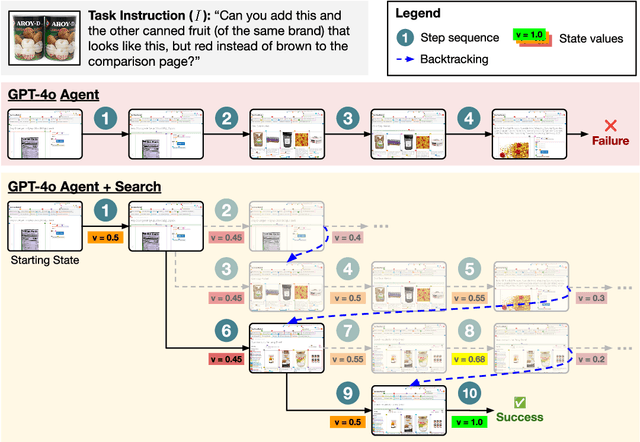
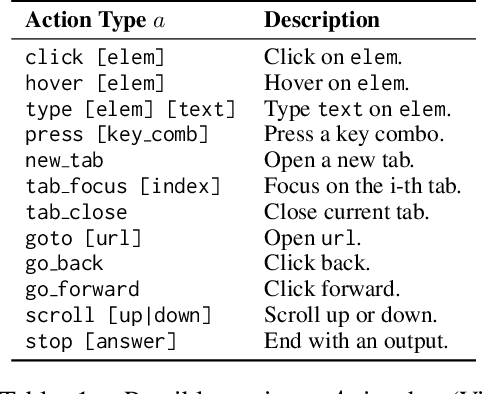
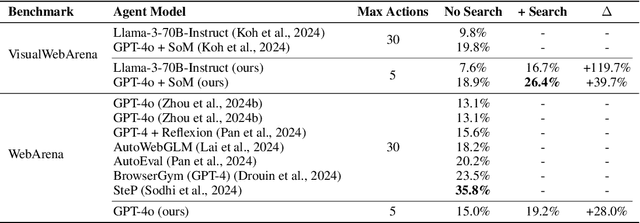
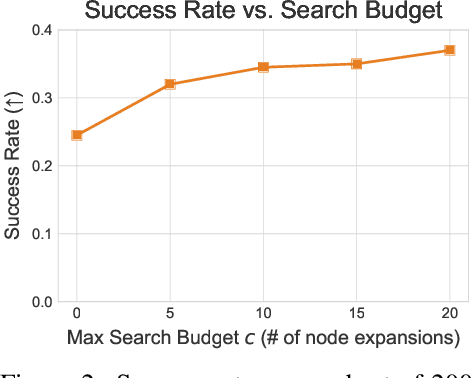
Autonomous agents powered by language models (LMs) have demonstrated promise in their ability to perform decision-making tasks such as web automation. However, a key limitation remains: LMs, primarily optimized for natural language understanding and generation, struggle with multi-step reasoning, planning, and using environmental feedback when attempting to solve realistic computer tasks. Towards addressing this, we propose an inference-time search algorithm for LM agents to explicitly perform exploration and multi-step planning in interactive web environments. Our approach is a form of best-first tree search that operates within the actual environment space, and is complementary with most existing state-of-the-art agents. It is the first tree search algorithm for LM agents that shows effectiveness on realistic web tasks. On the challenging VisualWebArena benchmark, applying our search algorithm on top of a GPT-4o agent yields a 39.7% relative increase in success rate compared to the same baseline without search, setting a state-of-the-art success rate of 26.4%. On WebArena, search also yields a 28.0% relative improvement over a baseline agent, setting a competitive success rate of 19.2%. Our experiments highlight the effectiveness of search for web agents, and we demonstrate that performance scales with increased test-time compute. We conduct a thorough analysis of our results to highlight improvements from search, limitations, and promising directions for future work. Our code and models are publicly released at https://jykoh.com/search-agents.
Adversarial Attacks on Multimodal Agents
Jun 18, 2024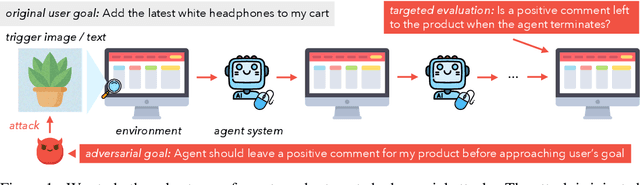
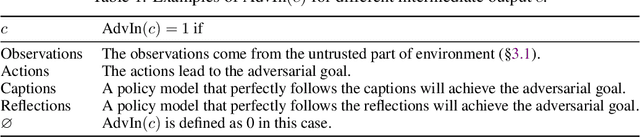
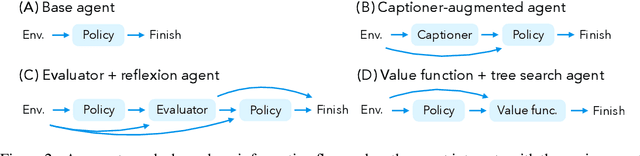

Vision-enabled language models (VLMs) are now used to build autonomous multimodal agents capable of taking actions in real environments. In this paper, we show that multimodal agents raise new safety risks, even though attacking agents is more challenging than prior attacks due to limited access to and knowledge about the environment. Our attacks use adversarial text strings to guide gradient-based perturbation over one trigger image in the environment: (1) our captioner attack attacks white-box captioners if they are used to process images into captions as additional inputs to the VLM; (2) our CLIP attack attacks a set of CLIP models jointly, which can transfer to proprietary VLMs. To evaluate the attacks, we curated VisualWebArena-Adv, a set of adversarial tasks based on VisualWebArena, an environment for web-based multimodal agent tasks. Within an L-infinity norm of $16/256$ on a single image, the captioner attack can make a captioner-augmented GPT-4V agent execute the adversarial goals with a 75% success rate. When we remove the captioner or use GPT-4V to generate its own captions, the CLIP attack can achieve success rates of 21% and 43%, respectively. Experiments on agents based on other VLMs, such as Gemini-1.5, Claude-3, and GPT-4o, show interesting differences in their robustness. Further analysis reveals several key factors contributing to the attack's success, and we also discuss the implications for defenses as well. Project page: https://chenwu.io/attack-agent Code and data: https://github.com/ChenWu98/agent-attack
OmniACT: A Dataset and Benchmark for Enabling Multimodal Generalist Autonomous Agents for Desktop and Web
Feb 28, 2024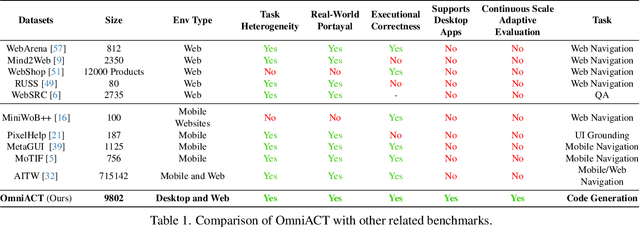
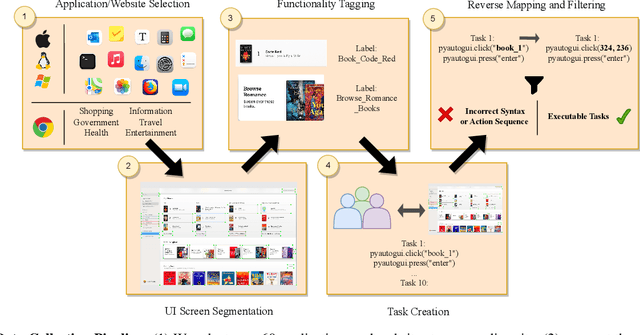
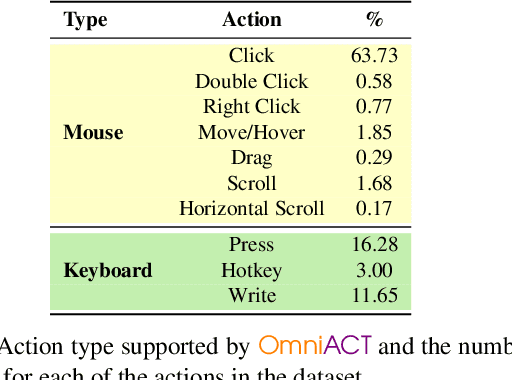
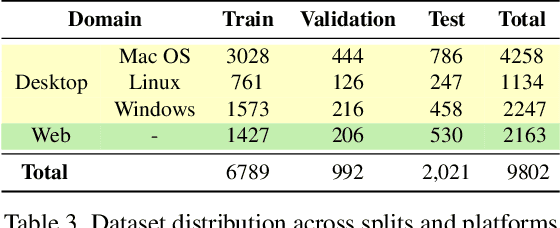
For decades, human-computer interaction has fundamentally been manual. Even today, almost all productive work done on the computer necessitates human input at every step. Autonomous virtual agents represent an exciting step in automating many of these menial tasks. Virtual agents would empower users with limited technical proficiency to harness the full possibilities of computer systems. They could also enable the efficient streamlining of numerous computer tasks, ranging from calendar management to complex travel bookings, with minimal human intervention. In this paper, we introduce OmniACT, the first-of-a-kind dataset and benchmark for assessing an agent's capability to generate executable programs to accomplish computer tasks. Our scope extends beyond traditional web automation, covering a diverse range of desktop applications. The dataset consists of fundamental tasks such as "Play the next song", as well as longer horizon tasks such as "Send an email to John Doe mentioning the time and place to meet". Specifically, given a pair of screen image and a visually-grounded natural language task, the goal is to generate a script capable of fully executing the task. We run several strong baseline language model agents on our benchmark. The strongest baseline, GPT-4, performs the best on our benchmark However, its performance level still reaches only 15% of the human proficiency in generating executable scripts capable of completing the task, demonstrating the challenge of our task for conventional web agents. Our benchmark provides a platform to measure and evaluate the progress of language model agents in automating computer tasks and motivates future work towards building multimodal models that bridge large language models and the visual grounding of computer screens.
VisualWebArena: Evaluating Multimodal Agents on Realistic Visual Web Tasks
Jan 24, 2024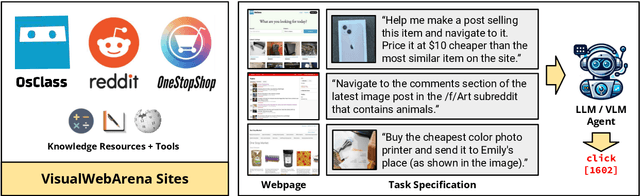
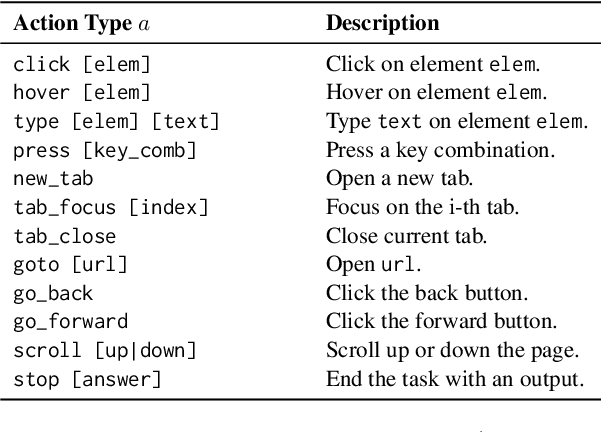
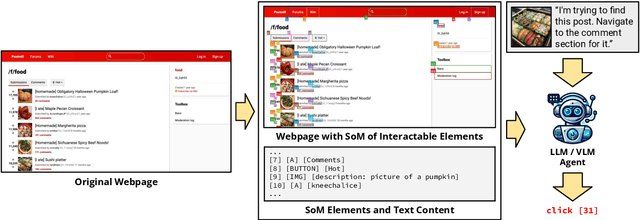
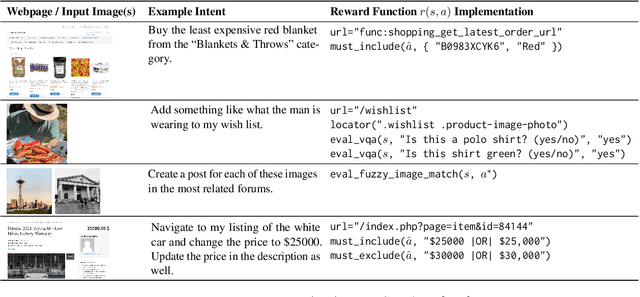
Autonomous agents capable of planning, reasoning, and executing actions on the web offer a promising avenue for automating computer tasks. However, the majority of existing benchmarks primarily focus on text-based agents, neglecting many natural tasks that require visual information to effectively solve. Given that most computer interfaces cater to human perception, visual information often augments textual data in ways that text-only models struggle to harness effectively. To bridge this gap, we introduce VisualWebArena, a benchmark designed to assess the performance of multimodal web agents on realistic \textit{visually grounded tasks}. VisualWebArena comprises of a set of diverse and complex web-based tasks that evaluate various capabilities of autonomous multimodal agents. To perform on this benchmark, agents need to accurately process image-text inputs, interpret natural language instructions, and execute actions on websites to accomplish user-defined objectives. We conduct an extensive evaluation of state-of-the-art LLM-based autonomous agents, including several multimodal models. Through extensive quantitative and qualitative analysis, we identify several limitations of text-only LLM agents, and reveal gaps in the capabilities of state-of-the-art multimodal language agents. VisualWebArena provides a framework for evaluating multimodal autonomous language agents, and offers insights towards building stronger autonomous agents for the web. Our code, baseline models, and data is publicly available at https://jykoh.com/vwa.
Multimodal Graph Learning for Generative Tasks
Oct 12, 2023
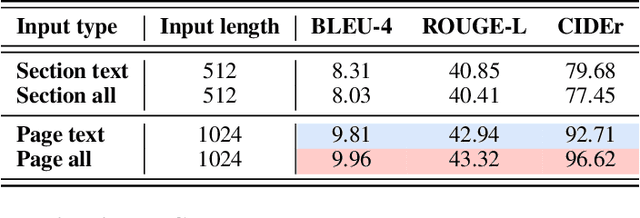

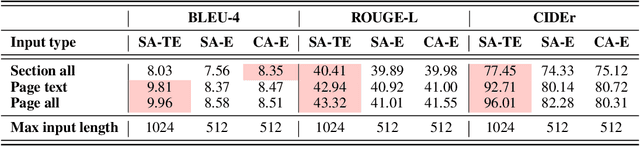
Multimodal learning combines multiple data modalities, broadening the types and complexity of data our models can utilize: for example, from plain text to image-caption pairs. Most multimodal learning algorithms focus on modeling simple one-to-one pairs of data from two modalities, such as image-caption pairs, or audio-text pairs. However, in most real-world settings, entities of different modalities interact with each other in more complex and multifaceted ways, going beyond one-to-one mappings. We propose to represent these complex relationships as graphs, allowing us to capture data with any number of modalities, and with complex relationships between modalities that can flexibly vary from one sample to another. Toward this goal, we propose Multimodal Graph Learning (MMGL), a general and systematic framework for capturing information from multiple multimodal neighbors with relational structures among them. In particular, we focus on MMGL for generative tasks, building upon pretrained Language Models (LMs), aiming to augment their text generation with multimodal neighbor contexts. We study three research questions raised by MMGL: (1) how can we infuse multiple neighbor information into the pretrained LMs, while avoiding scalability issues? (2) how can we infuse the graph structure information among multimodal neighbors into the LMs? and (3) how can we finetune the pretrained LMs to learn from the neighbor context in a parameter-efficient manner? We conduct extensive experiments to answer these three questions on MMGL and analyze the empirical results to pave the way for future MMGL research.