 Add to Chrome
 Add to Firefox
 Add to Edge
Generalizable CT-Free PET Attenuation and Scatter Correction for Pediatric Patients
Apr 24, 2026
Computed tomography (CT)-based attenuation and scatter correction improves quantitative PET but adds radiation exposure that is particularly undesirable in pediatric imaging. Existing CT-free methods are commonly trained in homogeneous settings and often degrade under scanner or radiotracer shifts, which limits their clinical utility. We propose the Generalizable PET Correction Network (GPCN), a dual-domain network for domain-robust CT-free PET attenuation and scatter correction. GPCN combines a multi-band contextual refinement module, which models pediatric anatomical variability through wavelet-based multiscale decomposition and long-range spatial context modeling, with a frequency-aware spectral decoupling module, which performs coordinate-conditioned amplitude/phase refinement in the Fourier domain. By synergizing multi-band spatial contextual modeling with asymmetric frequency-spectrum decoupling, the network explicitly separates invariant topological structures from domain-specific noise, thereby achieving precise quantitative recovery of both anatomical organs and focal lesions. This design aims to separate anatomy-dominant structures from domain-sensitive spectral residuals and to improve robustness across heterogeneous imaging conditions. We train and evaluate the method on 1085 pediatric whole-body PET scans acquired with two scanners and five radiotracers. In both joint training and zero-shot cross-domain evaluation, GPCN outperforms representative baselines and maintains stable quantitative accuracy on unseen scanner-tracer combinations. The method is further supported by ablation, region-wise quantitative analysis, and downstream segmentation experiments. In our cohort, the CT component of the conventional protocol corresponded to an average effective dose of 10.8 mSv, indicating the potential clinical value of reliable CT-free correction for pediatric PET.

Physics-Constrained Diffusion Reconstruction with Posterior Correction for Quantitative and Fast PET Imaging
Aug 20, 2025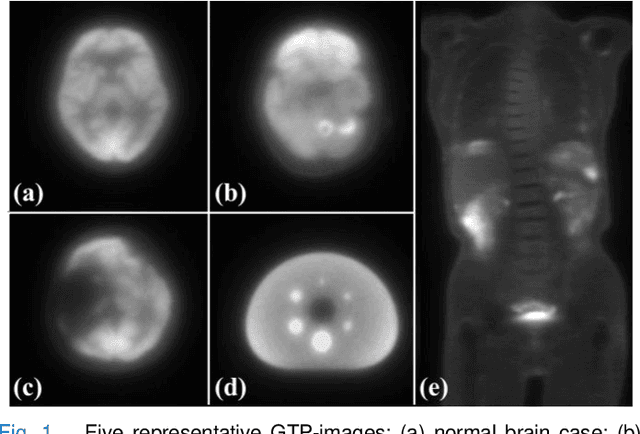
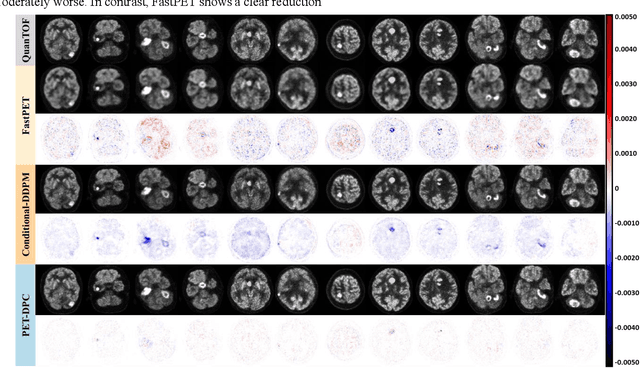
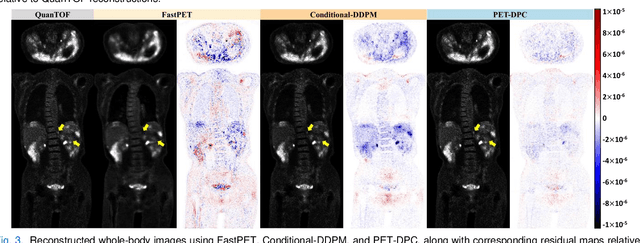
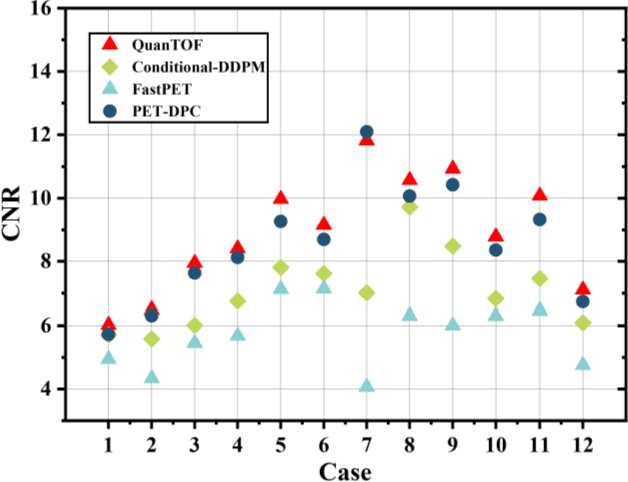
Deep learning-based reconstruction of positron emission tomography(PET) data has gained increasing attention in recent years. While these methods achieve fast reconstruction,concerns remain regarding quantitative accuracy and the presence of artifacts,stemming from limited model interpretability,data driven dependence, and overfitting risks.These challenges have hindered clinical adoption.To address them,we propose a conditional diffusion model with posterior physical correction (PET-DPC) for PET image reconstruction. An innovative normalization procedure generates the input Geometric TOF Probabilistic Image (GTP-image),while physical information is incorporated during the diffusion sampling process to perform posterior scatter,attenuation,and random corrections. The model was trained and validated on 300 brain and 50 whole-body PET datasets,a physical phantom,and 20 simulated brain datasets. PET-DPC produced reconstructions closely aligned with fully corrected OSEM images,outperforming end-to-end deep learning models in quantitative metrics and,in some cases, surpassing traditional iterative methods. The model also generalized well to out-of-distribution(OOD) data. Compared to iterative methods,PET-DPC reduced reconstruction time by 50% for brain scans and 85% for whole-body scans. Ablation studies confirmed the critical role of posterior correction in implementing scatter and attenuation corrections,enhancing reconstruction accuracy. Experiments with physical phantoms further demonstrated PET-DPC's ability to preserve background uniformity and accurately reproduce tumor-to-background intensity ratios. Overall,these results highlight PET-DPC as a promising approach for rapid, quantitatively accurate PET reconstruction,with strong potential to improve clinical imaging workflows.