 Add to Chrome
 Add to Firefox
 Add to Edge
QwenPaw-Data: Bridging Facts, Methodology, and Execution for Autonomous Enterprise Data Analytics
Jul 14, 2026
Enterprise data analysis is emerging as a distinct frontier for autonomous agents. Compared with general-purpose interaction and software engineering, it operates in an open, ambiguous, and continuously evolving environment. These characteristics call for a data-agent architecture that treats semantics, methodology, execution, and evolution as first-class system concerns. To this end, we introduce QwenPaw-Data, an agentic data system designed for enterprise intelligent data analysis. QwenPaw-Data consolidates heterogeneous assets from warehouses, dashboards, documents, interaction logs, and historical tasks into reusable, governable, and evolvable analysis assets, then turns natural-language requests into end-to-end analytical workflows spanning data understanding, retrieval, analysis, report generation, and decision support. Its architecture decomposes the problem into three collaborative subsystems: DataBridge provides trustworthy semantic grounding through interconnected metadata, knowledge, and trace graphs; Skill-Hub codifies expert analytical methodology into reusable and verifiable skills; and Host materializes these evidence and method assets into controllable, artifact-centric runtime execution. Across these subsystems, semantics, methods, traces, and feedback are continuously deposited back into the system, forming a self-evolving asset flywheel. Experiments on public benchmarks and real-world industrial BI workloads show that QwenPaw-Data improves both verifiable data access capability and higher-level analytical quality, offering a practical foundation for reliable, traceable, and continuously improving enterprise data agents.

TIEG-Youpu Solution for NeurIPS 2022 WikiKG90Mv2-LSC
Mar 30, 2026WikiKG90Mv2 in NeurIPS 2022 is a large encyclopedic knowledge graph. Embedding knowledge graphs into continuous vector spaces is important for many practical applications, such as knowledge acquisition, question answering, and recommendation systems. Compared to existing knowledge graphs, WikiKG90Mv2 is a large scale knowledge graph, which is composed of more than 90 millions of entities. Both efficiency and accuracy should be considered when building graph embedding models for knowledge graph at scale. To this end, we follow the retrieve then re-rank pipeline, and make novel modifications in both retrieval and re-ranking stage. Specifically, we propose a priority infilling retrieval model to obtain candidates that are structurally and semantically similar. Then we propose an ensemble based re-ranking model with neighbor enhanced representations to produce final link prediction results among retrieved candidates. Experimental results show that our proposed method outperforms existing baseline methods and improves MRR of validation set from 0.2342 to 0.2839.
Exploring Large Language Models for Knowledge Graph Completion
Sep 10, 2023

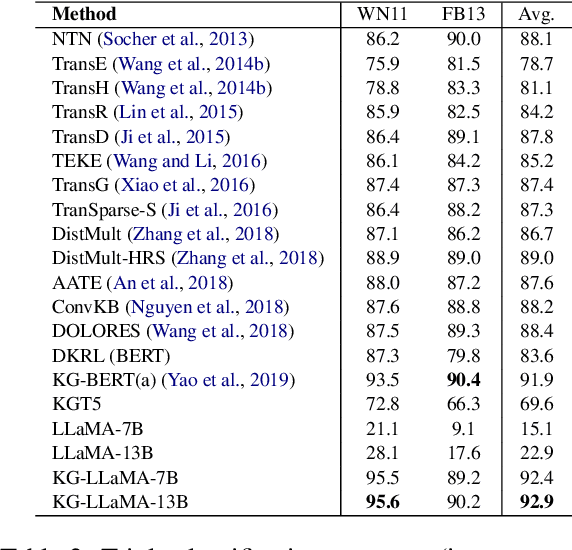

Knowledge graphs play a vital role in numerous artificial intelligence tasks, yet they frequently face the issue of incompleteness. In this study, we explore utilizing Large Language Models (LLM) for knowledge graph completion. We consider triples in knowledge graphs as text sequences and introduce an innovative framework called Knowledge Graph LLM (KG-LLM) to model these triples. Our technique employs entity and relation descriptions of a triple as prompts and utilizes the response for predictions. Experiments on various benchmark knowledge graphs demonstrate that our method attains state-of-the-art performance in tasks such as triple classification and relation prediction. We also find that fine-tuning relatively smaller models (e.g., LLaMA-7B, ChatGLM-6B) outperforms recent ChatGPT and GPT-4.
Friend Recall in Online Games via Pre-training Edge Transformers
Feb 20, 2023
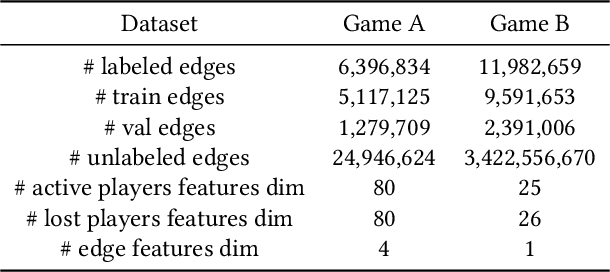

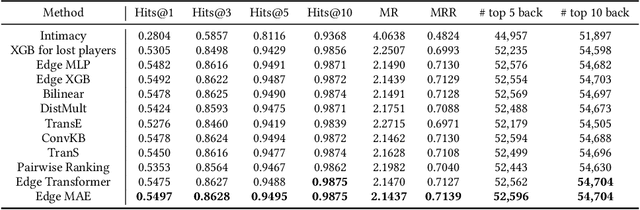
Friend recall is an important way to improve Daily Active Users (DAU) in Tencent games. Traditional friend recall methods focus on rules like friend intimacy or training a classifier for predicting lost players' return probability, but ignore feature information of (active) players and historical friend recall events. In this work, we treat friend recall as a link prediction problem and explore several link prediction methods which can use features of both active and lost players, as well as historical events. Furthermore, we propose a novel Edge Transformer model and pre-train the model via masked auto-encoders. Our method achieves state-of-the-art results in the offline experiments and online A/B Tests of three Tencent games.