 Add to Chrome
 Add to Firefox
 Add to Edge
Masked Generative-Contrastive Representation Learning for Cross-Dataset EEG-Based Emotion Recognition
Jul 05, 2026
Self-supervised learning (SSL) shows strong potential for cross-dataset transfer by improving feature representation and generalization. However, its application to EEG-based emotion recognition remains largely unexplored. Existing SSL methods struggle to capture the intricate spatiotemporal dependencies of EEG signals under varying channel configurations, extract fine-grained representations resilient to noise, and derive global features that generalize well across subjects. To address these challenges, we propose Masked Generative-Contrastive Representation Learning (MGCRL), a novel SSL framework specifically designed for EEG-based emotion recognition. Built upon a region-aware spatiotemporal encoder, MGCRL integrates generative and contrastive learning to achieve both fine-grained and global discriminative representations for cross-dataset generalization. MGCRL introduces three key designs: 1) a spatiotemporal encoder that incorporates region-based graph convolution to capture localized spatial and functional relationships, enhancing region-specific feature learning and mitigating the impact of varying EEG channel configurations across datasets; 2) a generative learning mechanism based on the joint embedding predictive architecture (JEPA) that utilizes masked features to capture noise robustness fine-grained representations, improving the model's capability to characterize subtle emotional states; and 3) a contrastive learning strategy that leverages masked and original features to learn temporally stable and cross-subject-invariant representations across the same stimuli, boosting emotion discrimination and cross-subject generalization. Under these designs, MGCRL exhibits remarkable ability to learn universal representation. Extensive experiments involving pretraining on the large FACED dataset and fine-tuning on multiple SEED-series datasets demonstrate the effectiveness of MGCRL.

The Dream Within Huang Long Cave: AI-Driven Interactive Narrative for Family Storytelling and Emotional Reflection
Apr 07, 2025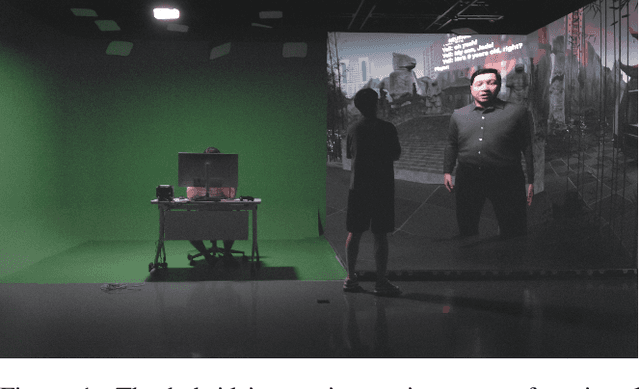
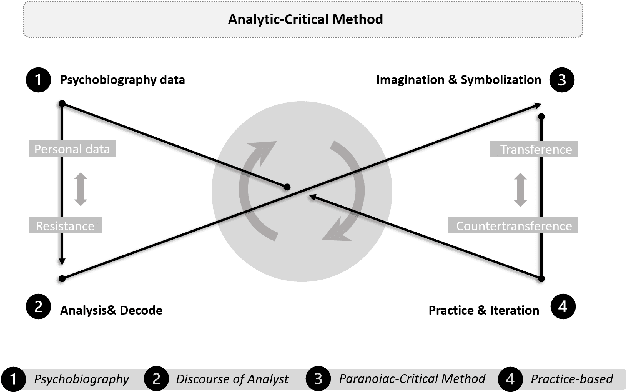
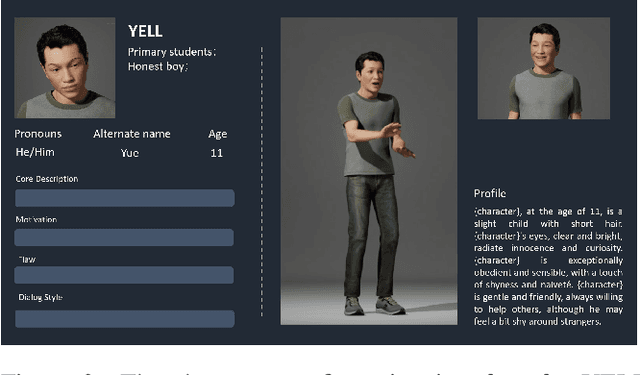
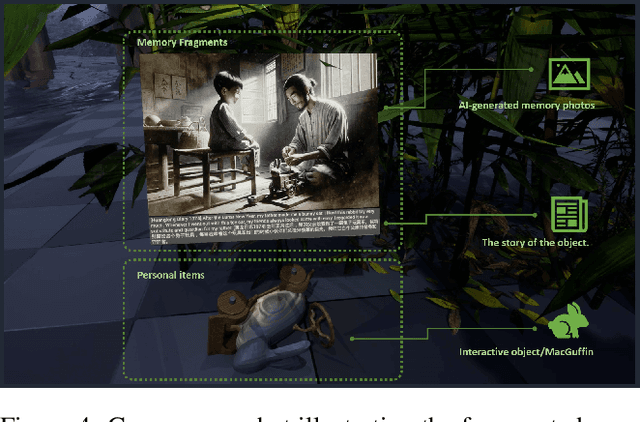
This paper introduces the art project The Dream Within Huang Long Cave, an AI-driven interactive and immersive narrative experience. The project offers new insights into AI technology, artistic practice, and psychoanalysis. Inspired by actual geographical landscapes and familial archetypes, the work combines psychoanalytic theory and computational technology, providing an artistic response to the concept of the non-existence of the Big Other. The narrative is driven by a combination of a large language model (LLM) and a realistic digital character, forming a virtual agent named YELL. Through dialogue and exploration within a cave automatic virtual environment (CAVE), the audience is invited to unravel the language puzzles presented by YELL and help him overcome his life challenges. YELL is a fictional embodiment of the Big Other, modeled after the artist's real father. Through a cross-temporal interaction with this digital father, the project seeks to deconstruct complex familial relationships. By demonstrating the non-existence of the Big Other, we aim to underscore the authenticity of interpersonal emotions, positioning art as a bridge for emotional connection and understanding within family dynamics.
Weaver: Foundation Models for Creative Writing
Jan 30, 2024
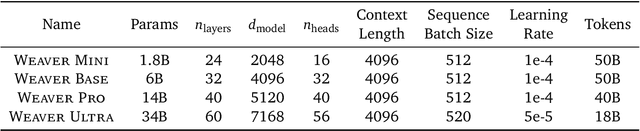
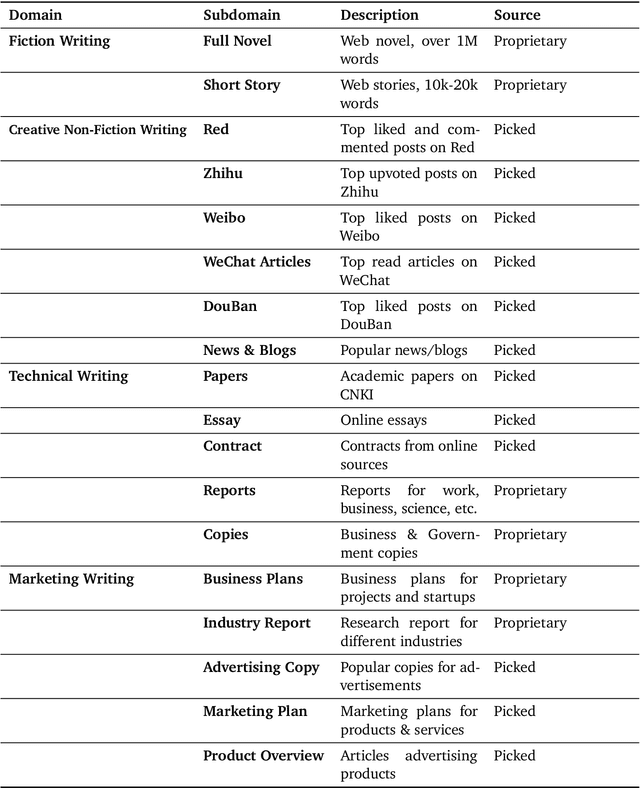
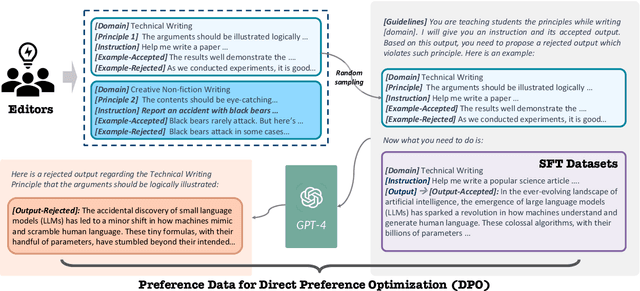
This work introduces Weaver, our first family of large language models (LLMs) dedicated to content creation. Weaver is pre-trained on a carefully selected corpus that focuses on improving the writing capabilities of large language models. We then fine-tune Weaver for creative and professional writing purposes and align it to the preference of professional writers using a suit of novel methods for instruction data synthesis and LLM alignment, making it able to produce more human-like texts and follow more diverse instructions for content creation. The Weaver family consists of models of Weaver Mini (1.8B), Weaver Base (6B), Weaver Pro (14B), and Weaver Ultra (34B) sizes, suitable for different applications and can be dynamically dispatched by a routing agent according to query complexity to balance response quality and computation cost. Evaluation on a carefully curated benchmark for assessing the writing capabilities of LLMs shows Weaver models of all sizes outperform generalist LLMs several times larger than them. Notably, our most-capable Weaver Ultra model surpasses GPT-4, a state-of-the-art generalist LLM, on various writing scenarios, demonstrating the advantage of training specialized LLMs for writing purposes. Moreover, Weaver natively supports retrieval-augmented generation (RAG) and function calling (tool usage). We present various use cases of these abilities for improving AI-assisted writing systems, including integration of external knowledge bases, tools, or APIs, and providing personalized writing assistance. Furthermore, we discuss and summarize a guideline and best practices for pre-training and fine-tuning domain-specific LLMs.