 Add to Chrome
 Add to Firefox
 Add to Edge
Masked Generative-Contrastive Representation Learning for Cross-Dataset EEG-Based Emotion Recognition
Jul 05, 2026
Self-supervised learning (SSL) shows strong potential for cross-dataset transfer by improving feature representation and generalization. However, its application to EEG-based emotion recognition remains largely unexplored. Existing SSL methods struggle to capture the intricate spatiotemporal dependencies of EEG signals under varying channel configurations, extract fine-grained representations resilient to noise, and derive global features that generalize well across subjects. To address these challenges, we propose Masked Generative-Contrastive Representation Learning (MGCRL), a novel SSL framework specifically designed for EEG-based emotion recognition. Built upon a region-aware spatiotemporal encoder, MGCRL integrates generative and contrastive learning to achieve both fine-grained and global discriminative representations for cross-dataset generalization. MGCRL introduces three key designs: 1) a spatiotemporal encoder that incorporates region-based graph convolution to capture localized spatial and functional relationships, enhancing region-specific feature learning and mitigating the impact of varying EEG channel configurations across datasets; 2) a generative learning mechanism based on the joint embedding predictive architecture (JEPA) that utilizes masked features to capture noise robustness fine-grained representations, improving the model's capability to characterize subtle emotional states; and 3) a contrastive learning strategy that leverages masked and original features to learn temporally stable and cross-subject-invariant representations across the same stimuli, boosting emotion discrimination and cross-subject generalization. Under these designs, MGCRL exhibits remarkable ability to learn universal representation. Extensive experiments involving pretraining on the large FACED dataset and fine-tuning on multiple SEED-series datasets demonstrate the effectiveness of MGCRL.

A new semi-supervised inductive transfer learning framework: Co-Transfer
Aug 21, 2021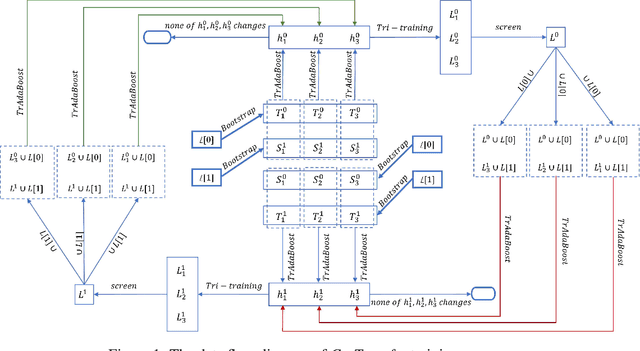
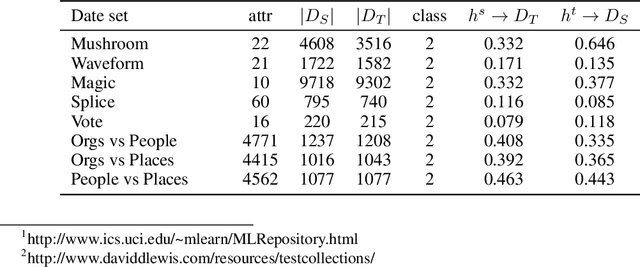
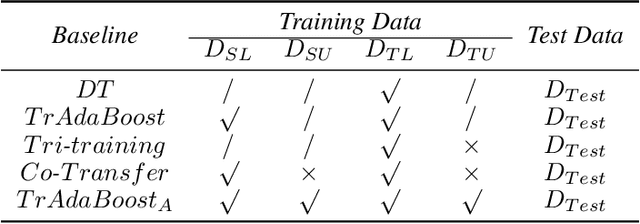
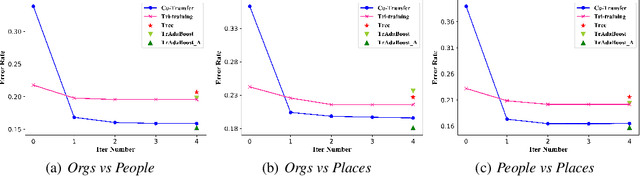
In many practical data mining scenarios, such as network intrusion detection, Twitter spam detection, and computer-aided diagnosis, a source domain that is different from but related to a target domain is very common. In addition, a large amount of unlabeled data is available in both source and target domains, but labeling each of them is difficult, expensive, time-consuming, and sometime unnecessary. Therefore, it is very important and worthwhile to fully explore the labeled and unlabeled data in source and target domains to settle the task in target domain. In this paper, a new semi-supervised inductive transfer learning framework, named Co-Transfer is proposed. Co-Transfer first generates three TrAdaBoost classifiers for transfer learning from the source domain to the target domain, and meanwhile another three TrAdaBoost classifiers are generated for transfer learning from the target domain to the source domain, using bootstraped samples from the original labeled data. In each round of co-transfer, each group of TrAdaBoost classifiers are refined using the carefully labeled data. Finally, the group of TrAdaBoost classifiers learned to transfer from the source domain to the target domain produce the final hypothesis. Experiments results illustrate Co-Transfer can effectively exploit and reuse the labeled and unlabeled data in source and target domains.