 Add to Chrome
 Add to Firefox
 Add to Edge
YOLO-NAS-Bench: A Surrogate Benchmark with Self-Evolving Predictors for YOLO Architecture Search
Mar 10, 2026
Neural Architecture Search (NAS) for object detection is severely bottlenecked by high evaluation cost, as fully training each candidate YOLO architecture on COCO demands days of GPU time. Meanwhile, existing NAS benchmarks largely target image classification, leaving the detection community without a comparable benchmark for NAS evaluation. To address this gap, we introduce YOLO-NAS-Bench, the first surrogate benchmark tailored to YOLO-style detectors. YOLO-NAS-Bench defines a search space spanning channel width, block depth, and operator type across both backbone and neck, covering the core modules of YOLOv8 through YOLO12. We sample 1,000 architectures via random, stratified, and Latin Hypercube strategies, train them on COCO-mini, and build a LightGBM surrogate predictor. To sharpen the predictor in the high-performance regime most relevant to NAS, we propose a Self-Evolving Mechanism that progressively aligns the predictor's training distribution with the high-performance frontier, by using the predictor itself to discover and evaluate informative architectures in each iteration. This method grows the pool to 1,500 architectures and raises the ensemble predictor's R2 from 0.770 to 0.815 and Sparse Kendall Tau from 0.694 to 0.752, demonstrating strong predictive accuracy and ranking consistency. Using the final predictor as the fitness function for evolutionary search, we discover architectures that surpass all official YOLOv8-YOLO12 baselines at comparable latency on COCO-mini, confirming the predictor's discriminative power for top-performing detection architectures.

The NLP Sandbox: an efficient model-to-data system to enable federated and unbiased evaluation of clinical NLP models
Jun 28, 2022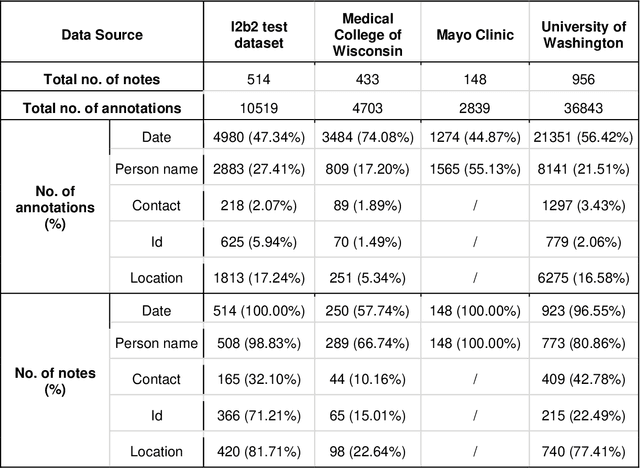
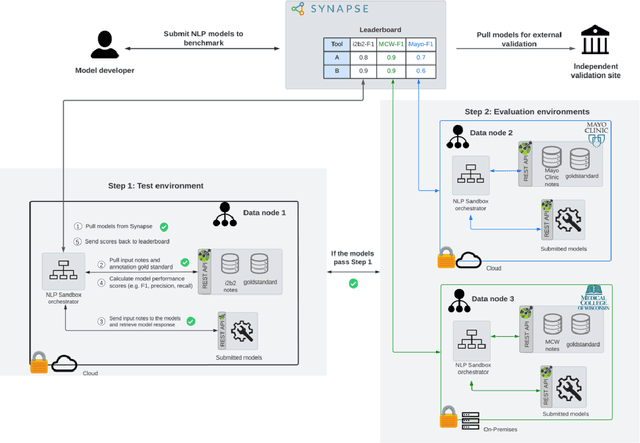
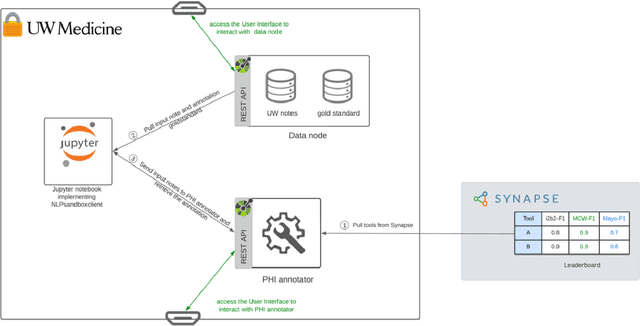
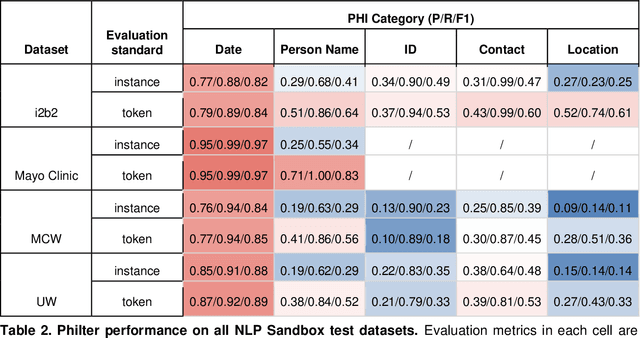
Objective The evaluation of natural language processing (NLP) models for clinical text de-identification relies on the availability of clinical notes, which is often restricted due to privacy concerns. The NLP Sandbox is an approach for alleviating the lack of data and evaluation frameworks for NLP models by adopting a federated, model-to-data approach. This enables unbiased federated model evaluation without the need for sharing sensitive data from multiple institutions. Materials and Methods We leveraged the Synapse collaborative framework, containerization software, and OpenAPI generator to build the NLP Sandbox (nlpsandbox.io). We evaluated two state-of-the-art NLP de-identification focused annotation models, Philter and NeuroNER, using data from three institutions. We further validated model performance using data from an external validation site. Results We demonstrated the usefulness of the NLP Sandbox through de-identification clinical model evaluation. The external developer was able to incorporate their model into the NLP Sandbox template and provide user experience feedback. Discussion We demonstrated the feasibility of using the NLP Sandbox to conduct a multi-site evaluation of clinical text de-identification models without the sharing of data. Standardized model and data schemas enable smooth model transfer and implementation. To generalize the NLP Sandbox, work is required on the part of data owners and model developers to develop suitable and standardized schemas and to adapt their data or model to fit the schemas. Conclusions The NLP Sandbox lowers the barrier to utilizing clinical data for NLP model evaluation and facilitates federated, multi-site, unbiased evaluation of NLP models.
The RSNA-ASNR-MICCAI BraTS 2021 Benchmark on Brain Tumor Segmentation and Radiogenomic Classification
Jul 05, 2021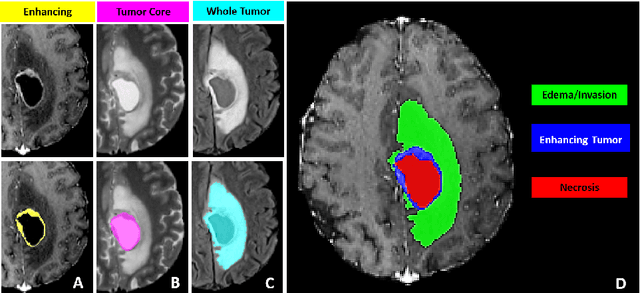
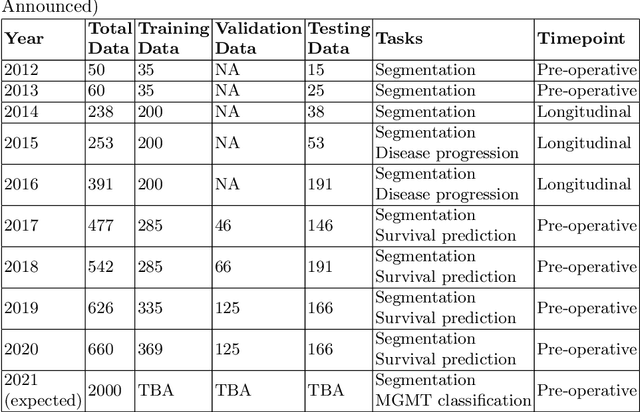
The BraTS 2021 challenge celebrates its 10th anniversary and is jointly organized by the Radiological Society of North America (RSNA), the American Society of Neuroradiology (ASNR), and the Medical Image Computing and Computer Assisted Interventions (MICCAI) society. Since its inception, BraTS has been focusing on being a common benchmarking venue for brain glioma segmentation algorithms, with well-curated multi-institutional multi-parametric magnetic resonance imaging (mpMRI) data. Gliomas are the most common primary malignancies of the central nervous system, with varying degrees of aggressiveness and prognosis. The RSNA-ASNR-MICCAI BraTS 2021 challenge targets the evaluation of computational algorithms assessing the same tumor compartmentalization, as well as the underlying tumor's molecular characterization, in pre-operative baseline mpMRI data from 2,000 patients. Specifically, the two tasks that BraTS 2021 focuses on are: a) the segmentation of the histologically distinct brain tumor sub-regions, and b) the classification of the tumor's O[6]-methylguanine-DNA methyltransferase (MGMT) promoter methylation status. The performance evaluation of all participating algorithms in BraTS 2021 will be conducted through the Sage Bionetworks Synapse platform (Task 1) and Kaggle (Task 2), concluding in distributing to the top ranked participants monetary awards of $60,000 collectively.