 Add to Chrome
 Add to Firefox
 Add to Edge
Multi-Agent Pathfinding with Non-Unit Integer Edge Costs via Enhanced Conflict-Based Search and Graph Discretization
Apr 07, 2026
Multi-Agent Pathfinding (MAPF) plays a critical role in various domains. Traditional MAPF methods typically assume unit edge costs and single-timestep actions, which limit their applicability to real-world scenarios. MAPFR extends MAPF to handle non-unit costs with real-valued edge costs and continuous-time actions, but its geometric collision model leads to an unbounded state space that compromises solver efficiency. In this paper, we propose MAPFZ, a novel MAPF variant on graphs with non-unit integer costs that preserves a finite state space while offering improved realism over classical MAPF. To solve MAPFZ efficiently, we develop CBS-NIC, an enhanced Conflict-Based Search framework incorporating time-interval-based conflict detection and an improved Safe Interval Path Planning (SIPP) algorithm. Additionally, we propose Bayesian Optimization for Graph Design (BOGD), a discretization method for non-unit edge costs that balances efficiency and accuracy with a sub-linear regret bound. Extensive experiments demonstrate that our approach outperforms state-of-the-art methods in runtime and success rate across diverse benchmark scenarios.

PJB: A Reasoning-Aware Benchmark for Person-Job Retrieval
Mar 18, 2026As retrieval models converge on generic benchmarks, the pressing question is no longer "who scores higher" but rather "where do systems fail, and why?" Person-job matching is a domain that urgently demands such diagnostic capability -- it requires systems not only to verify explicit constraints but also to perform skill-transfer inference and job-competency reasoning, yet existing benchmarks provide no systematic diagnostic support for this task. We introduce PJB (Person-Job Benchmark), a reasoning-aware retrieval evaluation dataset that uses complete job descriptions as queries and complete resumes as documents, defines relevance through job-competency judgment, is grounded in real-world recruitment data spanning six industry domains and nearly 200,000 resumes, and upgrades evaluation from "who scores higher" to "where do systems differ, and why" through domain-family and reasoning-type diagnostic labels. Diagnostic experiments using dense retrieval reveal that performance heterogeneity across industry domains far exceeds the gains from module upgrades for the same model, indicating that aggregate scores alone can severely mislead optimization decisions. At the module level, reranking yields stable improvements while query understanding not only fails to help but actually degrades overall performance when combined with reranking -- the two modules face fundamentally different improvement bottlenecks. The value of PJB lies not in yet another leaderboard of average scores, but in providing recruitment retrieval systems with a capability map that pinpoints where to invest.
KFWC: A Knowledge-Driven Deep Learning Model for Fine-grained Classification of Wet-AMD
Dec 23, 2021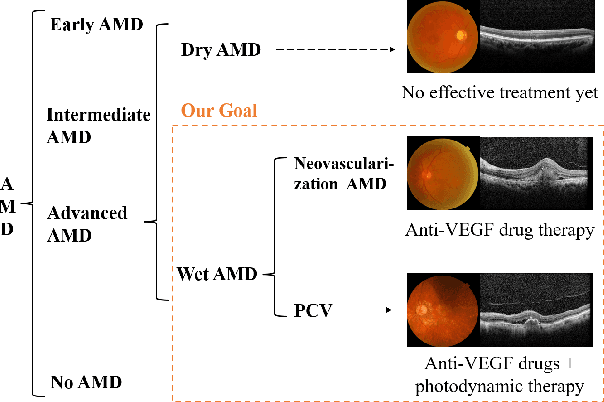
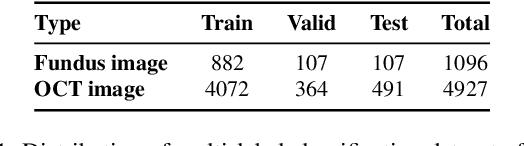
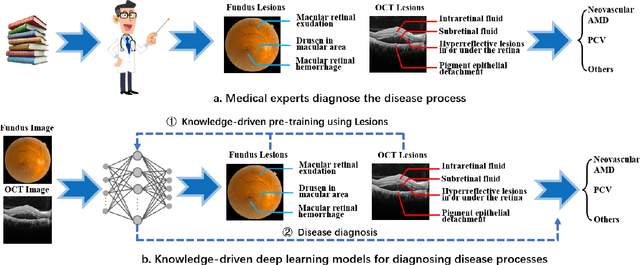
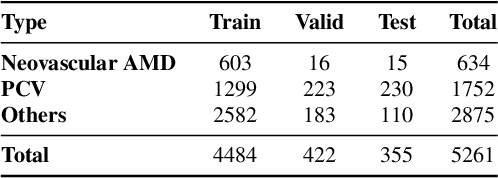
Automated diagnosis using deep neural networks can help ophthalmologists detect the blinding eye disease wet Age-related Macular Degeneration (AMD). Wet-AMD has two similar subtypes, Neovascular AMD and Polypoidal Choroidal Vessels (PCV). However, due to the difficulty in data collection and the similarity between images, most studies have only achieved the coarse-grained classification of wet-AMD rather than a finer-grained one of wet-AMD subtypes. To solve this issue, in this paper we propose a Knowledge-driven Fine-grained Wet-AMD Classification Model (KFWC), to classify fine-grained diseases with insufficient data. With the introduction of a priori knowledge of 10 lesion signs of input images into the KFWC, we aim to accelerate the KFWC by means of multi-label classification pre-training, to locate the decisive image features in the fine-grained disease classification task and therefore achieve better classification. Simultaneously, the KFWC can also provide good interpretability and effectively alleviate the pressure of data collection and annotation in the field of fine-grained disease classification for wet-AMD. The experiments demonstrate the effectiveness of the KFWC which reaches 99.71% in AU-ROC scores, and its considerable improvements over the data-driven w/o Knowledge and ophthalmologists, with the rates of 6.69% over the strongest baseline and 4.14% over ophthalmologists.