 Add to Chrome
 Add to Firefox
 Add to Edge
Counterfactual Graph for Multi-Agent LLM Calibration
May 28, 2026
Multi-agent LLM systems often treat agreement as evidence: when many agents in a panel give the same answer, that answer is assumed to be more reliable. We show that this assumption can fail after agents communicate. Communication can induce correlated failures and false consensus, so the same vote share may reflect reliable agreement in one topology but over-confidence in another. We propose CAGE-CAL, a counterfactual agent-graph calibration framework for multi-agent LLMs. For each query, CAGE-CAL compares an observed post-communication agent graph with a matched counterfactual no-communication graph, capturing both pairwise failure correlations and group-level dependencies. Rather than simply counting how many agents agree, CAGE-CAL estimates the counterfactual shift between observed and no-communication dependence, and calibrates confidence accordingly. Across five benchmarks, CAGE-CAL improves reliability discrimination with competitive ECE, and its calibrated confidence further improves topology selection over the best fixed-topology strategy.

Where LLM Annotators Fail: Label-Free Learning on Graphs with LLMs
May 27, 2026Node classification on graphs often requires labeled nodes, yet obtaining labels at graph scale is expensive. When node attributes contain semantic content, such as paper abstracts, web pages, or product descriptions, large language models (LLMs) can provide low-cost supervision by annotating a small subset of nodes. However, these LLM-generated labels are noisy, and existing label-free graph learning methods usually treat this noise as either global or class-conditional. We find that LLM annotation errors are not only class-dependent but also region-dependent: within the same class, reliability can vary sharply across feature-space clusters. In light of this, we propose Cluster-Aware Noise Estimation (CANE), a label-free learning framework that estimates cluster-conditional LLM reliability without ground truth labels, and uses this estimate to decide which pseudo-labels to trust, and which labels to correct. Across various graph benchmarks and GNN backbones, CANE improves over the strongest label-free baselines, with the largest gains on datasets exhibiting stronger cluster-conditional noise.
In-Context Optimization for Retrieval-Augmented Generation: A Gradient-Descent Perspective
May 25, 2026In-context learning has recently been linked to implicit gradient descent in linear self-attention models, suggesting that context can induce a forward-pass update. Retrieval-augmented generation (RAG) also relies on context, but retrieved documents are usually treated as static evidence rather than signals for adaptation. We study RAG as an in-context optimization process. First, we show that one linear self-attention layer can implement one gradient-descent step on a unified linearized RAG objective covering both projection-based and dot-product retrieval interfaces. This gives an exact regime where retrieval-augmented prediction and in-context optimization coincide. We use this result not as a literal model of LLM computation, but as a guide for adapting the interaction between queries and retrieved evidence. We then test the boundary of this correspondence: it remains stable under controlled linear extensions, but becomes feature-distribution dependent under nonlinear architectures. Finally, we turn this view into a lightweight method for frozen RAG LLMs. The method keeps the retriever and backbone fixed, and predicts a context-conditioned update to a generator-side evidence-use interface. Across seven QA benchmarks, two retrievers, and two frozen LLM backbones, this forward-only update improves a shared-interface baseline, transfers to held-out tasks, and approaches test-time gradient adaptation at much lower per-query cost.
RICE-PO: Turning Retrieval Interactions into Credit Signals for Reasoning Agents
May 25, 2026Retrieval is increasingly moving from one-shot matching toward interactive reasoning, where language agents iteratively inspect evidence, reformulate queries, and search again. Training such agents raises a credit-assignment challenge: executable actions such as queries or summaries can be directly evaluated by the retriever, while latent reasoning steps are not directly observable and only affect future executable actions. This asymmetry makes outcome-level reward assignment unreliable, as the same final reward may credit reasoning steps that did not actually shape retrieval success. We propose RICE-PO, a critic-free policy optimization framework that converts retrieval interactions into localized learning signals. RICE-PO selects high-uncertainty executable actions as anchors, evaluates local counterfactual branches using retrieval metrics, and propagates credit to latent reasoning steps only when reasoning-to-action influence is strong and future residual effects are stable. On BRIGHT and BEIR, RICE-PO consistently outperforms prompt-based agents and group-based RL baselines under the same retriever setting. These results show that the structure of agent-environment interaction itself can provide useful supervision for training reasoning-based retrieval agents.
Efficient and Effective Internal Memory Retrieval for LLM-Based Healthcare Prediction
Apr 08, 2026Large language models (LLMs) hold significant promise for healthcare, yet their reliability in high-stakes clinical settings is often compromised by hallucinations and a lack of granular medical context. While Retrieval Augmented Generation (RAG) can mitigate these issues, standard supervised pipelines require computationally intensive searches over massive external knowledge bases, leading to high latency that is impractical for time-sensitive care. To address this, we introduce Keys to Knowledge (K2K), a novel framework that replaces external retrieval with internal, key-based knowledge access. By encoding essential clinical information directly into the model's parameter space, K2K enables rapid retrieval from internal key-value memory without inference-time overhead. We further enhance retrieval quality through activation-guided probe construction and cross-attention reranking. Experimental results demonstrate that K2K achieves state-of-the-art performance across four benchmark healthcare outcome prediction datasets.
EvolveRouter: Co-Evolving Routing and Prompt for Multi-Agent Question Answering
Apr 06, 2026Large language model agents often exhibit complementary strengths, making routing a promising approach for multi-agent question answering. However, existing routing methods remain limited in two important ways: they typically optimize over a fixed pool of agents without improving the agents themselves, and they often rely on rigid collaboration schemes that cannot adapt the number of participating agents to the query. We propose EvolveRouter, a trainable framework that addresses both limitations by jointly improving agent quality and collaboration structure. First, EvolveRouter couples graph-based query routing with targeted instruction refinement in a closed-loop co-evolution process, allowing router diagnostics to guide agent improvement while refined agents provide cleaner supervision for routing. Second, it introduces an adaptive inference strategy that dynamically determines the effective collaboration size for each query through router-weighted answer agreement. Together, these designs enable more capable and more efficient multi-agent reasoning. Experiments on five question answering benchmarks show that EvolveRouter consistently outperforms SOTA routing baselines in both F1 and exact match, while further analysis confirms the benefits of closed-loop refinement and adaptive collaboration.
GLEN-Bench: A Graph-Language based Benchmark for Nutritional Health
Jan 26, 2026Nutritional interventions are important for managing chronic health conditions, but current computational methods provide limited support for personalized dietary guidance. We identify three key gaps: (1) dietary pattern studies often ignore real-world constraints such as socioeconomic status, comorbidities, and limited food access; (2) recommendation systems rarely explain why a particular food helps a given patient; and (3) no unified benchmark evaluates methods across the connected tasks needed for nutritional interventions. We introduce GLEN-Bench, the first comprehensive graph-language based benchmark for nutritional health assessment. We combine NHANES health records, FNDDS food composition data, and USDA food-access metrics to build a knowledge graph that links demographics, health conditions, dietary behaviors, poverty-related constraints, and nutrient needs. We test the benchmark using opioid use disorder, where models must detect subtle nutritional differences across disease stages. GLEN-Bench includes three linked tasks: risk detection identifies at-risk individuals from dietary and socioeconomic patterns; recommendation suggests personalized foods that meet clinical needs within resource constraints; and question answering provides graph-grounded, natural-language explanations to facilitate comprehension. We evaluate these graph-language approaches, including graph neural networks, large language models, and hybrid architectures, to establish solid baselines and identify practical design choices. Our analysis identifies clear dietary patterns linked to health risks, providing insights that can guide practical interventions.
RiTeK: A Dataset for Large Language Models Complex Reasoning over Textual Knowledge Graphs
Oct 17, 2024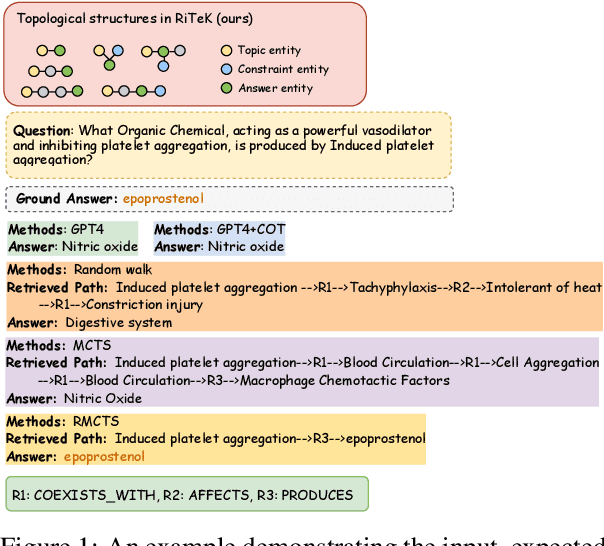


Answering complex real-world questions often requires accurate retrieval from textual knowledge graphs (TKGs). The scarcity of annotated data, along with intricate topological structures, makes this task particularly challenging. As the nature of relational path information could enhance the inference ability of Large Language Models (LLMs), efficiently retrieving more complex relational path information from TKGs presents another key challenge. To tackle these challenges, we first develop a Dataset for LLMs Complex Reasoning over Textual Knowledge Graphs (RiTeK) with a broad topological structure coverage.We synthesize realistic user queries that integrate diverse topological structures, relational information, and complex textual descriptions. We conduct rigorous expert evaluation to validate the quality of our synthesized queries. And then, we introduce an enhanced Monte Carlo Tree Search (MCTS) method, Relational MCTS, to automatically extract relational path information from textual graphs for specific queries. Our dataset mainly covers the medical domain as the relation types and entity are complex and publicly available. Experimental results indicate that RiTeK poses significant challenges for current retrieval and LLM systems, while the proposed Relational MCTS method enhances LLM inference ability and achieves state-of-the-art performance on RiTeK.
Benchmarking Retrieval-Augmented Large Language Models in Biomedical NLP: Application, Robustness, and Self-Awareness
May 16, 2024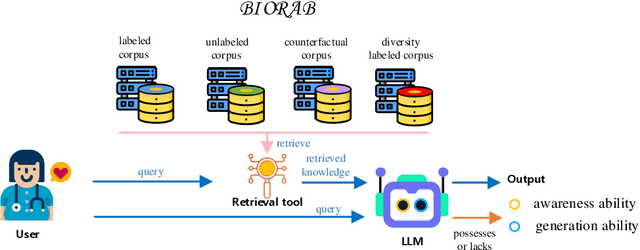
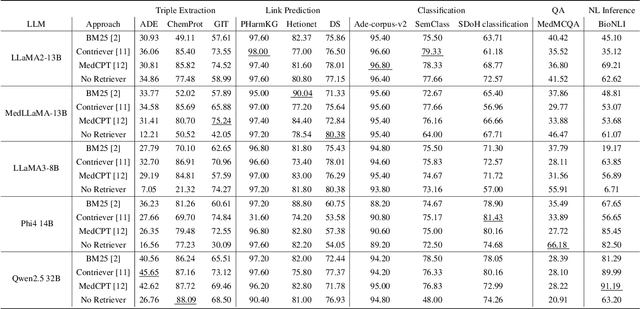
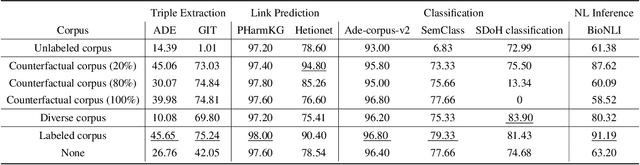
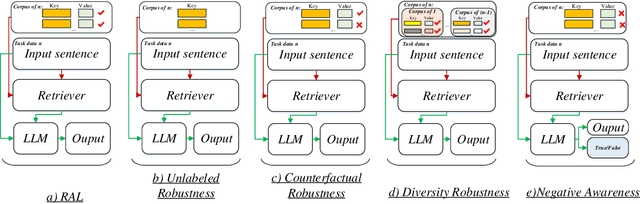
Large language models (LLM) have demonstrated remarkable capabilities in various biomedical natural language processing (NLP) tasks, leveraging the demonstration within the input context to adapt to new tasks. However, LLM is sensitive to the selection of demonstrations. To address the hallucination issue inherent in LLM, retrieval-augmented LLM (RAL) offers a solution by retrieving pertinent information from an established database. Nonetheless, existing research work lacks rigorous evaluation of the impact of retrieval-augmented large language models on different biomedical NLP tasks. This deficiency makes it challenging to ascertain the capabilities of RAL within the biomedical domain. Moreover, the outputs from RAL are affected by retrieving the unlabeled, counterfactual, or diverse knowledge that is not well studied in the biomedical domain. However, such knowledge is common in the real world. Finally, exploring the self-awareness ability is also crucial for the RAL system. So, in this paper, we systematically investigate the impact of RALs on 5 different biomedical tasks (triple extraction, link prediction, classification, question answering, and natural language inference). We analyze the performance of RALs in four fundamental abilities, including unlabeled robustness, counterfactual robustness, diverse robustness, and negative awareness. To this end, we proposed an evaluation framework to assess the RALs' performance on different biomedical NLP tasks and establish four different testbeds based on the aforementioned fundamental abilities. Then, we evaluate 3 representative LLMs with 3 different retrievers on 5 tasks over 9 datasets.