 Add to Chrome
 Add to Firefox
 Add to Edge
SAGE: Answer-Conditioned Uncertainty Targets for Verbal Uncertainty Alignment
Jun 09, 2026
Large language models increasingly express uncertainty through natural-language statements, yet these expressions often fail to reflect the model's sampled behavior. We study verbal uncertainty alignment as a distributional calibration problem: the appropriate uncertainty target for a prompt should be estimated from repeated model outputs rather than from an isolated response. However, group rollouts alone are insufficient, since the resulting target must provide a useful training signal. Existing targets only partially satisfy this requirement. We propose SAGE, Semantic-Answer Guided Entropy, a group-level uncertainty target that constructs an answer-conditioned uncertainty geometry over sampled responses. SAGE preserves categorical, numeric, and symbolic answer distinctions while maintaining a smooth and scale-preserving calibration signal. We further apply this target through Group-Uncertainty Preference Optimization, or GUPO, an uncertainty-channel training framework that supervises verbal uncertainty expressions rather than the full response. Experiments across factual, mathematical, and multiple-choice reasoning tasks show improved uncertainty ranking, lower calibration error, and reduced overconfidence.

Why Semantic Entropy Fails: Geometry-Aware and Calibrated Uncertainty for Policy Optimization
May 20, 2026Post-training has become central to improving reasoning and alignment in large language models, where critic-free models enable scalable learning from model-generated outputs but lack principled mechanisms to distinguish informative from noisy signals. Recent approaches leverage response-level measures as uncertainty signals to regulate group-based optimization methods such as GRPO. Yet their empirical success remains unstable and unclear in how they influence optimization dynamics. In this paper, we provide, to our knowledge, the first principled formulation that interprets uncertainty signals as mechanisms for characterizing and regulating gradient variance and learning signal quality. Based on both empirical and theoretical analysis, we identify two critical gaps of current entropy-based estimators: The anisotropic gap and The calibration gap. Motivated by this analysis, we propose Geometric-aware Calibrated Policy Optimization (GCPO), a novel framework integrating geometry-aware measures to capture semantic disagreement with reward-based calibration to align uncertainty with learning signal strength. Experiments on multiple benchmarks show that our approach more faithfully tracks gradient variability and consistently improves post-training performance. Our results highlight the importance of designing uncertainty signals that are aligned with optimization dynamics, offering a principled perspective for robust post-training.
ENSEMBITS: an alphabet of protein conformational ensembles
May 14, 2026Protein structure tokenizers (PSTs) are workhorses in protein language modeling, function prediction, and evolutionary analysis. However, existing PSTs only capture local geometry of static structures, and miss the correlated motions and alternative conformational states revealed by protein ensembles. Here we introduce Ensembits, the first tokenizer of protein conformational ensembles. Ensembits address challenges inherent to tokenizing dynamics: deriving informative geometric descriptors across conformations, permutation-invariance encoding of variable-size ensembles, and conquering sparsity in dynamics data. Trained with a Residual VQ-VAE using a frame distillation objective on a large molecular dynamics corpus, Ensembits outperforms all related methods on RMSF prediction, and is the strongest standalone structural tokenizer on an token-conditioned ANOVA test on per-residue motion amplitude. Ensembits further matches or exceeds static tokenizers on EC, GO, binding site/affinity prediction, and zero-shot mutation-effect prediction despite using far less pretraining data. Notably, the distillation objective enables Ensembits to predict dynamics token from one single predicted structure, which alleviates dynamics data sparsity. As the field moves from static structure prediction toward ensemble generation, Ensembits offer the discrete vocabulary needed to bring dynamics into protein language modeling and design.
EvolveRouter: Co-Evolving Routing and Prompt for Multi-Agent Question Answering
Apr 06, 2026Large language model agents often exhibit complementary strengths, making routing a promising approach for multi-agent question answering. However, existing routing methods remain limited in two important ways: they typically optimize over a fixed pool of agents without improving the agents themselves, and they often rely on rigid collaboration schemes that cannot adapt the number of participating agents to the query. We propose EvolveRouter, a trainable framework that addresses both limitations by jointly improving agent quality and collaboration structure. First, EvolveRouter couples graph-based query routing with targeted instruction refinement in a closed-loop co-evolution process, allowing router diagnostics to guide agent improvement while refined agents provide cleaner supervision for routing. Second, it introduces an adaptive inference strategy that dynamically determines the effective collaboration size for each query through router-weighted answer agreement. Together, these designs enable more capable and more efficient multi-agent reasoning. Experiments on five question answering benchmarks show that EvolveRouter consistently outperforms SOTA routing baselines in both F1 and exact match, while further analysis confirms the benefits of closed-loop refinement and adaptive collaboration.
Policy4OOD: A Knowledge-Guided World Model for Policy Intervention Simulation against the Opioid Overdose Crisis
Feb 12, 2026The opioid epidemic remains one of the most severe public health crises in the United States, yet evaluating policy interventions before implementation is difficult: multiple policies interact within a dynamic system where targeting one risk pathway may inadvertently amplify another. We argue that effective opioid policy evaluation requires three capabilities -- forecasting future outcomes under current policies, counterfactual reasoning about alternative past decisions, and optimization over candidate interventions -- and propose to unify them through world modeling. We introduce Policy4OOD, a knowledge-guided spatio-temporal world model that addresses three core challenges: what policies prescribe, where effects manifest, and when effects unfold.Policy4OOD jointly encodes policy knowledge graphs, state-level spatial dependencies, and socioeconomic time series into a policy-conditioned Transformer that forecasts future opioid outcomes.Once trained, the world model serves as a simulator: forecasting requires only a forward pass, counterfactual analysis substitutes alternative policy encodings in the historical sequence, and policy optimization employs Monte Carlo Tree Search over the learned simulator. To support this framework, we construct a state-level monthly dataset (2019--2024) integrating opioid mortality, socioeconomic indicators, and structured policy encodings. Experiments demonstrate that spatial dependencies and structured policy knowledge significantly improve forecasting accuracy, validating each architectural component and the potential of world modeling for data-driven public health decision support.
Drift-Bench: Diagnosing Cooperative Breakdowns in LLM Agents under Input Faults via Multi-Turn Interaction
Feb 02, 2026As Large Language Models transition to autonomous agents, user inputs frequently violate cooperative assumptions (e.g., implicit intent, missing parameters, false presuppositions, or ambiguous expressions), creating execution risks that text-only evaluations do not capture. Existing benchmarks typically assume well-specified instructions or restrict evaluation to text-only, single-turn clarification, and thus do not measure multi-turn disambiguation under grounded execution risk. We introduce \textbf{Drift-Bench}, the first diagnostic benchmark that evaluates agentic pragmatics under input faults through multi-turn clarification across state-oriented and service-oriented execution environments. Grounded in classical theories of communication, \textbf{Drift-Bench} provides a unified taxonomy of cooperative breakdowns and employs a persona-driven user simulator with the \textbf{Rise} evaluation protocol. Experiments show substantial performance drops under these faults, with clarification effectiveness varying across user personas and fault types. \MethodName bridges clarification research and agent safety evaluation, enabling systematic diagnosis of failures that can lead to unsafe executions.
BLURR: A Boosted Low-Resource Inference for Vision-Language-Action Models
Dec 12, 2025Vision-language-action (VLA) models enable impressive zero shot manipulation, but their inference stacks are often too heavy for responsive web demos or high frequency robot control on commodity GPUs. We present BLURR, a lightweight inference wrapper that can be plugged into existing VLA controllers without retraining or changing model checkpoints. Instantiated on the pi-zero VLA controller, BLURR keeps the original observation interfaces and accelerates control by combining an instruction prefix key value cache, mixed precision execution, and a single step rollout schedule that reduces per step computation. In our SimplerEnv based evaluation, BLURR maintains task success rates comparable to the original controller while significantly lowering effective FLOPs and wall clock latency. We also build an interactive web demo that allows users to switch between controllers and toggle inference options in real time while watching manipulation episodes. This highlights BLURR as a practical approach for deploying modern VLA policies under tight compute budgets.
Linear Spherical Sliced Optimal Transport: A Fast Metric for Comparing Spherical Data
Nov 09, 2024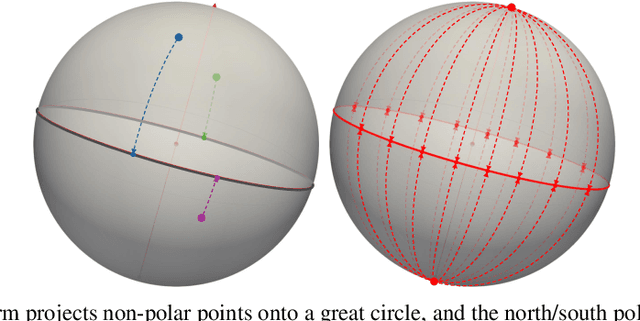
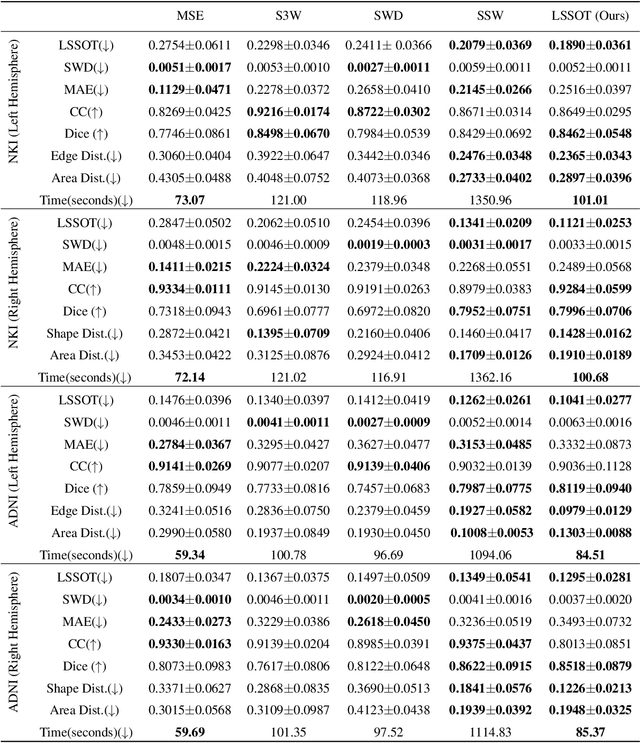
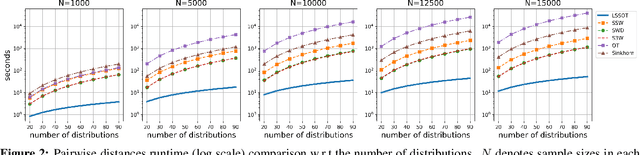
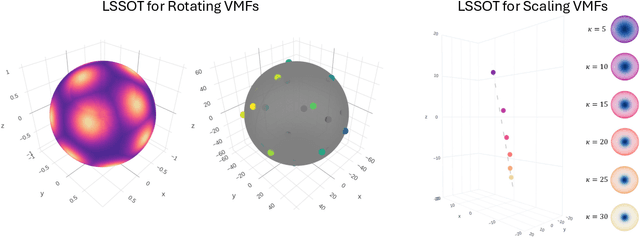
Efficient comparison of spherical probability distributions becomes important in fields such as computer vision, geosciences, and medicine. Sliced optimal transport distances, such as spherical and stereographic spherical sliced Wasserstein distances, have recently been developed to address this need. These methods reduce the computational burden of optimal transport by slicing hyperspheres into one-dimensional projections, i.e., lines or circles. Concurrently, linear optimal transport has been proposed to embed distributions into \( L^2 \) spaces, where the \( L^2 \) distance approximates the optimal transport distance, thereby simplifying comparisons across multiple distributions. In this work, we introduce the Linear Spherical Sliced Optimal Transport (LSSOT) framework, which utilizes slicing to embed spherical distributions into \( L^2 \) spaces while preserving their intrinsic geometry, offering a computationally efficient metric for spherical probability measures. We establish the metricity of LSSOT and demonstrate its superior computational efficiency in applications such as cortical surface registration, 3D point cloud interpolation via gradient flow, and shape embedding. Our results demonstrate the significant computational benefits and high accuracy of LSSOT in these applications.