 Add to Chrome
 Add to Firefox
 Add to Edge
GeoVista: Visually Grounded Active Perception for Ultra-High-Resolution Remote Sensing Understanding
May 14, 2026
Interpreting ultra-high-resolution (UHR) remote sensing images requires models to search for sparse and tiny visual evidence across large-scale scenes. Existing remote sensing vision-language models can inspect local regions with zooming and cropping tools, but most exploration strategies follow either a one-shot focus or a single sequential trajectory. Such single-path exploration can lose global context, leave scattered regions unvisited, and revisit or count the same evidence multiple times. To this end, we propose GeoVista, a planning-driven active perception framework for UHR remote sensing interpretation. Instead of committing to one zooming path, GeoVista first builds a global exploration plan, then verifies multiple candidate regions through branch-wise local inspection, while maintaining an explicit evidence state for cross-region aggregation and de-duplication. To enable this behavior, we introduce APEX-GRO, a cold-start supervised trajectory corpus that reformulates diverse UHR tasks as Global-Region-Object interactive reasoning processes with a unified, scale-invariant spatial representation. We further design an Observe-Plan-Track mechanism for global observation, adaptive region inspection, and evidence tracking, and align the model with a GRPO-based strategy using step-wise rewards for planning, localization, and final answer correctness. Experiments on RSHR-Bench, XLRS-Bench, and LRS-VQA show that GeoVista achieves state-of-the-art performance. Code and dataset are available at https://github.com/ryan6073/GeoVista

Anim-Director: A Large Multimodal Model Powered Agent for Controllable Animation Video Generation
Aug 19, 2024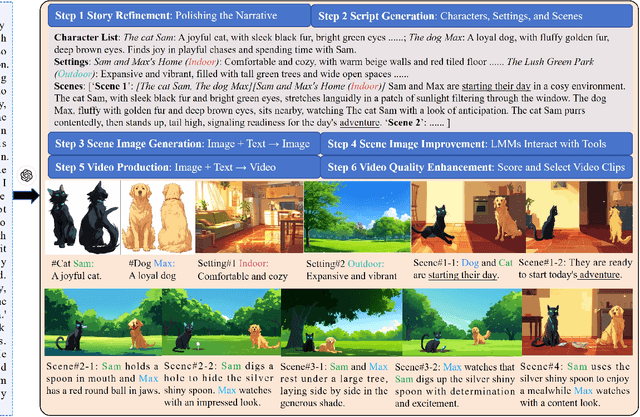
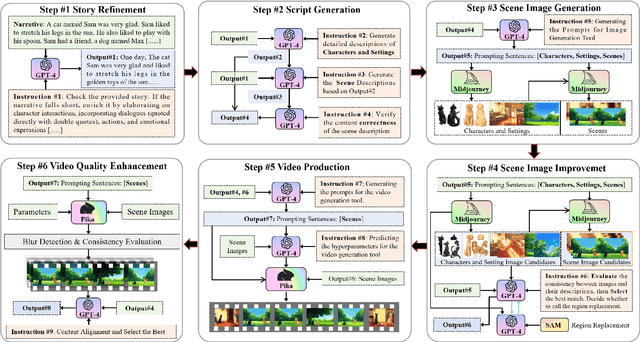
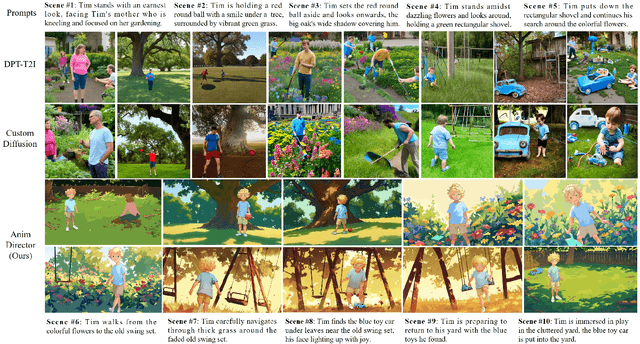
Traditional animation generation methods depend on training generative models with human-labelled data, entailing a sophisticated multi-stage pipeline that demands substantial human effort and incurs high training costs. Due to limited prompting plans, these methods typically produce brief, information-poor, and context-incoherent animations. To overcome these limitations and automate the animation process, we pioneer the introduction of large multimodal models (LMMs) as the core processor to build an autonomous animation-making agent, named Anim-Director. This agent mainly harnesses the advanced understanding and reasoning capabilities of LMMs and generative AI tools to create animated videos from concise narratives or simple instructions. Specifically, it operates in three main stages: Firstly, the Anim-Director generates a coherent storyline from user inputs, followed by a detailed director's script that encompasses settings of character profiles and interior/exterior descriptions, and context-coherent scene descriptions that include appearing characters, interiors or exteriors, and scene events. Secondly, we employ LMMs with the image generation tool to produce visual images of settings and scenes. These images are designed to maintain visual consistency across different scenes using a visual-language prompting method that combines scene descriptions and images of the appearing character and setting. Thirdly, scene images serve as the foundation for producing animated videos, with LMMs generating prompts to guide this process. The whole process is notably autonomous without manual intervention, as the LMMs interact seamlessly with generative tools to generate prompts, evaluate visual quality, and select the best one to optimize the final output.