 Add to Chrome
 Add to Firefox
 Add to Edge
Judging Is Not Enumerating: Silent Omissions in LLM-Authored Acceptable Sets
Aug 02, 2026
Language models are increasingly promoted from examinees to examiners: they write the test suites, answer keys, rubrics, and reward functions that define correctness for other systems. We measure the capability that role assumes and find it lacking under the protocol the role is usually deployed with, one-shot greedy authoring with no test-time reasoning. Across four reference constructions - two with complete finite truth, one with a hardened executable reference (HumanEval+/MBPP+), one with an explicitly incomplete lexical reference (WordNet) - models judge whether a candidate belongs far better than they author the set itself. On the incompleteness-proof algorithmic construction the gap is +0.34 to +0.29 F1 over a 24x parameter range and does not close; on executable code, models judging at F1 0.74-0.90 author suites admitting only 19-42% of oracle-correct solutions. A control locates the deficit: asked to emit the predicate rather than its extension, the same models reach F1 about 0.99. The failure is not missing knowledge or an inability to specify, but an inability to materialise the region a specification induces. The dominant error is omission, which resists audit: an over-inclusion is a token a reviewer can challenge, a missing member an absence whose discovery is the authoring problem itself. Models detect planted over-inclusions 6-7x more often than planted omissions, and a production deployment of 43,227 items fails omission-first at 10:1. Wired into RLVR, an authored key costs 1.9 points of accuracy against an exact oracle and 18.5 WordNet-relative (six paired seeds, p=0.031). Gating authored verifiers on a known-correct probe cuts false rejection from 58-92% to at most 5%, but keeps only 5-39% of suites. Repairing them instead, by rewriting each wrong expected value to what a reference execution returns, raises yield 3.3-10.6x across four author families.

Auditing Discovery Claims: A Two-Sided Criterion for Agentic Science, with the Negative Side Decidable
Aug 02, 2026When a self-improving AI-for-science system claims a new capability, the evidence is usually a benchmark delta, a description-length gate, or a p-value. None separates a real gain from extra search, from a changed verifier, or from adaptation to a fallible oracle. We build a two-sided audit whose negative side is a formal fact: a pseudoknot-free oracle provably cannot represent a crossing base pair, so the prior verifier's range is bounded exactly, offline, before any run. "New" is relative to the agent's prior self, never to the base model. First, how far a single fallible oracle can inflate a capability claim. An invented, solver-free operator solves 43/60 crossing RNA targets under the predictor it optimizes, above a context-free floor of 0/60; under three predictors, 1/60 survives. Paired on the same 43 targets, a predictor the operator never saw confirms 2 of its designs against 26 for a minimum-free-energy solver (p = 8e-7). No statistic computed from the system and its own oracle sees that gap. Second, agent-written procedures can beat a human-written one under a judge no objective can flatter, at a fraction of the compute. Of six frontier models, the two whose operators ran without timeouts carry over at 0.293 against our 0.095 (n = 951 paired units, target-clustered [+0.108, +0.297], p = 5e-5) while spending 4.6-10x fewer oracle calls. Three rungs: difference under an outside adjudicator (reached), not bought with compute (reached, both directions), mechanism identified and transferable (not reached; seven candidates tested, none moves the statistic). The ceiling is the panel itself: its three predictors share nearest-neighbour thermodynamic parameters, two agreeing at kappa = 0.673. The audit is as unsparing about our own system: matched undirected search is an exact zero, and a search-free probe puts 84% of our headline effect on targets a random sequence already solves.
Capability from Access Structure, Not Scale: Lower Bounds and Pre-Registered Tests for Hybrid Sequence Models
Jul 14, 2026The Platonic Representation Hypothesis (PRH) holds that as models scale, representations of heterogeneous networks converge toward a shared model of reality. We propose its sequel and boundary, the Capability Convergence Hypothesis (CCH): under a fixed per-token inference budget, representational convergence does not entail capability convergence. Capability instead converges toward a class, the access-complete hybrid: any architecture holding both a compressive O(1)-state channel and a scalable verbatim-index channel. We anchor it on a witness task, the Newton's-apple problem in an infinite stream, and name three resource walls: a Shannon wall barring any o(Nb)-state architecture, a horizon wall barring any fixed window, and a circuit wall barring fixed-depth attention-only composition (conditional on TC0 != NC1). Under an explicit separability assumption a hybrid crosses all three by paying each wall's price, so capability is strictly super-additive under composition. We separate what we prove from what we conjecture: the access-completeness principle rests on information-theoretic lower bounds and pre-registered experiments, while the field-level convergence trend is an economics-motivated conjecture. We report the first pre-registered small-scale tests under criteria frozen before the data: the predicted scissors gap is measured (exact-retrieval error 0.994 vs. 0.000 once a 64-scalar state gains one global-attention layer), the state-tracking bifurcation lands at the registered boundary, and a conjunction witness shows an irreducibly two-channel solution; one prediction failed with its direction reversed and is reported as such. Representational convergence is given freely by scale; capability convergence must be purchased by access structure.
NTIRE 2026 Challenge on Video Saliency Prediction: Methods and Results
Apr 16, 2026This paper presents an overview of the NTIRE 2026 Challenge on Video Saliency Prediction. The goal of the challenge participants was to develop automatic saliency map prediction methods for the provided video sequences. The novel dataset of 2,000 diverse videos with an open license was prepared for this challenge. The fixations and corresponding saliency maps were collected using crowdsourced mouse tracking and contain viewing data from over 5,000 assessors. Evaluation was performed on a subset of 800 test videos using generally accepted quality metrics. The challenge attracted over 20 teams making submissions, and 7 teams passed the final phase with code review. All data used in this challenge is made publicly available - https://github.com/msu-video-group/NTIRE26_Saliency_Prediction.
STENet: Superpixel Token Enhancing Network for RGB-D Salient Object Detection
Mar 23, 2026Transformer-based methods for RGB-D Salient Object Detection (SOD) have gained significant interest, owing to the transformer's exceptional capacity to capture long-range pixel dependencies. Nevertheless, current RGB-D SOD methods face challenges, such as the quadratic complexity of the attention mechanism and the limited local detail extraction. To overcome these limitations, we propose a novel Superpixel Token Enhancing Network (STENet), which introduces superpixels into cross-modal interaction. STENet follows the two-stream encoder-decoder structure. Its cores are two tailored superpixel-driven cross-modal interaction modules, responsible for global and local feature enhancement. Specifically, we update the superpixel generation method by expanding the neighborhood range of each superpixel, allowing for flexible transformation between pixels and superpixels. With the updated superpixel generation method, we first propose the Superpixel Attention Global Enhancing Module to model the global pixel-to-superpixel relationship rather than the traditional global pixel-to-pixel relationship, which can capture region-level information and reduce computational complexity. We also propose the Superpixel Attention Local Refining Module, which leverages pixel similarity within superpixels to filter out a subset of pixels (i.e., local pixels) and then performs feature enhancement on these local pixels, thereby capturing concerned local details. Furthermore, we fuse the globally and locally enhanced features along with the cross-scale features to achieve comprehensive feature representation. Experiments on seven RGB-D SOD datasets reveal that our STENet achieves competitive performance compared to state-of-the-art methods. The code and results of our method are available at https://github.com/Mark9010/STENet.
LMStyle Benchmark: Evaluating Text Style Transfer for Chatbots
Mar 13, 2024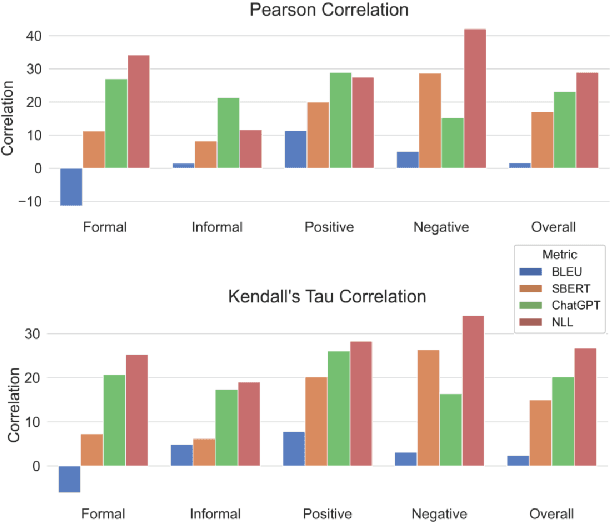
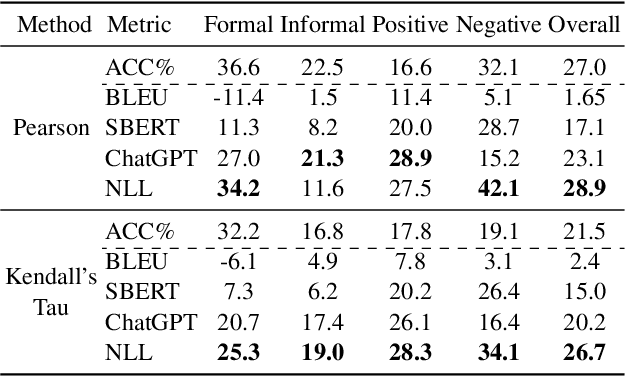
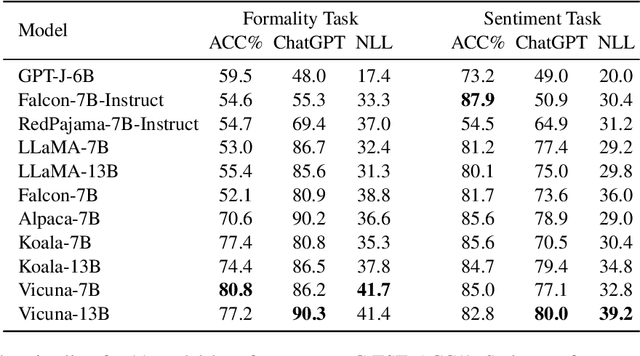
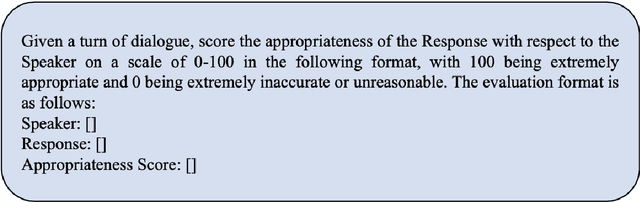
Since the breakthrough of ChatGPT, large language models (LLMs) have garnered significant attention in the research community. With the development of LLMs, the question of text style transfer for conversational models has emerged as a natural extension, where chatbots may possess their own styles or even characters. However, standard evaluation metrics have not yet been established for this new settings. This paper aims to address this issue by proposing the LMStyle Benchmark, a novel evaluation framework applicable to chat-style text style transfer (C-TST), that can measure the quality of style transfer for LLMs in an automated and scalable manner. In addition to conventional style strength metrics, LMStyle Benchmark further considers a novel aspect of metrics called appropriateness, a high-level metrics take account of coherence, fluency and other implicit factors without the aid of reference samples. Our experiments demonstrate that the new evaluation methods introduced by LMStyle Benchmark have a higher correlation with human judgments in terms of appropriateness. Based on LMStyle Benchmark, we present a comprehensive list of evaluation results for popular LLMs, including LLaMA, Alpaca, and Vicuna, reflecting their stylistic properties, such as formality and sentiment strength, along with their appropriateness.
ExtremeBERT: A Toolkit for Accelerating Pretraining of Customized BERT
Nov 30, 2022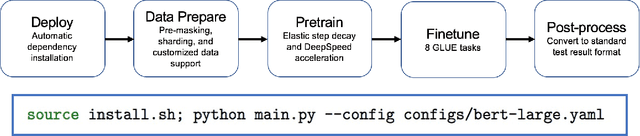
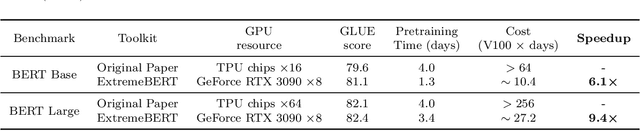
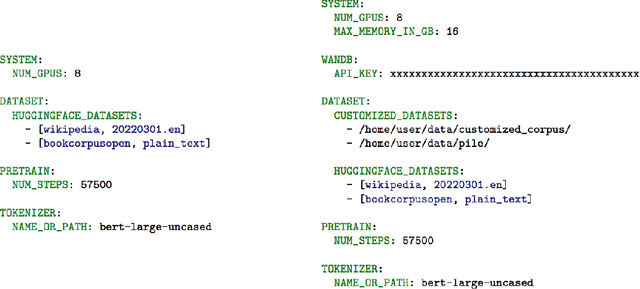
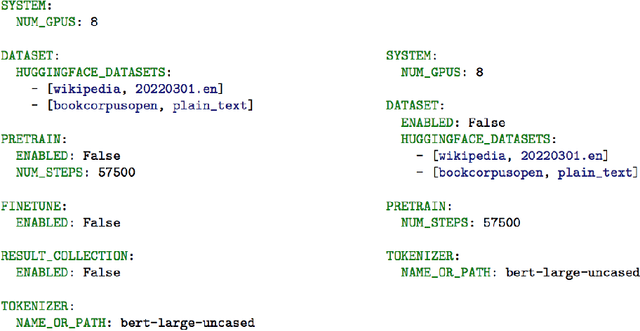
In this paper, we present ExtremeBERT, a toolkit for accelerating and customizing BERT pretraining. Our goal is to provide an easy-to-use BERT pretraining toolkit for the research community and industry. Thus, the pretraining of popular language models on customized datasets is affordable with limited resources. Experiments show that, to achieve the same or better GLUE scores, the time cost of our toolkit is over $6\times$ times less for BERT Base and $9\times$ times less for BERT Large when compared with the original BERT paper. The documentation and code are released at https://github.com/extreme-bert/extreme-bert under the Apache-2.0 license.