 Add to Chrome
 Add to Firefox
 Add to Edge
OneModel: A Unified Foundation for Platform-Scale Multi-Scenario Ranking
Aug 20, 2026
Platform-scale recommender systems often span multiple business streams such as organic recommendation, advertising, and merchant services, where user behaviors form a continuous cross-stream trajectory. Maintaining separate ranking systems fragments user representations and increases engineering cost. We propose \textbf{OneModel}, a unified framework for multi-stream final ranking. OneModel maps heterogeneous behaviors into shared event sequences, learns long-context user representations with an action-oriented backbone, and introduces \emph{Scenario-aware Information Modulation} to balance cross-stream transfer and stream-specific specialization. For production deployment, OneModel further adopts stratified user representation, multi-objective training, and optimized online serving with feature decomposition, user feature prefetching, shared user-tower computation, and graph-level inference optimization. We deploy OneModel in production at \emph{Xiaohongshu}, where it delivers consistent offline gains over strong baselines and scales favorably with context length and model capacity. Online A/B tests improve Time Spent by \textbf{+0.33\%} and Engagement by \textbf{+1.25\%} in Explore Feed, lift advertising value by \textbf{+3.43\%} and CTR by \textbf{+8.18\%} in Feed Advertising, and raise DGMV by \textbf{+1.1867\%} and GPM by \textbf{+2.1585\%} in Merchant Recommendation, validating unified multi-stream ranking as an effective production foundation.

Hierarchical Latent Reasoning for LLM-based Recommendation
Jul 30, 2026Large Language Models (LLMs) have shown strong potential for recommendation by leveraging their semantic understanding and contextual modeling capabilities. Recent studies further introduce reasoning mechanisms to improve user preference modeling. However, explicit natural-language reasoning incurs substantial inference overhead, whereas existing latent reasoning methods mainly focus on generating or verifying intermediate states, leaving their layer-wise preference roles and contributions insufficiently characterized. We propose HiLaR, a Hierarchical Latent Reasoning framework with layer-aware reinforcement optimization for LLM-based recommendation. HiLaR constructs temporal-guided hierarchical user preference representations, aligns them with multiple LLM latent reasoning states, and organizes the reasoning process from broad preferences to fine-grained current intents. To further optimize the reasoning trajectory, HiLaR combines final recommendation feedback with layer-aware process rewards derived from the marginal target-likelihood gain of each state. Experiments on four Amazon benchmark datasets show that HiLaR generally outperforms strong sequential, generative, and LLM-based recommendation baselines. Ablation and sensitivity analyses further verify the contribution of hierarchical representation learning, latent alignment, and process-level optimization. Our code is available in https://github.com/hupeiyu21/HiLaR.
Guiding the Recommender: Information-Aware Auto-Bidding for Content Promotion
Jan 28, 2026Modern content platforms offer paid promotion to mitigate cold start by allocating exposure via auctions. Our empirical analysis reveals a counterintuitive flaw in this paradigm: while promotion rescues low-to-medium quality content, it can harm high-quality content by forcing exposure to suboptimal audiences, polluting engagement signals and downgrading future recommendation. We recast content promotion as a dual-objective optimization that balances short-term value acquisition with long-term model improvement. To make this tractable at bid time in content promotion, we introduce a decomposable surrogate objective, gradient coverage, and establish its formal connection to Fisher Information and optimal experimental design. We design a two-stage auto-bidding algorithm based on Lagrange duality that dynamically paces budget through a shadow price and optimizes impression-level bids using per-impression marginal utilities. To address missing labels at bid time, we propose a confidence-gated gradient heuristic, paired with a zeroth-order variant for black-box models that reliably estimates learning signals in real time. We provide theoretical guarantees, proving monotone submodularity of the composite objective, sublinear regret in online auction, and budget feasibility. Extensive offline experiments on synthetic and real-world datasets validate the framework: it outperforms baselines, achieves superior final AUC/LogLoss, adheres closely to budget targets, and remains effective when gradients are approximated zeroth-order. These results show that strategic, information-aware promotion can improve long-term model performance and organic outcomes beyond naive impression-maximization strategies.
Competitive Bridge Bidding with Deep Neural Networks
Mar 05, 2019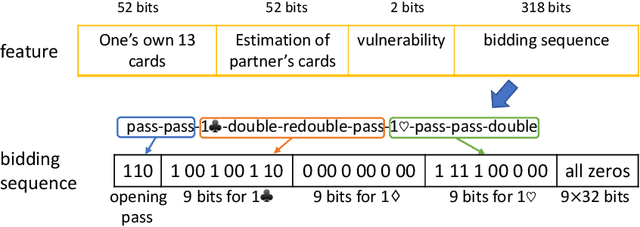
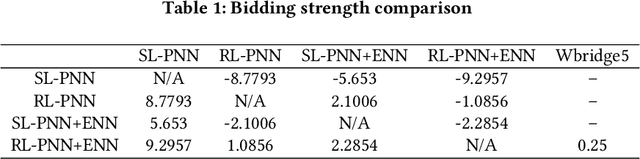
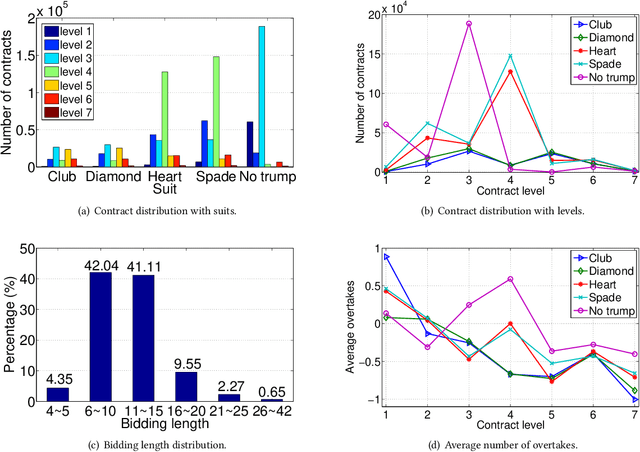
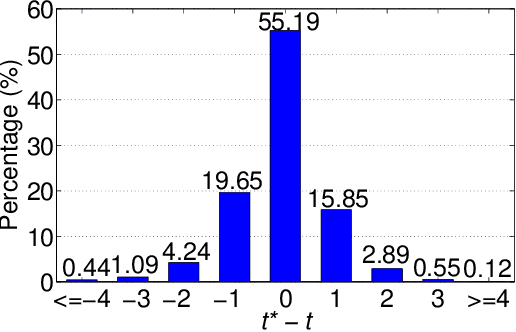
The game of bridge consists of two stages: bidding and playing. While playing is proved to be relatively easy for computer programs, bidding is very challenging. During the bidding stage, each player knowing only his/her own cards needs to exchange information with his/her partner and interfere with opponents at the same time. Existing methods for solving perfect-information games cannot be directly applied to bidding. Most bridge programs are based on human-designed rules, which, however, cannot cover all situations and are usually ambiguous and even conflicting with each other. In this paper, we, for the first time, propose a competitive bidding system based on deep learning techniques, which exhibits two novelties. First, we design a compact representation to encode the private and public information available to a player for bidding. Second, based on the analysis of the impact of other players' unknown cards on one's final rewards, we design two neural networks to deal with imperfect information, the first one inferring the cards of the partner and the second one taking the outputs of the first one as part of its input to select a bid. Experimental results show that our bidding system outperforms the top rule-based program.