 Add to Chrome
 Add to Firefox
 Add to Edge
A Finite E-Group of Nilpotency Class Three
Aug 07, 2026
A group is an E-group if every element commutes with each of its endomorphic images. Caranti asked whether a finite E-group can have nilpotency class three. We prove that the $3$-group of order $3^{84}$ introduced by Abdollahi, Faghihi, and Mohammadi Hassanabadi, and later shown by Abdollahi, Faghihi, Linton, and O'Brien to have the corresponding automorphism property, is an E-group. Let $P$ denote this group and put $V=P/Φ(P)\cong \mathbb{F}_3^9$. The nine power relations of $P$ determine a linear map $q:V\longrightarrowΛ^2 V$. We prove that $q$ has no nonzero proper subspace $U$ satisfying $q(U)\subseteqΛ^2 U$. Since the image induced by any endomorphism of $P$ on $V$ has precisely this closure property, every endomorphism acts on $V$ either invertibly or trivially. The invertible case is the known A-group case. In the trivial case the image first lies in $Φ(P)=P'$, and the power relations then force it into $Ω_1(P')=Z(P)$. Thus every element commutes with every endomorphic image. The tensor rigidity is reduced to an exact finite calculation on the $9841$ points of $\mathrm{PG}(8,3)$.

An Exact Counterexample to Carlson's Associated-Prime Depth Conjecture from a Group of Order 128
Jul 26, 2026In Question~3.1 of his 1995 paper on depth and transfer, Carlson asked whether the depth of a finite-group cohomology ring is always realized by the dimension of one of its associated primes. We give a negative answer. Let \[ G=\SG{128}{859},\qquad k=\kbar. \] An exact presentation certificate proves that $\depth H^*(G;k)=2$. Okuyama's associated-prime theorem would convert an associated prime of dimension two into a rank-two elementary abelian subgroup $E\leq G$ satisfying $\depth H^*(C_G(E);k)=2$. We enumerate all $75$ rank-two elementary abelian subgroups of $G$ and obtain six centralizer types. Duflot's theorem gives depth at least three for four types, while exact ideal-quotient certificates exhibit regular sequences of length three for the remaining two. Hence every rank-two centralizer has cohomological depth at least three, so $H^*(G;k)$ has no associated prime of dimension two. The finite group presentation, the three cohomology-ring presentations, the enumeration summary, and the exact algebraic certificates are included for independent verification.
An Explicit Counterexample to Stanley's Rankwise Lower-Bound Conjecture for Differential Posets
Jul 25, 2026In Problem~6 of his 1988 paper on differential posets, Stanley asked for the least possible cardinality of a fixed rank of an $r$-differential poset and suggested that the minimum should be attained by $Y^r$, the $r$-fold Cartesian power of Young's lattice. We disprove the resulting universal coefficientwise lower bound. For every $r\geq 3$, we construct an infinite $r$-differential poset $P^{(r)}$ satisfying \[ \card{P^{(r)}_4} =\card{(Y^r)_4}-\left\lfloor\frac r3\right\rfloor. \] For $r=3$, the construction replaces thirteen rank-four lower-cover blocks of $Y^3$ by twelve blocks with the same point and pair incidence multiplicities, producing the initial rank sequence $1,3,9,22,50$ instead of $1,3,9,22,51$. A reflection extension then yields an infinite differential poset. The construction does not address the cases $r=1$ and $r=2$.
DeepMath-Creative: A Benchmark for Evaluating Mathematical Creativity of Large Language Models
May 13, 2025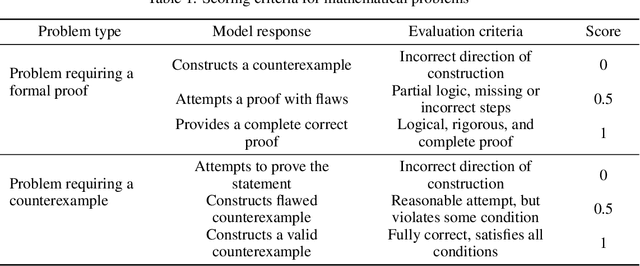
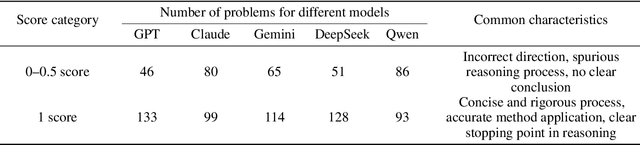
To advance the mathematical proficiency of large language models (LLMs), the DeepMath team has launched an open-source initiative aimed at developing an open mathematical LLM and systematically evaluating its mathematical creativity. This paper represents the initial contribution of this initiative. While recent developments in mathematical LLMs have predominantly emphasized reasoning skills, as evidenced by benchmarks on elementary to undergraduate-level mathematical tasks, the creative capabilities of these models have received comparatively little attention, and evaluation datasets remain scarce. To address this gap, we propose an evaluation criteria for mathematical creativity and introduce DeepMath-Creative, a novel, high-quality benchmark comprising constructive problems across algebra, geometry, analysis, and other domains. We conduct a systematic evaluation of mainstream LLMs' creative problem-solving abilities using this dataset. Experimental results show that even under lenient scoring criteria -- emphasizing core solution components and disregarding minor inaccuracies, such as small logical gaps, incomplete justifications, or redundant explanations -- the best-performing model, O3 Mini, achieves merely 70% accuracy, primarily on basic undergraduate-level constructive tasks. Performance declines sharply on more complex problems, with models failing to provide substantive strategies for open problems. These findings suggest that, although current LLMs display a degree of constructive proficiency on familiar and lower-difficulty problems, such performance is likely attributable to the recombination of memorized patterns rather than authentic creative insight or novel synthesis.