 Add to Chrome
 Add to Firefox
 Add to Edge
GAPD: Gold-Action Policy Distillation for Agentic Reinforcement Learning in Knowledge Base Question Answering
May 28, 2026
Reinforcement learning (RL) is a natural fit for agentic knowledge base question answering (KBQA), where a model must issue executable actions, observe knowledge-base feedback, and eventually return an answer. However, current RL-based KBQA systems mainly optimize sparse rewards from the final answer, leaving intermediate action errors weakly supervised. This is especially limiting for logical-form annotated KBQA benchmarks: gold logical forms can be converted into executable action sequences, but existing pipelines use them mainly for warm-start data construction rather than for on-policy RL updates. We propose GAPD, a training-time Gold-Action Policy Distillation framework that adds dense token-level guidance to outcome-based RL. To align gold actions with on-policy student rollouts, GAPD uses MID-ANCHOR MATCHING: it treats the intermediate entities reached during student exploration and gold execution as state anchors, and matches student states to gold states through these explored entity sets. The current policy conditioned on this aligned gold action serves as a stop-gradient teacher, whose token distribution is distilled back to the ordinary student policy over generated action-token spans. GAPD consistently surpasses the current state of the art on WebQSP, GrailQA, and GraphQ.

CUTEv2: Unified and Configurable Matrix Extension for Diverse CPU Architectures with Minimal Design Overhead
Apr 13, 2026Matrix extensions have emerged as an essential feature in modern CPUs to address the surging demands of AI workloads. However, existing designs often incur substantial hardware and software design overhead. Tight coupling with the CPU pipeline complicates integration across diverse CPUs, while fine-grained synchronous instructions hinder the development of high-performance kernels. This paper proposes a unified and configurable CPU matrix extension architecture. By decoupling matrix units from the CPU pipeline, the design enables low-overhead integration while maintaining close coordination with existing compute and memory resources. The configurable matrix unit supports mixed-precision operations and adapts to diverse compute demands and memory bandwidth constraints. An asynchronous matrix multiplication abstraction with flexible granularity conceals hardware details, simplifies matrix-vector overlap, and supports a unified software stack. The architecture is integrated into four open-source CPU RTL platforms and evaluated on representative AI models. Matrix unit utilization under GEMM workloads exceeds 90% across all platforms. When configured with compute throughput and memory bandwidth comparable to Intel AMX, our design achieves speedups of 1.57x, 1.57x, and 2.31x on ResNet, BERT, and Llama3, with over 30% of the gains attributed to overlapped matrix-vector execution. A 4 TOPS@2GHz matrix unit occupies only 0.53 mm\textsuperscript{2} in 14nm CMOS. These results demonstrate strong cross-platform adaptability and effective hardware-software co-optimization, offering a practical matrix extension for the open-source community.
Divide-Then-Align: Honest Alignment based on the Knowledge Boundary of RAG
May 27, 2025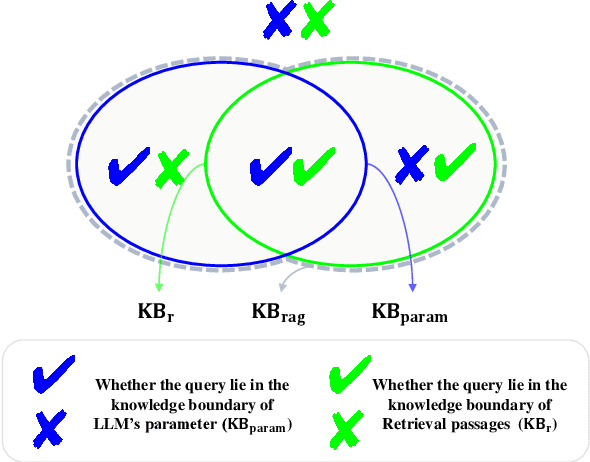
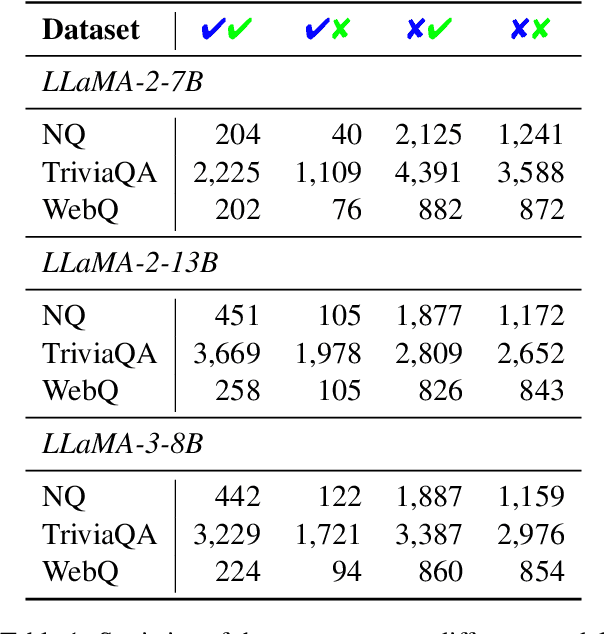
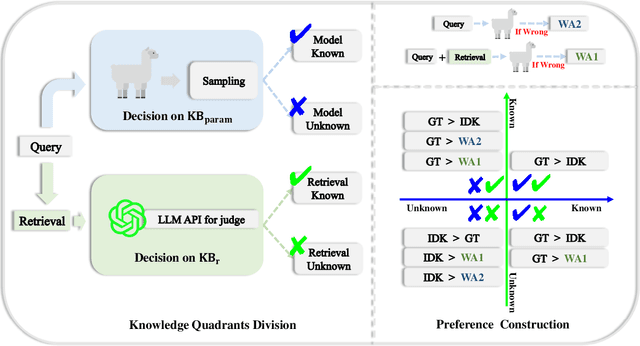
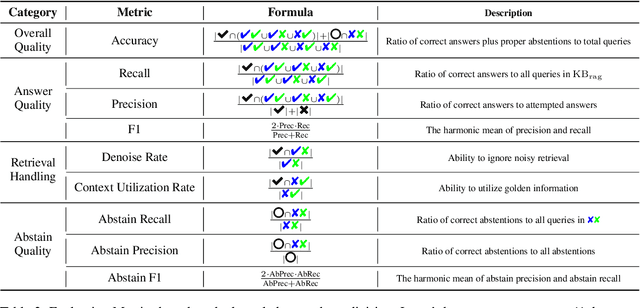
Large language models (LLMs) augmented with retrieval systems have significantly advanced natural language processing tasks by integrating external knowledge sources, enabling more accurate and contextually rich responses. To improve the robustness of such systems against noisy retrievals, Retrieval-Augmented Fine-Tuning (RAFT) has emerged as a widely adopted method. However, RAFT conditions models to generate answers even in the absence of reliable knowledge. This behavior undermines their reliability in high-stakes domains, where acknowledging uncertainty is critical. To address this issue, we propose Divide-Then-Align (DTA), a post-training approach designed to endow RAG systems with the ability to respond with "I don't know" when the query is out of the knowledge boundary of both the retrieved passages and the model's internal knowledge. DTA divides data samples into four knowledge quadrants and constructs tailored preference data for each quadrant, resulting in a curated dataset for Direct Preference Optimization (DPO). Experimental results on three benchmark datasets demonstrate that DTA effectively balances accuracy with appropriate abstention, enhancing the reliability and trustworthiness of retrieval-augmented systems.