 Add to Chrome
 Add to Firefox
 Add to Edge
RELATE: A Reinforcement Learning-Enhanced LLM Framework for Advertising Text Generation
Feb 12, 2026
In online advertising, advertising text plays a critical role in attracting user engagement and driving advertiser value. Existing industrial systems typically follow a two-stage paradigm, where candidate texts are first generated and subsequently aligned with online performance metrics such as click-through rate(CTR). This separation often leads to misaligned optimization objectives and low funnel efficiency, limiting global optimality. To address these limitations, we propose RELATE, a reinforcement learning-based end-to-end framework that unifies generation and objective alignment within a single model. Instead of decoupling text generation from downstream metric alignment, RELATE integrates performance and compliance objectives directly into the generation process via policy learning. To better capture ultimate advertiser value beyond click-level signals, We incorporate conversion-oriented metrics into the objective and jointly model them with compliance constraints as multi-dimensional rewards, enabling the model to generate high-quality ad texts that improve conversion performance under policy constraints. Extensive experiments on large-scale industrial datasets demonstrate that RELATE consistently outperforms baselines. Furthermore, online deployment on a production advertising platform yields statistically significant improvements in click-through conversion rate(CTCVR) under strict policy constraints, validating the robustness and real-world effectiveness of the proposed framework.

PoseMoE: Mixture-of-Experts Network for Monocular 3D Human Pose Estimation
Dec 18, 2025The lifting-based methods have dominated monocular 3D human pose estimation by leveraging detected 2D poses as intermediate representations. The 2D component of the final 3D human pose benefits from the detected 2D poses, whereas its depth counterpart must be estimated from scratch. The lifting-based methods encode the detected 2D pose and unknown depth in an entangled feature space, explicitly introducing depth uncertainty to the detected 2D pose, thereby limiting overall estimation accuracy. This work reveals that the depth representation is pivotal for the estimation process. Specifically, when depth is in an initial, completely unknown state, jointly encoding depth features with 2D pose features is detrimental to the estimation process. In contrast, when depth is initially refined to a more dependable state via network-based estimation, encoding it together with 2D pose information is beneficial. To address this limitation, we present a Mixture-of-Experts network for monocular 3D pose estimation named PoseMoE. Our approach introduces: (1) A mixture-of-experts network where specialized expert modules refine the well-detected 2D pose features and learn the depth features. This mixture-of-experts design disentangles the feature encoding process for 2D pose and depth, therefore reducing the explicit influence of uncertain depth features on 2D pose features. (2) A cross-expert knowledge aggregation module is proposed to aggregate cross-expert spatio-temporal contextual information. This step enhances features through bidirectional mapping between 2D pose and depth. Extensive experiments show that our proposed PoseMoE outperforms the conventional lifting-based methods on three widely used datasets: Human3.6M, MPI-INF-3DHP, and 3DPW.
TCPFormer: Learning Temporal Correlation with Implicit Pose Proxy for 3D Human Pose Estimation
Jan 03, 2025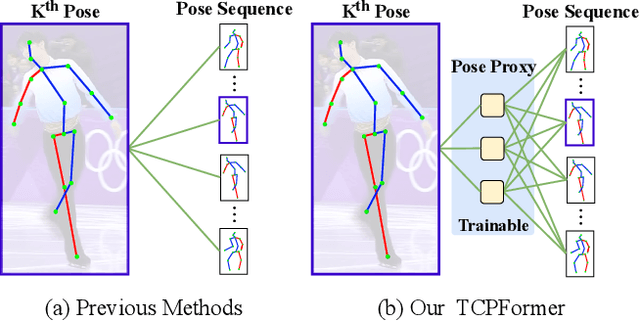


Recent multi-frame lifting methods have dominated the 3D human pose estimation. However, previous methods ignore the intricate dependence within the 2D pose sequence and learn single temporal correlation. To alleviate this limitation, we propose TCPFormer, which leverages an implicit pose proxy as an intermediate representation. Each proxy within the implicit pose proxy can build one temporal correlation therefore helping us learn more comprehensive temporal correlation of human motion. Specifically, our method consists of three key components: Proxy Update Module (PUM), Proxy Invocation Module (PIM), and Proxy Attention Module (PAM). PUM first uses pose features to update the implicit pose proxy, enabling it to store representative information from the pose sequence. PIM then invocates and integrates the pose proxy with the pose sequence to enhance the motion semantics of each pose. Finally, PAM leverages the above mapping between the pose sequence and pose proxy to enhance the temporal correlation of the whole pose sequence. Experiments on the Human3.6M and MPI-INF-3DHP datasets demonstrate that our proposed TCPFormer outperforms the previous state-of-the-art methods.