 Add to Chrome
 Add to Firefox
 Add to Edge
PointNeRT: A Physics Aware Neural Ray Tracing Surrogate for Propagation Channel Modeling
May 12, 2026
Ray tracing (RT) has emerged as a key tool for propagation channel modeling and network planning. Conventional RT is based on electromagnetic (EM) wave theory and its application relies on detailed mesh-based environment representations and material properties. In realistic environments, limited environmental geometry and material uncertainties hinder its scalability to complex scenarios. In this paper, we propose a novel physics aware neural RT surrogate named PointNeRT to address these limitations. The proposed model directly takes point clouds as environmental input, and efficiently reconstruct multipath without explicitly constructing mesh models or manually defining EM interaction rules. PointNeRT adopts a hop-by-hop modeling strategy guided by physical interaction constraints. It supports sequential prediction of multipath propagation and power attenuation. Numerical results and experiments demonstrate that the proposed method implicitly captures surface normal characteristics and EM material effects. It further achieves robust generalization in mobility scenarios and provides a physics-guided neural modeling of multipath propagation.

Deep Learning Based Dynamic Environment Reconstruction for Vehicular ISAC Scenarios
Aug 07, 2025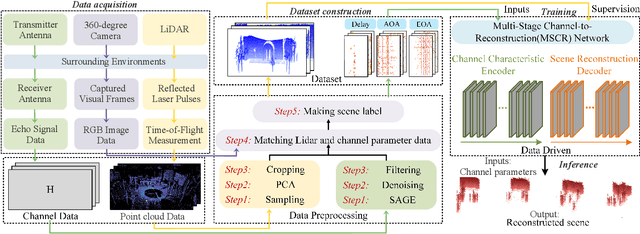
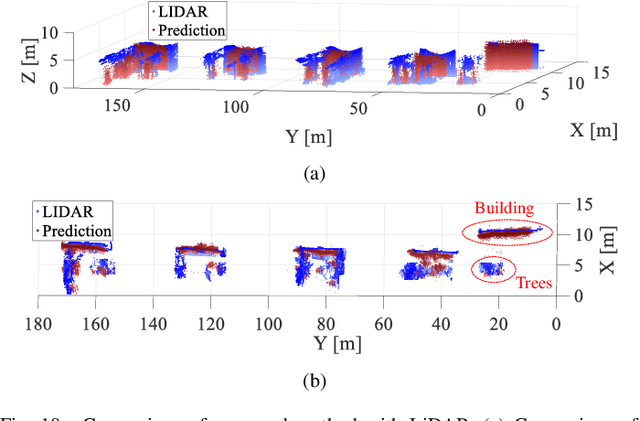
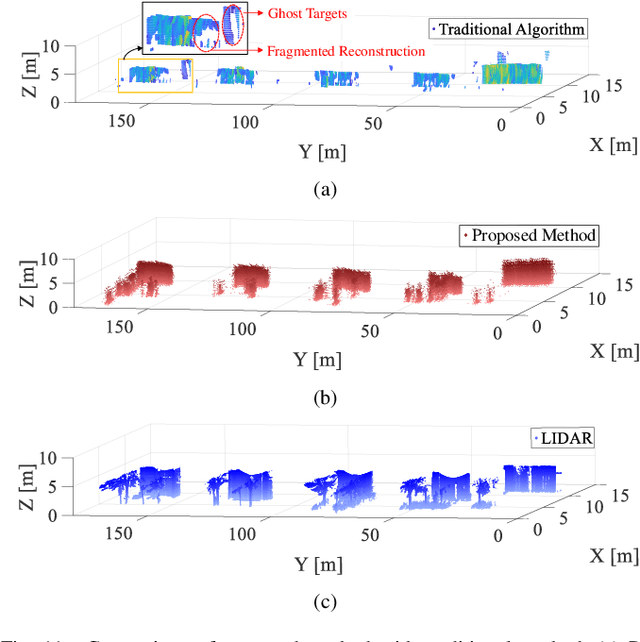
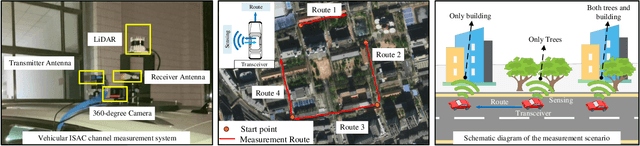
Integrated Sensing and Communication (ISAC) technology plays a critical role in future intelligent transportation systems, by enabling vehicles to perceive and reconstruct the surrounding environment through reuse of wireless signals, thereby reducing or even eliminating the need for additional sensors such as LiDAR or radar. However, existing ISAC based reconstruction methods often lack the ability to track dynamic scenes with sufficient accuracy and temporal consistency, limiting the real world applicability. To address this limitation, we propose a deep learning based framework for vehicular environment reconstruction by using ISAC channels. We first establish a joint channel environment dataset based on multi modal measurements from real world urban street scenarios. Then, a multistage deep learning network is developed to reconstruct the environment. Specifically, a scene decoder identifies the environmental context such as buildings, trees and so on; a cluster center decoder predicts coarse spatial layouts by localizing dominant scattering centers; a point cloud decoder recovers fine grained geometry and structure of surrounding environments. Experimental results demonstrate that the proposed method achieves high-quality dynamic environment reconstruction with a Chamfer Distance of 0.29 and F Score@1% of 0.87. In addition, complexity analysis demonstrates the efficiency and practical applicability of the method in real time scenarios. This work provides a pathway toward low cost environment reconstruction based on ISAC for future intelligent transportation.