 Add to Chrome
 Add to Firefox
 Add to Edge
Channel Measurements and Modeling based on Composite Environmental Factor for Urban Street-Canyon Intersections
Apr 02, 2026
In urban environments, vehicle-to-everything (V2X) communications require accurate wireless channel characterization. This requirement is particularly critical at street-canyon intersections, where building blockage and rich multipath propagation can severely degrade link reliability. Due to its unique environmental layout, the channel characteristics in urban canyon are influenced by building distribution. However, this feature has not been well captured in existing channel models. In this paper, we propose an environment-related statistical channel model based on 5.8~GHz channel measurements. We construct a composite environmental factor to characterize environmental differences in intersections. Then, the factor is incorporated into 3GPP path-loss model and further linked to small-scale channel parameters. Finally, accuracy of the proposed model is validated using second-order channel statistics. The results show that the proposed model can effectively characterize propagation properties of urban street-canyon intersection channels with different building conditions. The proposed model provides a physically interpretable and statistically effective framework for channel simulation and performance evaluation in urban vehicular scenarios.

Deep Learning Based Site-Specific Channel Inference Using Satellite Images
Mar 30, 2026Site-specific channel inference plays a critical role in the design and evaluation of next-generation wireless communication systems by considering the surrounding propagation environment. However, traditional methods are unscalable, while existing AI-based approaches using satellite image are confined to predicting large-scale fading parameters, lacking the capacity to reconstruct the complete channel impulse response (CIR). To address this limitation, we propose a deep learning-based site-specific channel inference framework using satellite images to predict structured Tapped Delay Line (TDL) parameters. We first establish a joint channel-satellite dataset based on measurements. Then, a novel deep learning network is developed to reconstruct the channel parameters. Specifically, a cross-attention-fused dual-branch pipeline extracts macroscopic and microscopic environmental features, while a recurrent tracking module captures the long-term dynamic evolution of multipath components. Experimental results demonstrate that the proposed method achieves high-quality reconstruction of the CIR in unseen scenarios, with a Power Delay Profile (PDP) Average Cosine Similarity exceeding 0.96. This work provides a pathway toward site-specific channel inference for future dynamic wireless networks.
A Geometry Map-Based Site-Specific Propagation Channel Model for Urban Scenarios
Nov 19, 2025With the rapid deployments of 5G and 6G networks, accurate modeling of urban radio propagation has become critical for system design and network planning. However, conventional statistical or empirical models fail to fully capture the influence of detailed geometric features on site-specific channel variances in dense urban environments. In this paper, we propose a geometry map-based propagation channel model that directly extracts key parameters from a 3D geometry map and incorporates the Uniform Theory of Diffraction (UTD) to recursively compute multiple diffraction fields, thereby enabling accurate prediction of site-specific large-scale path loss and time-varying Doppler characteristics in urban scenarios. A well-designed identification algorithm is developed to efficiently detect buildings that significantly affect signal propagation. The proposed model is validated using urban measurement data, showing excellent agreement of path loss in both line-of-sight (LOS) and nonline-of-sight (NLOS) conditions. In particular, for NLOS scenarios with complex diffractions, it outperforms the 3GPP and simplified models, reducing the RMSE by 7.1 dB and 3.18 dB, respectively. Doppler analysis further demonstrates its accuracy in capturing time-varying propagation characteristics, confirming the scalability and generalization of the model in urban environments.
Deep Learning Based Dynamic Environment Reconstruction for Vehicular ISAC Scenarios
Aug 07, 2025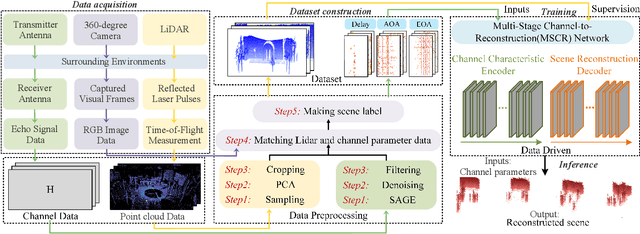
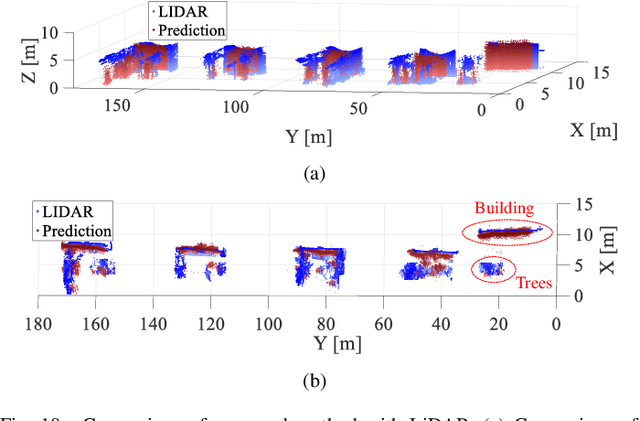
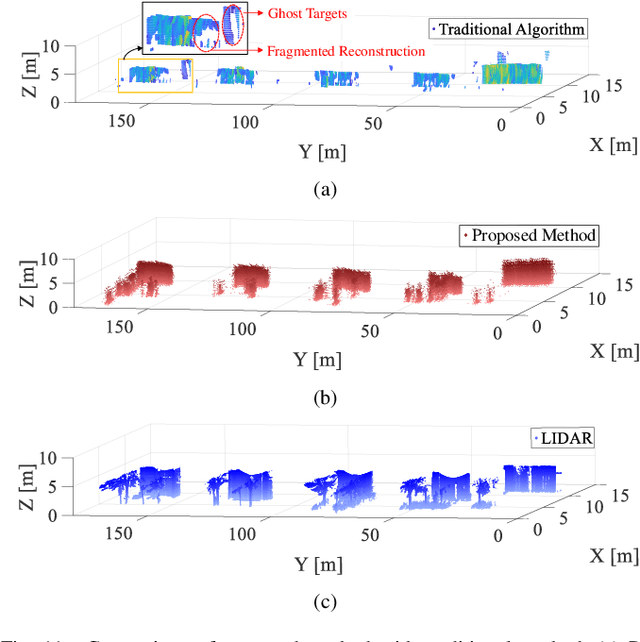
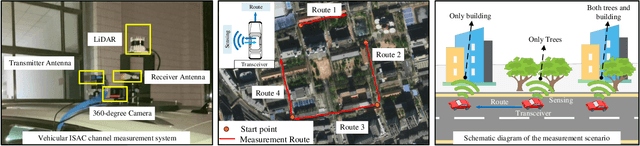
Integrated Sensing and Communication (ISAC) technology plays a critical role in future intelligent transportation systems, by enabling vehicles to perceive and reconstruct the surrounding environment through reuse of wireless signals, thereby reducing or even eliminating the need for additional sensors such as LiDAR or radar. However, existing ISAC based reconstruction methods often lack the ability to track dynamic scenes with sufficient accuracy and temporal consistency, limiting the real world applicability. To address this limitation, we propose a deep learning based framework for vehicular environment reconstruction by using ISAC channels. We first establish a joint channel environment dataset based on multi modal measurements from real world urban street scenarios. Then, a multistage deep learning network is developed to reconstruct the environment. Specifically, a scene decoder identifies the environmental context such as buildings, trees and so on; a cluster center decoder predicts coarse spatial layouts by localizing dominant scattering centers; a point cloud decoder recovers fine grained geometry and structure of surrounding environments. Experimental results demonstrate that the proposed method achieves high-quality dynamic environment reconstruction with a Chamfer Distance of 0.29 and F Score@1% of 0.87. In addition, complexity analysis demonstrates the efficiency and practical applicability of the method in real time scenarios. This work provides a pathway toward low cost environment reconstruction based on ISAC for future intelligent transportation.