 Add to Chrome
 Add to Firefox
 Add to Edge
When to Act, Ask, or Learn: Uncertainty-Aware Policy Steering
Feb 25, 2026
Policy steering is an emerging way to adapt robot behaviors at deployment-time: a learned verifier analyzes low-level action samples proposed by a pre-trained policy (e.g., diffusion policy) and selects only those aligned with the task. While Vision-Language Models (VLMs) are promising general-purpose verifiers due to their reasoning capabilities, existing frameworks often assume these models are well-calibrated. In practice, the overconfident judgment from VLM can degrade the steering performance under both high-level semantic uncertainty in task specifications and low-level action uncertainty or incapability of the pre-trained policy. We propose uncertainty-aware policy steering (UPS), a framework that jointly reasons about semantic task uncertainty and low-level action feasibility, and selects an uncertainty resolution strategy: execute a high-confidence action, clarify task ambiguity via natural language queries, or ask for action interventions to correct the low-level policy when it is deemed incapable at the task. We leverage conformal prediction to calibrate the composition of the VLM and the pre-trained base policy, providing statistical assurances that the verifier selects the correct strategy. After collecting interventions during deployment, we employ residual learning to improve the capability of the pre-trained policy, enabling the system to learn continually but with minimal expensive human feedback. We demonstrate our framework through experiments in simulation and on hardware, showing that UPS can disentangle confident, ambiguous, and incapable scenarios and minimizes expensive user interventions compared to uncalibrated baselines and prior human- or robot-gated continual learning approaches. Videos can be found at https://jessie-yuan.github.io/ups/

Towards an LLM-Based Speech Interface for Robot-Assisted Feeding
Oct 27, 2024Physically assistive robots present an opportunity to significantly increase the well-being and independence of individuals with motor impairments or other forms of disability who are unable to complete activities of daily living (ADLs). Speech interfaces, especially ones that utilize Large Language Models (LLMs), can enable individuals to effectively and naturally communicate high-level commands and nuanced preferences to robots. In this work, we demonstrate an LLM-based speech interface for a commercially available assistive feeding robot. Our system is based on an iteratively designed framework, from the paper "VoicePilot: Harnessing LLMs as Speech Interfaces for Physically Assistive Robots," that incorporates human-centric elements for integrating LLMs as interfaces for robots. It has been evaluated through a user study with 11 older adults at an independent living facility. Videos are located on our project website: https://sites.google.com/andrew.cmu.edu/voicepilot/.
VoicePilot: Harnessing LLMs as Speech Interfaces for Physically Assistive Robots
Apr 05, 2024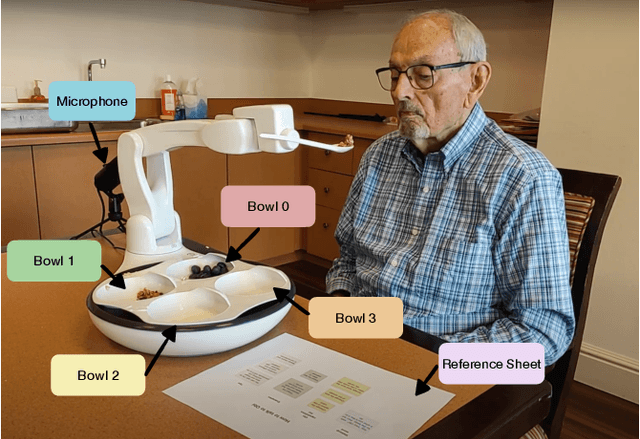
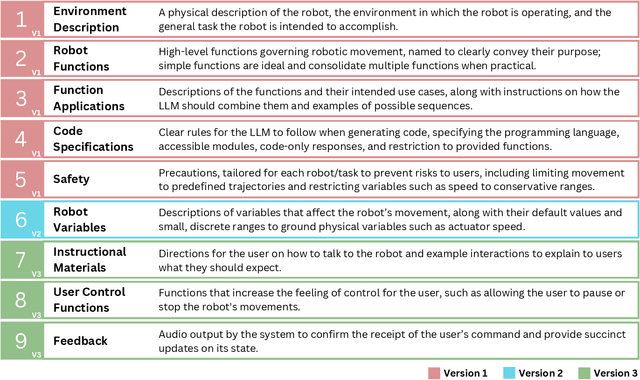
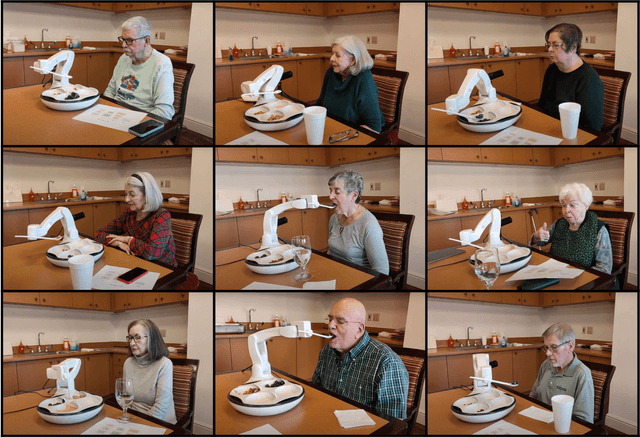
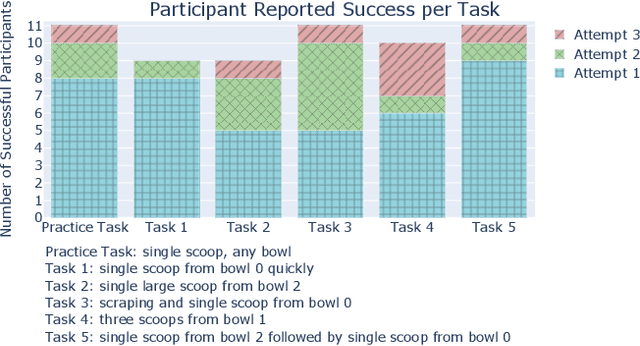
Physically assistive robots present an opportunity to significantly increase the well-being and independence of individuals with motor impairments or other forms of disability who are unable to complete activities of daily living. Speech interfaces, especially ones that utilize Large Language Models (LLMs), can enable individuals to effectively and naturally communicate high-level commands and nuanced preferences to robots. Frameworks for integrating LLMs as interfaces to robots for high level task planning and code generation have been proposed, but fail to incorporate human-centric considerations which are essential while developing assistive interfaces. In this work, we present a framework for incorporating LLMs as speech interfaces for physically assistive robots, constructed iteratively with 3 stages of testing involving a feeding robot, culminating in an evaluation with 11 older adults at an independent living facility. We use both quantitative and qualitative data from the final study to validate our framework and additionally provide design guidelines for using LLMs as speech interfaces for assistive robots. Videos and supporting files are located on our project website: https://sites.google.com/andrew.cmu.edu/voicepilot/