 Add to Chrome
 Add to Firefox
 Add to Edge
OctoSense: Self-Supervised Learning for Multimodal Robot Perception
Jun 25, 2026
We present OctoSense, an open-source sensor platform with stereo RGB and event cameras, LiDAR, a thermal camera, an inertial measurement unit, RTK-corrected global positioning system, and proprioception (CAN bus data from a car, and joint angles for a quadruped robot). The eponymous OctoSense dataset contains 59 hours of time-synchronized driving data across different types of environments at different times of the day, including situations with highly degraded sensors. We demonstrate multi-modal self-supervised learning using such real-world robotics data, where sensors have different representations, frequencies, latencies and noise. Our approach, a "late-fusion" masked autoencoder, (i) uses modality-specific tokenizers to account for different spatiotemporal characteristics of these sensors, and (ii) caches modality-specific tokens at inference time to process new measurements as they come. This architecture (i) is fast (6.68 ms and 112 ms on NVIDIA 5090 and Orin NX respectively, to compute the representation), (ii) performs better than existing image-only foundation models on tasks such as estimation of optical flow, depth, semantic segmentation, and ego-motion (translation, rotation, and steering angle), and (iii) predicts robustly at nighttime or in situations where sensory data is degraded. See our project page for links to the dataset, code, and supplementary videos: https://abisulco.com/octosense/.

A Multi-Robot Platform for Robotic Triage Combining Onboard Sensing and Foundation Models
Dec 09, 2025
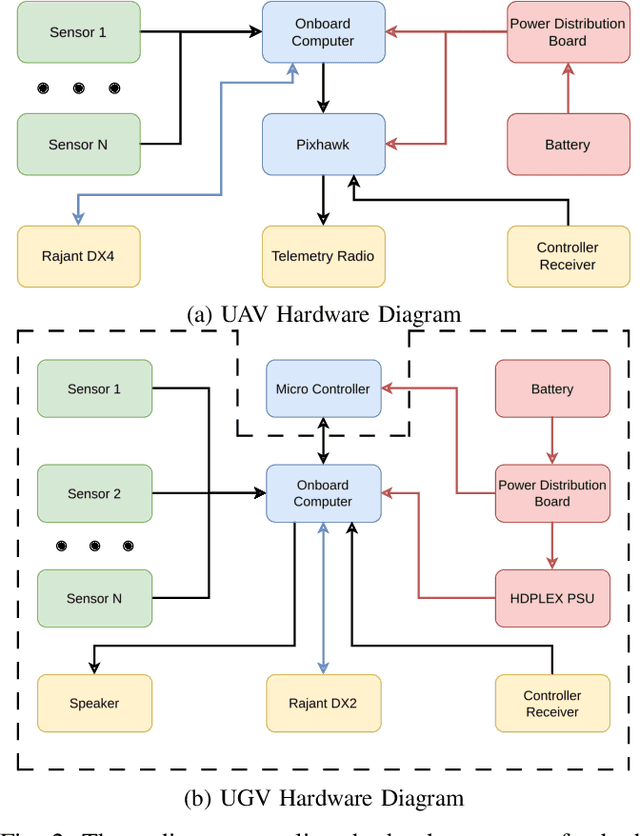
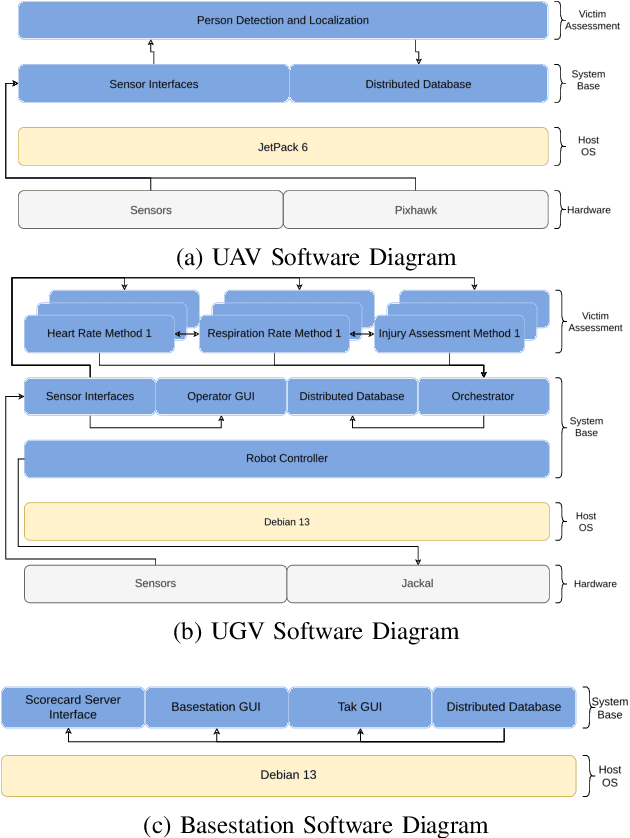
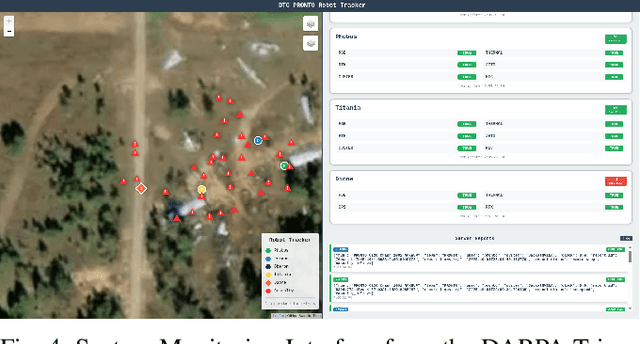
This report presents a heterogeneous robotic system designed for remote primary triage in mass-casualty incidents (MCIs). The system employs a coordinated air-ground team of unmanned aerial vehicles (UAVs) and unmanned ground vehicles (UGVs) to locate victims, assess their injuries, and prioritize medical assistance without risking the lives of first responders. The UAV identify and provide overhead views of casualties, while UGVs equipped with specialized sensors measure vital signs and detect and localize physical injuries. Unlike previous work that focused on exploration or limited medical evaluation, this system addresses the complete triage process: victim localization, vital sign measurement, injury severity classification, mental status assessment, and data consolidation for first responders. Developed as part of the DARPA Triage Challenge, this approach demonstrates how multi-robot systems can augment human capabilities in disaster response scenarios to maximize lives saved.