 Add to Chrome
 Add to Firefox
 Add to Edge
TDMM-LM: Bridging Facial Understanding and Animation via Language Models
Mar 14, 2026
Text-guided human body animation has advanced rapidly, yet facial animation lags due to the scarcity of well-annotated, text-paired facial corpora. To close this gap, we leverage foundation generative models to synthesize a large, balanced corpus of facial behavior. We design prompts suite covering emotions and head motions, generate about 80 hours of facial videos with multiple generators, and fit per-frame 3D facial parameters, yielding large-scale (prompt and parameter) pairs for training. Building on this dataset, we probe language models for bidirectional competence over facial motion via two complementary tasks: (1) Motion2Language: given a sequence of 3D facial parameters, the model produces natural-language descriptions capturing content, style, and dynamics; and (2) Language2Motion: given a prompt, the model synthesizes the corresponding sequence of 3D facial parameters via quantized motion tokens for downstream animation. Extensive experiments show that in this setting language models can both interpret and synthesize facial motion with strong generalization. To best of our knowledge, this is the first work to cast facial-parameter modeling as a language problem, establishing a unified path for text-conditioned facial animation and motion understanding.

A Critical Investigation of Deep Reinforcement Learning for Navigation
Jan 04, 2019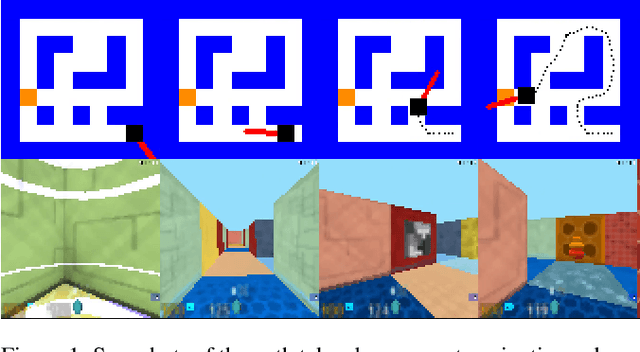
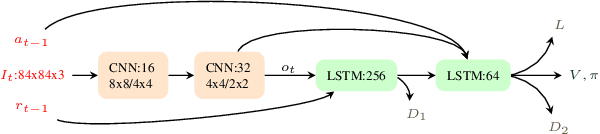
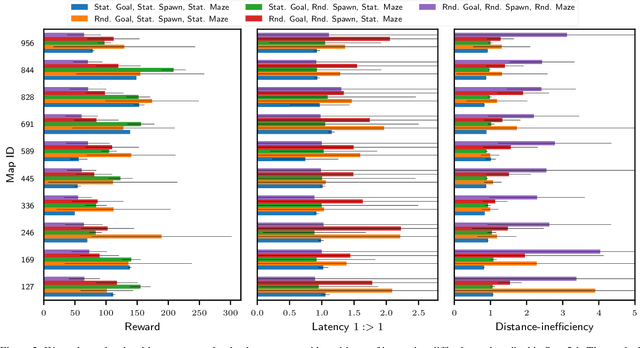
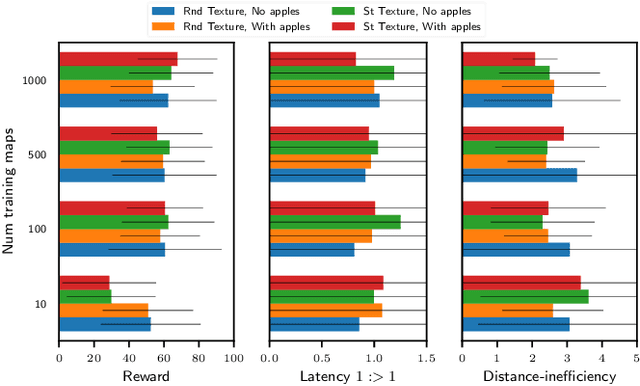
The navigation problem is classically approached in two steps: an exploration step, where map-information about the environment is gathered; and an exploitation step, where this information is used to navigate efficiently. Deep reinforcement learning (DRL) algorithms, alternatively, approach the problem of navigation in an end-to-end fashion. Inspired by the classical approach, we ask whether DRL algorithms are able to inherently explore, gather and exploit map-information over the course of navigation. We build upon Mirowski et al. [2017] work and introduce a systematic suite of experiments that vary three parameters: the agent's starting location, the agent's target location, and the maze structure. We choose evaluation metrics that explicitly measure the algorithm's ability to gather and exploit map-information. Our experiments show that when trained and tested on the same maps, the algorithm successfully gathers and exploits map-information. However, when trained and tested on different sets of maps, the algorithm fails to transfer the ability to gather and exploit map-information to unseen maps. Furthermore, we find that when the goal location is randomized and the map is kept static, the algorithm is able to gather and exploit map-information but the exploitation is far from optimal. We open-source our experimental suite in the hopes that it serves as a framework for the comparison of future algorithms and leads to the discovery of robust alternatives to classical navigation methods.