 Add to Chrome
 Add to Firefox
 Add to Edge
RUMLEM: A Dictionary-Based Lemmatizer for Romansh
Apr 13, 2026
Lemmatization -- the task of mapping an inflected word form to its dictionary form -- is a crucial component of many NLP applications. In this paper, we present RUMLEM, a lemmatizer that covers the five main varieties of Romansh as well as the supra-regional standard variety Rumantsch Grischun. It is based on comprehensive, community-driven morphological databases for Romansh, enabling RUMLEM to cover 77-84% of the words in a typical Romansh text. Since there is a dedicated database for each Romansh variety, an additional application of RUMLEM is variety-aware language classification. Evaluation on 30'000 Romansh texts of varying lengths shows that RUMLEM correctly identifies the variety in 95% of cases. In addition, a proof of concept demonstrates the feasibility of Romansh vs. non-Romansh language classification based on the lemmatizer.

Translation Asymmetry in LLMs as a Data Augmentation Factor: A Case Study for 6 Romansh Language Varieties
Mar 26, 2026Recent strategies for low-resource machine translation rely on LLMs to generate synthetic data from higher-resource languages. We find that this method fails for Romansh, because LLMs tend to confuse its 6 distinct language varieties. Our experiments show that instead, the direction of data augmentation should be aligned with the resource gradient between source and target language. This approach surpasses Gemini 3 Pro in the lowest-resource variety of Romansh by 23 BLEU. A human evaluation confirms that our experiments yield the first model that generates fluent translations in the individual Romansh varieties.
Robust Language Identification for Romansh Varieties
Mar 16, 2026The Romansh language has several regional varieties, called idioms, which sometimes have limited mutual intelligibility. Despite this linguistic diversity, there has been a lack of documented efforts to build a language identification (LID) system that can distinguish between these idioms. Since Romansh LID should also be able to recognize Rumantsch Grischun, a supra-regional variety that combines elements of several idioms, this makes for a novel and interesting classification problem. In this paper, we present a LID system for Romansh idioms based on an SVM approach. We evaluate our model on a newly curated benchmark across two domains and find that it reaches an average in-domain accuracy of 97%, enabling applications such as idiom-aware spell checking or machine translation. Our classifier is publicly available.
DeReason: A Difficulty-Aware Curriculum Improves Decoupled SFT-then-RL Training for General Reasoning
Mar 11, 2026Reinforcement learning with Verifiable Rewards (RLVR) has emerged as a powerful paradigm for eliciting reasoning capabilities in large language models, particularly in mathematics and coding. While recent efforts have extended this paradigm to broader general scientific (STEM) domains, the complex interplay between supervised fine-tuning (SFT) and RL in these contexts remains underexplored. In this paper, we conduct controlled experiments revealing a critical challenge: for general STEM domains, RL applied directly to base models is highly sample-inefficient and is consistently surpassed by supervised fine-tuning (SFT) on moderate-quality responses. Yet sequential SFT followed by RL can further improve performance, suggesting that the two stages play complementary roles, and that how training data is allocated between them matters. Therefore, we propose DeReason, a difficulty-based data decoupling strategy for general reasoning. DeReason partitions training data by reasoning intensity estimated via LLM-based scoring into reasoning-intensive and non-reasoning-intensive subsets. It allocates broad-coverage, non-reasoning-intensive problems to SFT to establish foundational domain knowledge, and reserves a focused subset of difficult problems for RL to cultivate complex reasoning. We demonstrate that this principled decoupling yields better performance than randomly splitting the data for sequential SFT and RL. Extensive experiments on general STEM and mathematical benchmarks demonstrate that our decoupled curriculum training significantly outperforms SFT-only, RL-only, and random-split baselines. Our work provides a systematic study of the interplay between SFT and RL for general reasoning, offering a highly effective and generalized post-training recipe.
SwissGov-RSD: A Human-annotated, Cross-lingual Benchmark for Token-level Recognition of Semantic Differences Between Related Documents
Dec 08, 2025Recognizing semantic differences across documents, especially in different languages, is crucial for text generation evaluation and multilingual content alignment. However, as a standalone task it has received little attention. We address this by introducing SwissGov-RSD, the first naturalistic, document-level, cross-lingual dataset for semantic difference recognition. It encompasses a total of 224 multi-parallel documents in English-German, English-French, and English-Italian with token-level difference annotations by human annotators. We evaluate a variety of open-source and closed source large language models as well as encoder models across different fine-tuning settings on this new benchmark. Our results show that current automatic approaches perform poorly compared to their performance on monolingual, sentence-level, and synthetic benchmarks, revealing a considerable gap for both LLMs and encoder models. We make our code and datasets publicly available.
Apertus: Democratizing Open and Compliant LLMs for Global Language Environments
Sep 17, 2025
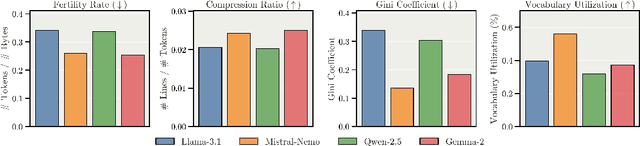

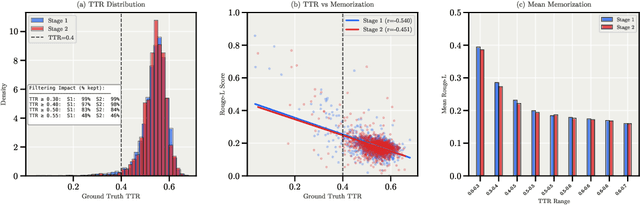
We present Apertus, a fully open suite of large language models (LLMs) designed to address two systemic shortcomings in today's open model ecosystem: data compliance and multilingual representation. Unlike many prior models that release weights without reproducible data pipelines or regard for content-owner rights, Apertus models are pretrained exclusively on openly available data, retroactively respecting robots.txt exclusions and filtering for non-permissive, toxic, and personally identifiable content. To mitigate risks of memorization, we adopt the Goldfish objective during pretraining, strongly suppressing verbatim recall of data while retaining downstream task performance. The Apertus models also expand multilingual coverage, training on 15T tokens from over 1800 languages, with ~40% of pretraining data allocated to non-English content. Released at 8B and 70B scales, Apertus approaches state-of-the-art results among fully open models on multilingual benchmarks, rivalling or surpassing open-weight counterparts. Beyond model weights, we release all scientific artifacts from our development cycle with a permissive license, including data preparation scripts, checkpoints, evaluation suites, and training code, enabling transparent audit and extension.
20min-XD: A Comparable Corpus of Swiss News Articles
Apr 30, 2025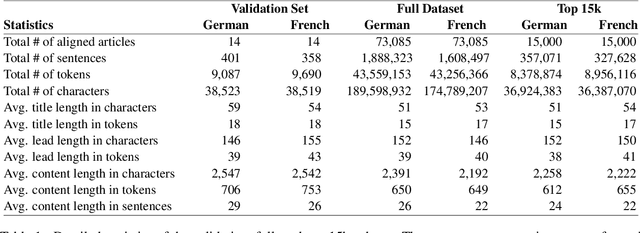
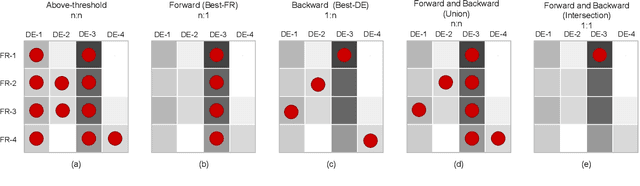
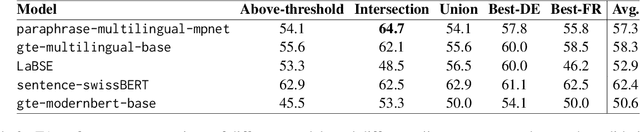
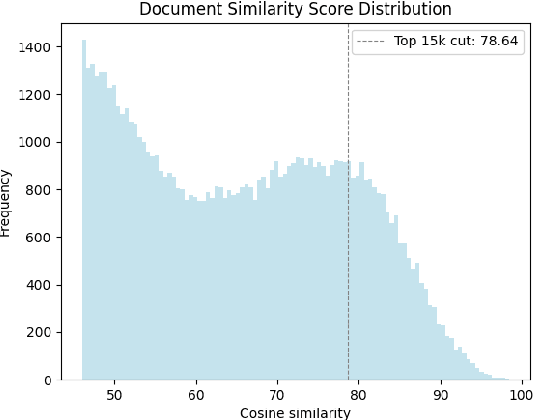
We present 20min-XD (20 Minuten cross-lingual document-level), a French-German, document-level comparable corpus of news articles, sourced from the Swiss online news outlet 20 Minuten/20 minutes. Our dataset comprises around 15,000 article pairs spanning 2015 to 2024, automatically aligned based on semantic similarity. We detail the data collection process and alignment methodology. Furthermore, we provide a qualitative and quantitative analysis of the corpus. The resulting dataset exhibits a broad spectrum of cross-lingual similarity, ranging from near-translations to loosely related articles, making it valuable for various NLP applications and broad linguistically motivated studies. We publicly release the dataset in document- and sentence-aligned versions and code for the described experiments.
Source-primed Multi-turn Conversation Helps Large Language Models Translate Documents
Mar 13, 2025LLMs have paved the way for truly simple document-level machine translation, but challenges such as omission errors remain. In this paper, we study a simple method for handling document-level machine translation, by leveraging previous contexts in a multi-turn conversational manner. Specifically, by decomposing documents into segments and iteratively translating them while maintaining previous turns, this method ensures coherent translations without additional training, and can fully re-use the KV cache of previous turns thus minimizing computational overhead. We further propose a `source-primed' method that first provides the whole source document before multi-turn translation. We empirically show this multi-turn method outperforms both translating entire documents in a single turn and translating each segment independently according to multiple automatic metrics in representative LLMs, establishing a strong baseline for document-level translation using LLMs.
Fine-tuning the SwissBERT Encoder Model for Embedding Sentences and Documents
May 13, 2024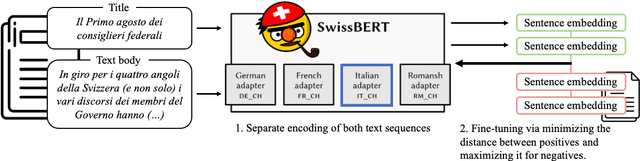
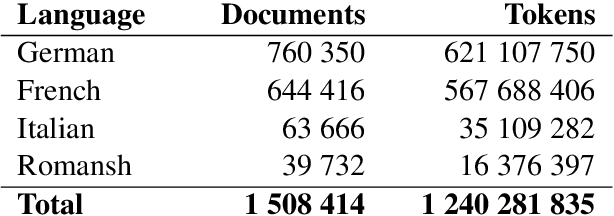
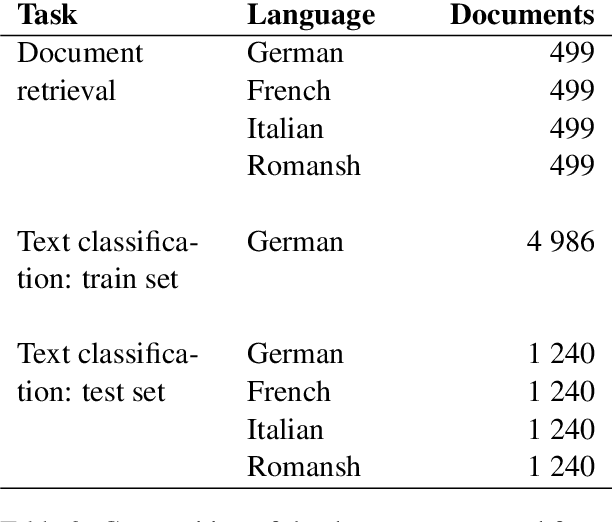
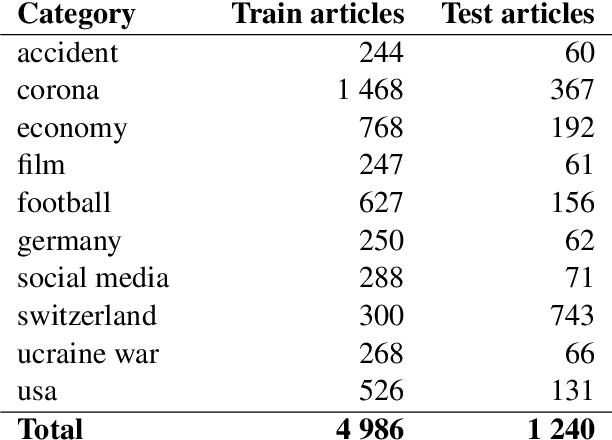
Encoder models trained for the embedding of sentences or short documents have proven useful for tasks such as semantic search and topic modeling. In this paper, we present a version of the SwissBERT encoder model that we specifically fine-tuned for this purpose. SwissBERT contains language adapters for the four national languages of Switzerland -- German, French, Italian, and Romansh -- and has been pre-trained on a large number of news articles in those languages. Using contrastive learning based on a subset of these articles, we trained a fine-tuned version, which we call SentenceSwissBERT. Multilingual experiments on document retrieval and text classification in a Switzerland-specific setting show that SentenceSwissBERT surpasses the accuracy of the original SwissBERT model and of a comparable baseline. The model is openly available for research use.
Linear-time Minimum Bayes Risk Decoding with Reference Aggregation
Feb 06, 2024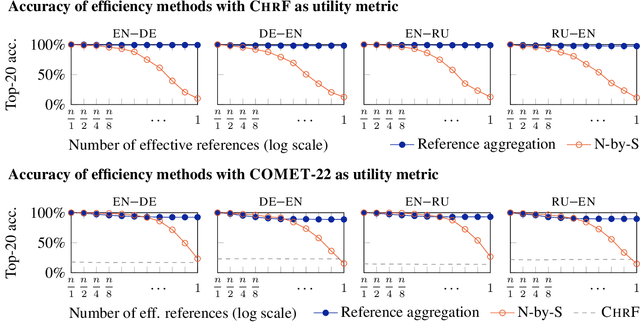
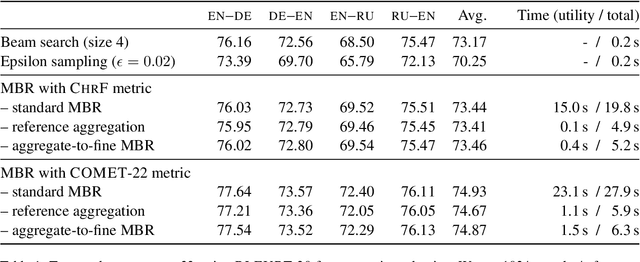
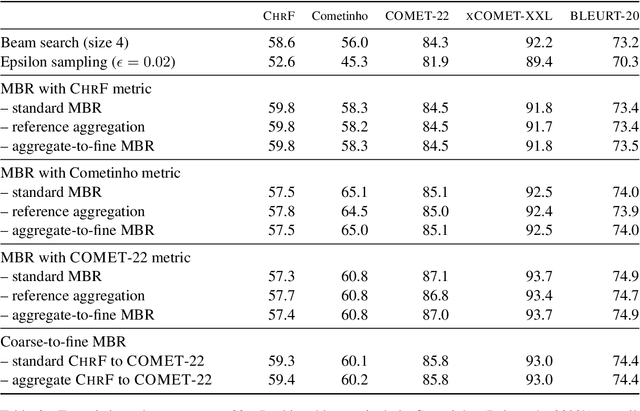

Minimum Bayes Risk (MBR) decoding is a text generation technique that has been shown to improve the quality of machine translations, but is expensive, even if a sampling-based approximation is used. Besides requiring a large number of sampled sequences, it requires the pairwise calculation of a utility metric, which has quadratic complexity. In this paper, we propose to approximate pairwise metric scores with scores calculated against aggregated reference representations. This changes the complexity of utility estimation from $O(n^2)$ to $O(n)$, while empirically preserving most of the quality gains of MBR decoding. We release our source code at https://github.com/ZurichNLP/mbr