 Add to Chrome
 Add to Firefox
 Add to Edge
It's Not What You Say, It's How You Say It: Evaluating LLM Responses to Expressions of Belief
Jul 20, 2026
Users frequently express their beliefs to large language models (LLMs). In some situations, the LLM should accept these contextual beliefs as true. In others, they should stick to their prior knowledge. Notably, users' expressions of belief (EoBs) can take linguistically diverse forms - using presuppositions, evidential and certainty markers, or varied tones - each of which may have a different persuasiveness over the LLMs. We introduce a typology to systematically evaluate how different EoBs affect whether models follow context versus prior knowledge. The typology is grounded in four linguistically motivated dimensions: form, evidentiality, epistemic stance, and tone, spanning 17 fine-grained types. By pairing these EoBs with world knowledge facts, we generate controlled EoB-query pairs that isolate the effect of linguistic variation. Using this benchmark, we evaluate 16 LLMs that differ in architecture (Llama3, Qwen3, Gemma3), scale (1B-30B parameters), and training stages (base vs instruct). We identify meaningful variations in response behavior across these axes, e.g., that bigger models and instruction models tend to be less context-following than smaller models and base models. We further identify specific EoBs that statistically significantly persuade LMs more consistently than others. Our work reveals systematic patterns in how linguistic framing affects LLM context integration, with implications for prompt engineering and model robustness.

ALEE: Any-Language Evaluation of Embeddings via English-Centric Minimal Pairs
Jun 30, 2026Text embeddings are standard for semantic similarity tasks, yet their evaluation remains an open challenge. Current benchmarks are static, cover only a limited set of languages, are often domain-specific, susceptible to overfitting, and poorly representative of low-resource languages. To address these limitations, we introduce ALEE, a framework that extends Sentence Smith (Li et al., 2025) to the cross-lingual and paragraph level. ALEE uses Abstract Meaning Representations (AMR) to generate English minimal pairs with controlled, fine-grained semantic shifts, which are paired with translations in target languages. This approach enables targeted diagnostics for models in any language with English parallel data. We conduct a large-scale empirical study across a diverse set of embedding models and 275+ languages spanning three parallel datasets. On ALEE, performance varies substantially across languages, text lengths, and linguistic phenomena, exposing persistent gaps in cross-lingual semantic representation that track language prevalence in training resources and subword tokenization. We release ALEE at https://github.com/Andrian0s/any-lang-embed-eval
SwissGov-RSD: A Human-annotated, Cross-lingual Benchmark for Token-level Recognition of Semantic Differences Between Related Documents
Dec 08, 2025Recognizing semantic differences across documents, especially in different languages, is crucial for text generation evaluation and multilingual content alignment. However, as a standalone task it has received little attention. We address this by introducing SwissGov-RSD, the first naturalistic, document-level, cross-lingual dataset for semantic difference recognition. It encompasses a total of 224 multi-parallel documents in English-German, English-French, and English-Italian with token-level difference annotations by human annotators. We evaluate a variety of open-source and closed source large language models as well as encoder models across different fine-tuning settings on this new benchmark. Our results show that current automatic approaches perform poorly compared to their performance on monolingual, sentence-level, and synthetic benchmarks, revealing a considerable gap for both LLMs and encoder models. We make our code and datasets publicly available.
20min-XD: A Comparable Corpus of Swiss News Articles
Apr 30, 2025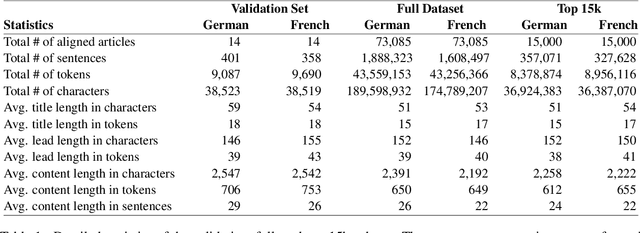
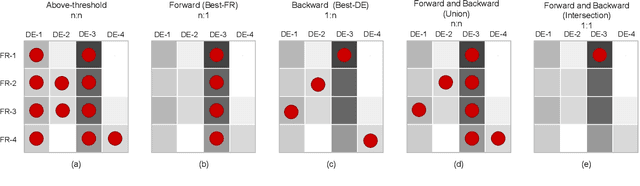
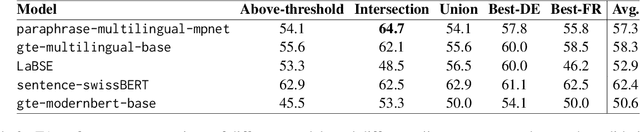
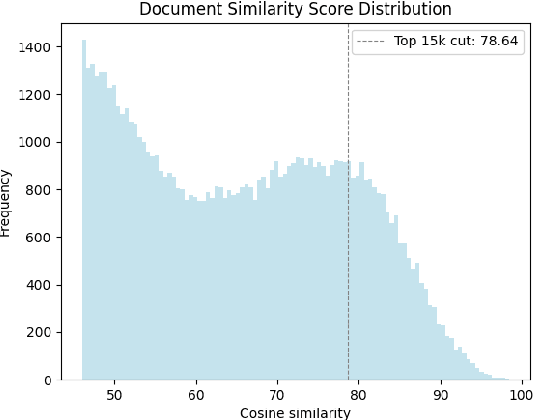
We present 20min-XD (20 Minuten cross-lingual document-level), a French-German, document-level comparable corpus of news articles, sourced from the Swiss online news outlet 20 Minuten/20 minutes. Our dataset comprises around 15,000 article pairs spanning 2015 to 2024, automatically aligned based on semantic similarity. We detail the data collection process and alignment methodology. Furthermore, we provide a qualitative and quantitative analysis of the corpus. The resulting dataset exhibits a broad spectrum of cross-lingual similarity, ranging from near-translations to loosely related articles, making it valuable for various NLP applications and broad linguistically motivated studies. We publicly release the dataset in document- and sentence-aligned versions and code for the described experiments.
Machine Translation Models are Zero-Shot Detectors of Translation Direction
Jan 12, 2024

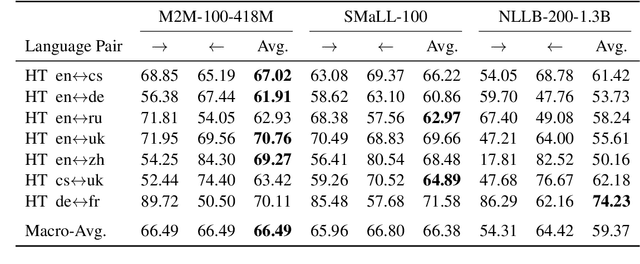
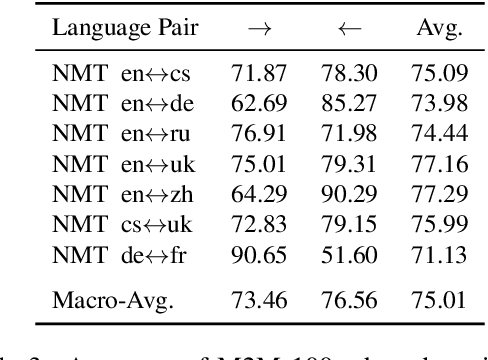
Detecting the translation direction of parallel text has applications for machine translation training and evaluation, but also has forensic applications such as resolving plagiarism or forgery allegations. In this work, we explore an unsupervised approach to translation direction detection based on the simple hypothesis that $p(\text{translation}|\text{original})>p(\text{original}|\text{translation})$, motivated by the well-known simplification effect in translationese or machine-translationese. In experiments with massively multilingual machine translation models across 20 translation directions, we confirm the effectiveness of the approach for high-resource language pairs, achieving document-level accuracies of 82-96% for NMT-produced translations, and 60-81% for human translations, depending on the model used. Code and demo are available at https://github.com/ZurichNLP/translation-direction-detection