 Add to Chrome
 Add to Firefox
 Add to Edge
Entropy-Augmented Multi-Objective Policy Optimization in Multiagent Systems
Aug 12, 2026
Autonomous agent teams deployed in settings such as marine and extraterrestrial outposts must coordinate actions to achieve optimal outcomes across multiple competing objectives. Multi-objective evolutionary algorithms such as NSGA-II optimize for diversity in the objective space, but neglect diversity in the behavior space, possibly leading to premature convergence and a collapse in behaviors that may differentiate policies in different external conditions. To address this, we introduce an entropy-augmented policy evaluation strategy that incorporates an entropy bonus into agent fitness scores, discouraging behavioral homogeneity across the evolving population. By augmenting policy evaluation with a behavior-space diversity signal while preserving the underlying Pareto optimization framework, our method is designed to encourage exploration of behaviorally distinct policies in multiagent domains. We evaluate our approach across rover-domain experiments with qualitatively distinct reward structures and observe hypervolume improvements of up to 48% relative to the NSGA-II baseline, suggesting that behavioral diversity is a promising and underexplored direction for improving multi-objective multiagent evolutionary optimization.

Unsupervised Change Detection for Space Habitats Using 3D Point Clouds
Dec 04, 2023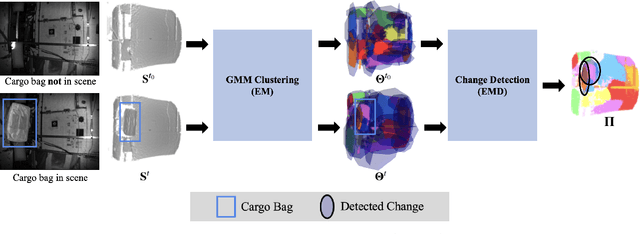

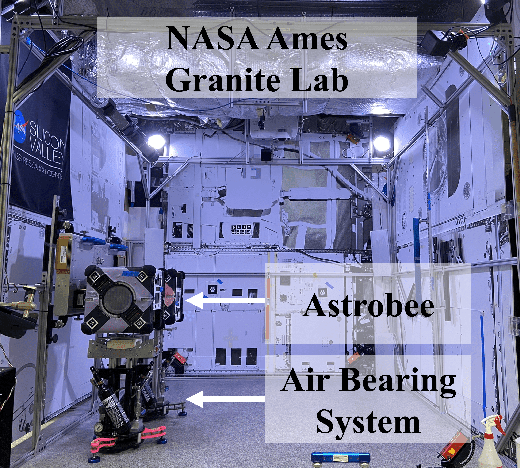
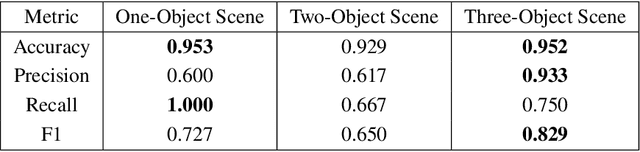
This work presents an algorithm for scene change detection from point clouds to enable autonomous robotic caretaking in future space habitats. Autonomous robotic systems will help maintain future deep-space habitats, such as the Gateway space station, which will be uncrewed for extended periods. Existing scene analysis software used on the International Space Station (ISS) relies on manually-labeled images for detecting changes. In contrast, the algorithm presented in this work uses raw, unlabeled point clouds as inputs. The algorithm first applies modified Expectation-Maximization Gaussian Mixture Model (GMM) clustering to two input point clouds. It then performs change detection by comparing the GMMs using the Earth Mover's Distance. The algorithm is validated quantitatively and qualitatively using a test dataset collected by an Astrobee robot in the NASA Ames Granite Lab comprising single frame depth images taken directly by Astrobee and full-scene reconstructed maps built with RGB-D and pose data from Astrobee. The runtimes of the approach are also analyzed in depth. The source code is publicly released to promote further development.
Multi-Agent 3D Map Reconstruction and Change Detection in Microgravity with Free-Flying Robots
Nov 05, 2023Assistive free-flyer robots autonomously caring for future crewed outposts -- such as NASA's Astrobee robots on the International Space Station (ISS) -- must be able to detect day-to-day interior changes to track inventory, detect and diagnose faults, and monitor the outpost status. This work presents a framework for multi-agent cooperative mapping and change detection to enable robotic maintenance of space outposts. One agent is used to reconstruct a 3D model of the environment from sequences of images and corresponding depth information. Another agent is used to periodically scan the environment for inconsistencies against the 3D model. Change detection is validated after completing the surveys using real image and pose data collected by Astrobee robots in a ground testing environment and from microgravity aboard the ISS. This work outlines the objectives, requirements, and algorithmic modules for the multi-agent reconstruction system, including recommendations for its use by assistive free-flyers aboard future microgravity outposts.