 Add to Chrome
 Add to Firefox
 Add to Edge
Sub-metre Lunar DEM Generation and Validation from Chandrayaan-2 OHRC Multi-View Imagery Using Open-Source Photogrammetry
Apr 01, 2026
High-resolution digital elevation models (DEMs) of the lunar surface are essential for surface mobility planning, landing site characterization, and planetary science. The Orbiter High Resolution Camera (OHRC) on board Chandrayaan-2 has the best ground sampling capabilities of any lunar orbital imaging currently in use by acquiring panchromatic imagery at a resolution of roughly 20-30 cm per pixel. This work presents, for the first time, the generation of sub-metre DEMs from OHRC multi-view imagery using an exclusively open-source pipeline. Candidate stereo pairs are identified from non-paired OHRC archives through geometric analysis of image metadata, employing baseline-to-height (B/H) ratio computation and convergence angle estimation. Dense stereo correspondence and ray triangulation are then applied to generate point clouds, which are gridded into DEMs at effective spatial resolutions between approximately 24 and 54 cm across five geographically distributed lunar sites. Absolute elevation consistency is established through Iterative Closest Point (ICP) alignment against Lunar Reconnaissance Orbiter Narrow Angle Camera (NAC) Digital Terrain Models, followed by constant-bias offset correction. Validation against NAC reference terrain yields a vertical RMSE of 5.85 m (at native OHRC resolution), and a horizontal accuracy of less than 30 cm assessed by planimetric feature matching.

Unsupervised Change Detection for Space Habitats Using 3D Point Clouds
Dec 04, 2023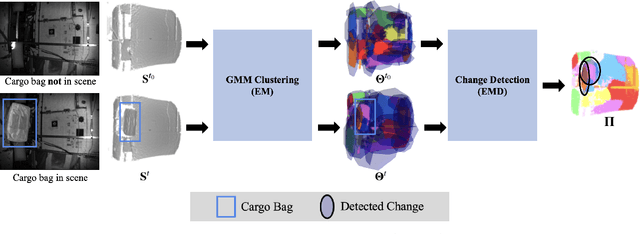

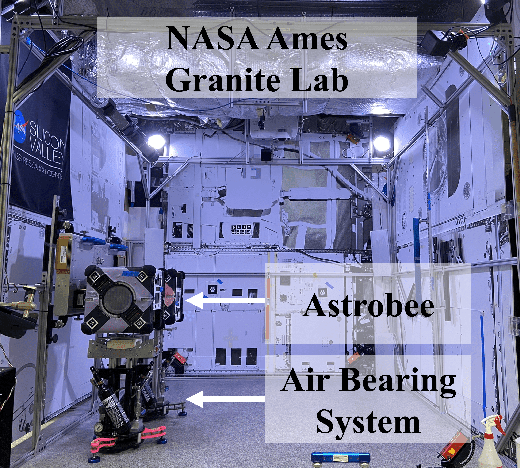
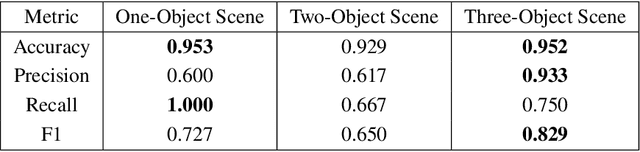
This work presents an algorithm for scene change detection from point clouds to enable autonomous robotic caretaking in future space habitats. Autonomous robotic systems will help maintain future deep-space habitats, such as the Gateway space station, which will be uncrewed for extended periods. Existing scene analysis software used on the International Space Station (ISS) relies on manually-labeled images for detecting changes. In contrast, the algorithm presented in this work uses raw, unlabeled point clouds as inputs. The algorithm first applies modified Expectation-Maximization Gaussian Mixture Model (GMM) clustering to two input point clouds. It then performs change detection by comparing the GMMs using the Earth Mover's Distance. The algorithm is validated quantitatively and qualitatively using a test dataset collected by an Astrobee robot in the NASA Ames Granite Lab comprising single frame depth images taken directly by Astrobee and full-scene reconstructed maps built with RGB-D and pose data from Astrobee. The runtimes of the approach are also analyzed in depth. The source code is publicly released to promote further development.
Multi-Agent 3D Map Reconstruction and Change Detection in Microgravity with Free-Flying Robots
Nov 05, 2023Assistive free-flyer robots autonomously caring for future crewed outposts -- such as NASA's Astrobee robots on the International Space Station (ISS) -- must be able to detect day-to-day interior changes to track inventory, detect and diagnose faults, and monitor the outpost status. This work presents a framework for multi-agent cooperative mapping and change detection to enable robotic maintenance of space outposts. One agent is used to reconstruct a 3D model of the environment from sequences of images and corresponding depth information. Another agent is used to periodically scan the environment for inconsistencies against the 3D model. Change detection is validated after completing the surveys using real image and pose data collected by Astrobee robots in a ground testing environment and from microgravity aboard the ISS. This work outlines the objectives, requirements, and algorithmic modules for the multi-agent reconstruction system, including recommendations for its use by assistive free-flyers aboard future microgravity outposts.