 Add to Chrome
 Add to Firefox
 Add to Edge
Entropy-Augmented Multi-Objective Policy Optimization in Multiagent Systems
Aug 12, 2026
Autonomous agent teams deployed in settings such as marine and extraterrestrial outposts must coordinate actions to achieve optimal outcomes across multiple competing objectives. Multi-objective evolutionary algorithms such as NSGA-II optimize for diversity in the objective space, but neglect diversity in the behavior space, possibly leading to premature convergence and a collapse in behaviors that may differentiate policies in different external conditions. To address this, we introduce an entropy-augmented policy evaluation strategy that incorporates an entropy bonus into agent fitness scores, discouraging behavioral homogeneity across the evolving population. By augmenting policy evaluation with a behavior-space diversity signal while preserving the underlying Pareto optimization framework, our method is designed to encourage exploration of behaviorally distinct policies in multiagent domains. We evaluate our approach across rover-domain experiments with qualitatively distinct reward structures and observe hypervolume improvements of up to 48% relative to the NSGA-II baseline, suggesting that behavioral diversity is a promising and underexplored direction for improving multi-objective multiagent evolutionary optimization.

Post Hoc Extraction of Pareto Fronts for Continuous Control
Mar 03, 2026Agents in the real world must often balance multiple objectives, such as speed, stability, and energy efficiency in continuous control. To account for changing conditions and preferences, an agent must ideally learn a Pareto frontier of policies representing multiple optimal trade-offs. Recent advances in multi-policy multi-objective reinforcement learning (MORL) enable learning a Pareto front directly, but require full multi-objective consideration from the start of training. In practice, multi-objective preferences often arise after a policy has already been trained on a single specialised objective. Existing MORL methods cannot leverage these pre-trained `specialists' to learn Pareto fronts and avoid incurring the sample costs of retraining. We introduce Mixed Advantage Pareto Extraction (MAPEX), an offline MORL method that constructs a frontier of policies by reusing pre-trained specialist policies, critics, and replay buffers. MAPEX combines evaluations from specialist critics into a mixed advantage signal, and weights a behaviour cloning loss with it to train new policies that balance multiple objectives. MAPEX's post hoc Pareto front extraction preserves the simplicity of single-objective off-policy RL, and avoids retrofitting these algorithms into complex MORL frameworks. We formally describe the MAPEX procedure and evaluate MAPEX on five multi-objective MuJoCo environments. Given the same starting policies, MAPEX produces comparable fronts at $0.001\%$ the sample cost of established baselines.
A COLREGs-Compliant Conflict Resolution Strategy for Autonomous Surface Vehicles
Dec 13, 2023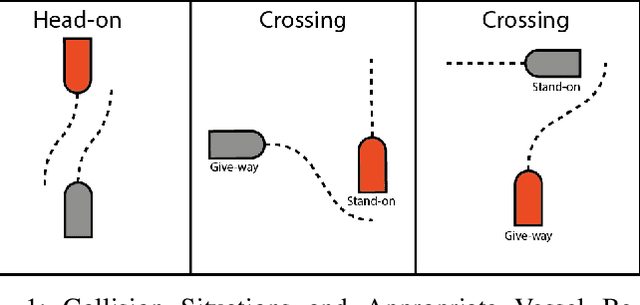
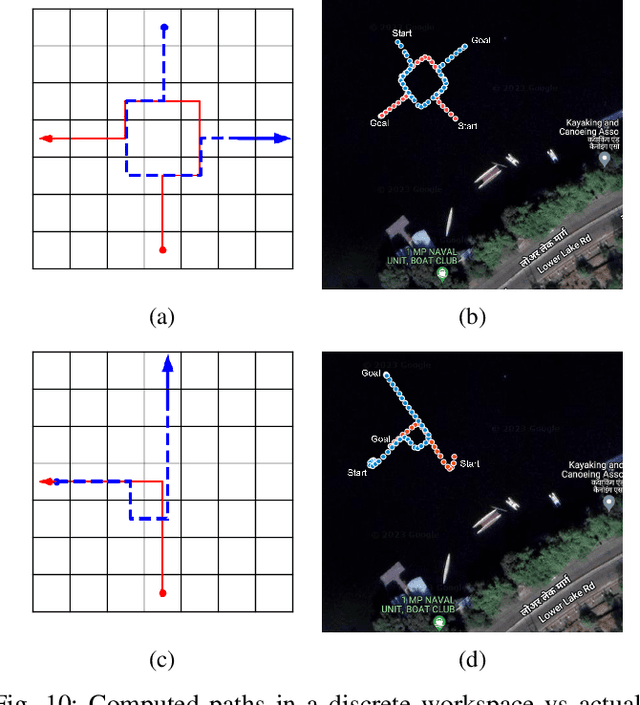
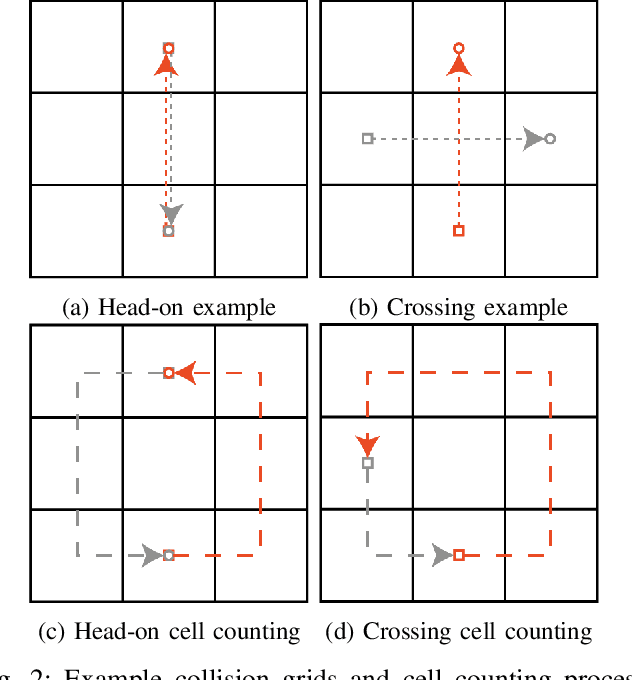
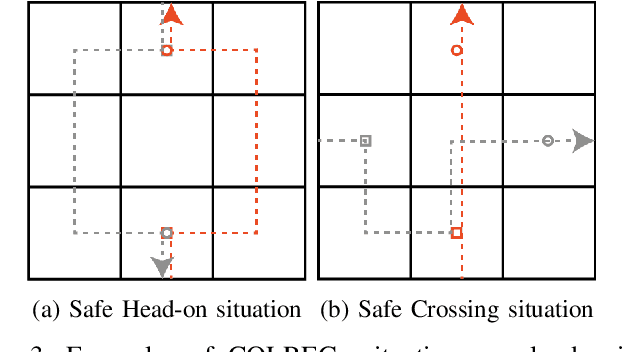
This paper presents a novel conflict resolution strategy for autonomous surface vehicles (ASVs) to safely navigate and avoid collisions in a multi-vessel environment at sea. Collisions between two or more marine vessels must be avoided by following the International Regulations for Preventing Collisions at Sea (COLREGs). We propose strategy a two-phase strategy called as COLREGs Compliant Conflict-Resolving (COMCORE) strategy, that generates collision-free trajectories for ASVs while complying with COLREGs. In phase-1, a shortest path for each agent is determined, while in phase-2 conflicts are detected and resolved by modifying the path in compliance with COLREGs. COMCORE solution optimises vessel trajectories for lower costs while also providing a safe and collision-free plan for each vessel. Simulation results are presented to show the applicability of COMCORE for larger number agents with very low computational requirement and hence scalable. Further, we experimentally demonstrate COMCORE for two ASVs in a lake to show its ability to determine solution and implementation capability in the real-world.