 Add to Chrome
 Add to Firefox
 Add to Edge
Entropy-Augmented Multi-Objective Policy Optimization in Multiagent Systems
Aug 12, 2026
Autonomous agent teams deployed in settings such as marine and extraterrestrial outposts must coordinate actions to achieve optimal outcomes across multiple competing objectives. Multi-objective evolutionary algorithms such as NSGA-II optimize for diversity in the objective space, but neglect diversity in the behavior space, possibly leading to premature convergence and a collapse in behaviors that may differentiate policies in different external conditions. To address this, we introduce an entropy-augmented policy evaluation strategy that incorporates an entropy bonus into agent fitness scores, discouraging behavioral homogeneity across the evolving population. By augmenting policy evaluation with a behavior-space diversity signal while preserving the underlying Pareto optimization framework, our method is designed to encourage exploration of behaviorally distinct policies in multiagent domains. We evaluate our approach across rover-domain experiments with qualitatively distinct reward structures and observe hypervolume improvements of up to 48% relative to the NSGA-II baseline, suggesting that behavioral diversity is a promising and underexplored direction for improving multi-objective multiagent evolutionary optimization.

Counterfactual Conditional Likelihood Rewards for Multiagent Exploration
Feb 12, 2026Efficient exploration is critical for multiagent systems to discover coordinated strategies, particularly in open-ended domains such as search and rescue or planetary surveying. However, when exploration is encouraged only at the individual agent level, it often leads to redundancy, as agents act without awareness of how their teammates are exploring. In this work, we introduce Counterfactual Conditional Likelihood (CCL) rewards, which score each agent's exploration by isolating its unique contribution to team exploration. Unlike prior methods that reward agents solely for the novelty of their individual observations, CCL emphasizes observations that are informative with respect to the joint exploration of the team. Experiments in continuous multiagent domains show that CCL rewards accelerate learning for domains with sparse team rewards, where most joint actions yield zero rewards, and are particularly effective in tasks that require tight coordination among agents.
Safe Multiagent Coordination via Entropic Exploration
Dec 29, 2024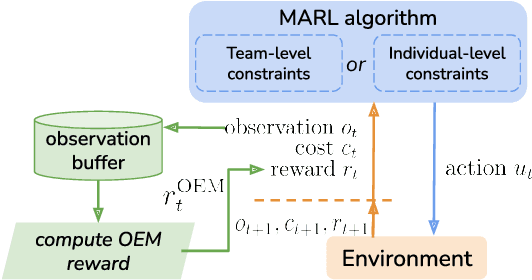
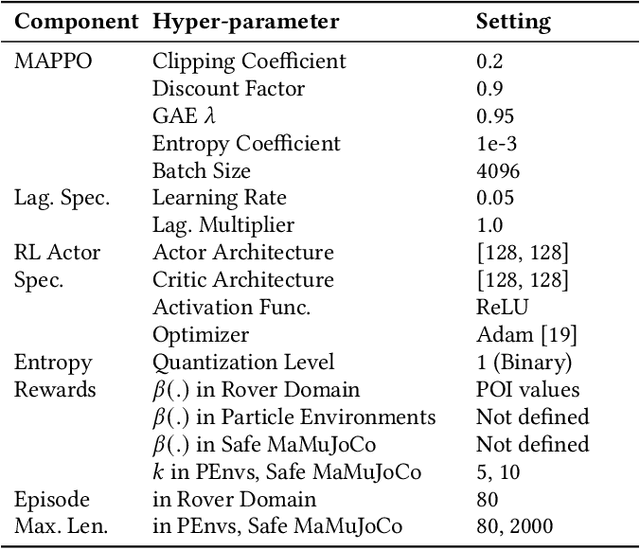
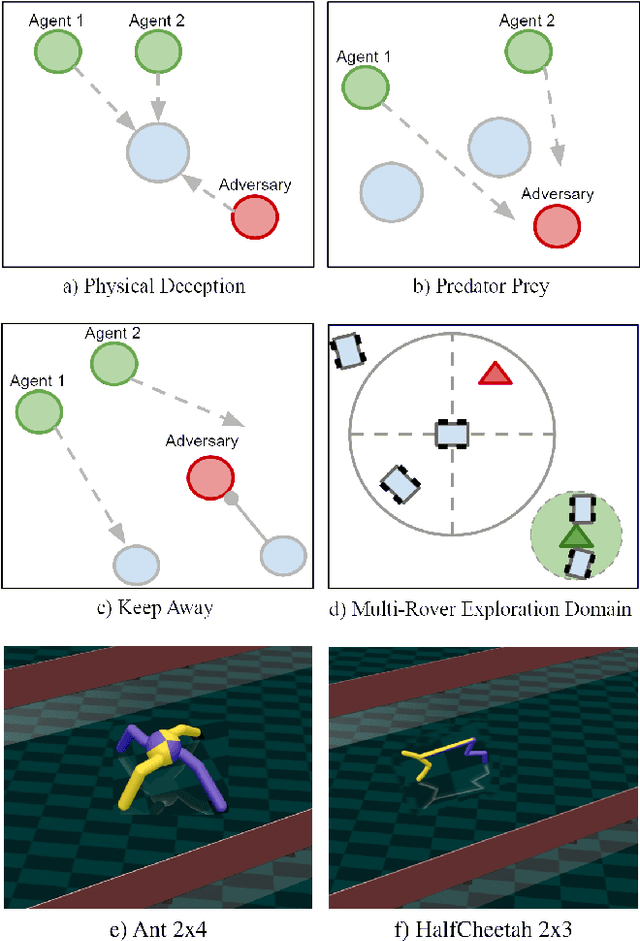
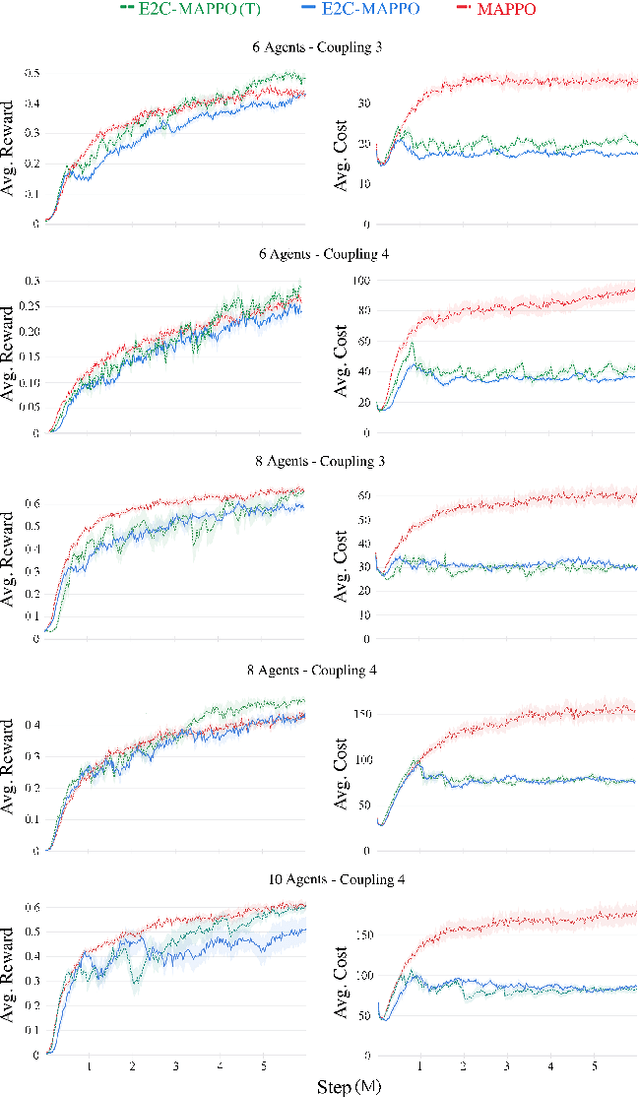
Many real-world multiagent learning problems involve safety concerns. In these setups, typical safe reinforcement learning algorithms constrain agents' behavior, limiting exploration -- a crucial component for discovering effective cooperative multiagent behaviors. Moreover, the multiagent literature typically models individual constraints for each agent and has yet to investigate the benefits of using joint team constraints. In this work, we analyze these team constraints from a theoretical and practical perspective and propose entropic exploration for constrained multiagent reinforcement learning (E2C) to address the exploration issue. E2C leverages observation entropy maximization to incentivize exploration and facilitate learning safe and effective cooperative behaviors. Experiments across increasingly complex domains show that E2C agents match or surpass common unconstrained and constrained baselines in task performance while reducing unsafe behaviors by up to $50\%$.