 Add to Chrome
 Add to Firefox
 Add to Edge
Vision Transformers for Preoperative CT-Based Prediction of Histopathologic Chemotherapy Response Score in High-Grade Serous Ovarian Carcinoma
Apr 10, 2026
Purpose. High-grade serous ovarian carcinoma (HGSOC) is characterized by pronounced biological and spatial heterogeneity and is frequently diagnosed at an advanced stage. Neoadjuvant chemotherapy (NACT) followed by delayed primary surgery is commonly employed in patients unsuitable for primary cytoreduction. The Chemotherapy Response Score (CRS) is a validated histopathological biomarker of response to NACT, but it is only available postoperatively. In this study, we investigate whether pre-treatment computed tomography (CT) imaging and clinical data can be used to predict CRS as an investigational decision-support adjunct to inform multidisciplinary team (MDT) discussions regarding expected treatment response. Methods. We proposed a 2.5D multimodal deep learning framework that processes lesion-dense omental slices using a pre-trained Vision Transformer encoder and integrates the resulting visual representations with clinical variables through an intermediate fusion module to predict CRS. Results. Our multimodal model, integrating imaging and clinical data, achieved a ROC-AUC of 0.95 alongside 95% accuracy and 80% precision on the internal test cohort (IEO, n=41 patients). On the external test set (OV04, n=70 patients), it achieved a ROC-AUC of 0.68, alongside 67% accuracy and 75% precision. Conclusion. These preliminary results demonstrate the feasibility of transformer-based deep learning for preoperative prediction of CRS in HGSOC using routine clinical data and CT imaging. As an investigational, pre-treatment decision-support tool, this approach may assist MDT discussions by providing early, non-invasive estimates of treatment response.

Calibrating Ensembles for Scalable Uncertainty Quantification in Deep Learning-based Medical Segmentation
Sep 20, 2022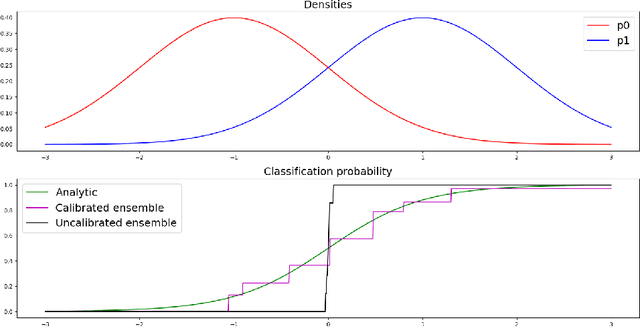
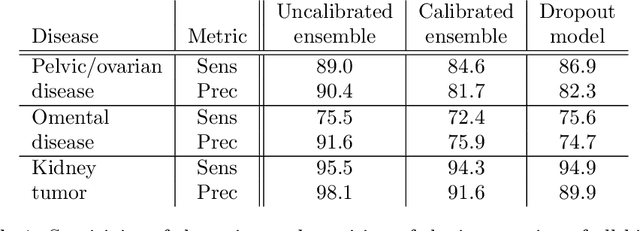
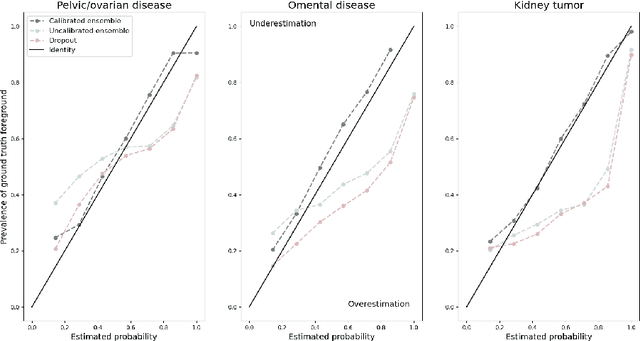
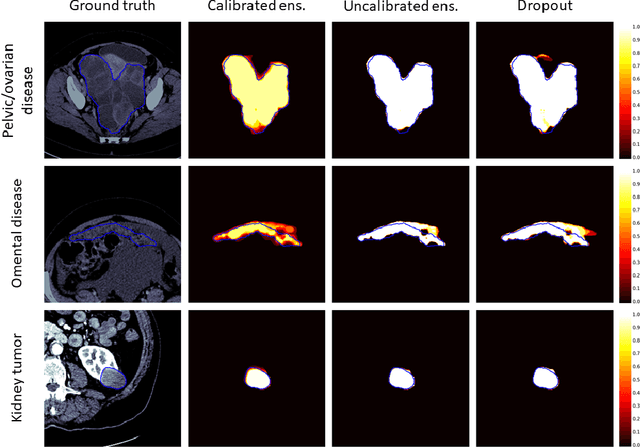
Uncertainty quantification in automated image analysis is highly desired in many applications. Typically, machine learning models in classification or segmentation are only developed to provide binary answers; however, quantifying the uncertainty of the models can play a critical role for example in active learning or machine human interaction. Uncertainty quantification is especially difficult when using deep learning-based models, which are the state-of-the-art in many imaging applications. The current uncertainty quantification approaches do not scale well in high-dimensional real-world problems. Scalable solutions often rely on classical techniques, such as dropout, during inference or training ensembles of identical models with different random seeds to obtain a posterior distribution. In this paper, we show that these approaches fail to approximate the classification probability. On the contrary, we propose a scalable and intuitive framework to calibrate ensembles of deep learning models to produce uncertainty quantification measurements that approximate the classification probability. On unseen test data, we demonstrate improved calibration, sensitivity (in two out of three cases) and precision when being compared with the standard approaches. We further motivate the usage of our method in active learning, creating pseudo-labels to learn from unlabeled images and human-machine collaboration.